
Moose
Alces alces
Alces alces are the largest members of the deer family. They are characterized by their impressive size, long legs, and a distinctive overhanging snout. Males possess lar…
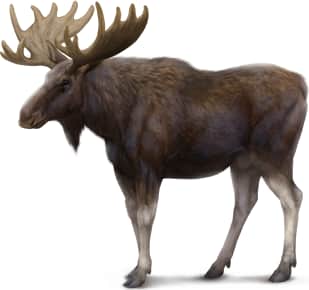
How to identify
Alces alces are the largest members of the deer family. They are characterized by their impressive size, long legs, and a distinctive overhanging snout. Males possess large, palmate (flat, hand-like) antlers, which are shed and regrown annually. The size and shape of antlers vary with age and individual. Females do not have antlers. Their coat is typically a dark brown to black color. They have a dewlap, a flap of skin that hangs from the throat.
Range
Alces alces, known as the moose in North America and the Eurasian elk in Europe and Asia, has a wide distribution across the northern hemisphere. In North America, their range extends throughout Canada, Alaska, and the northeastern and upper midwestern United States, with smaller populations in the Rocky Mountains. In Eurasia, they are found in Scandinavia, Eastern Europe, Russia, and parts of northern China and Mongolia.
Habitat
Alces alces inhabit boreal forests and mixed deciduous-coniferous forests, typically in close proximity to water bodies such as lakes, swamps, and rivers. They are often found in areas with dense undergrowth and early successional forests that provide ample browse. They are well-adapted to cold climates and can tolerate deep snow.
Similar species
Within North America, elk (Cervus canadensis) are smaller, have brown coats, and males possess branching, non-palmate antlers. Deer species like white-tailed deer (Odocoileus virginianus) and mule deer (Odocoileus hemionus) are significantly smaller and have different antler shapes.
Name and etymology
Genus
Alces
Latin for Elk
Origin
Sources
- Palmer, Index Generum Mammalium (1904) ↗
Palmer, T. S. 1904. Index Generum Mammalium: a list of the genera and families of mammals. North American Fauna 23. Government Printing Office, Washington. https://doi.org/10.5962/bhl.title.39809
Species epithet
alces
Latin for Elk
Origin
Sources
- Wikipedia: Alces alces ↗
“Alces alces.” Wikipedia. https://en.wikipedia.org/wiki/Moose
Explore more names in the etymology index.
More illustrations
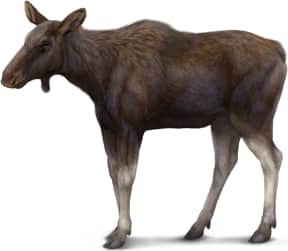
Female
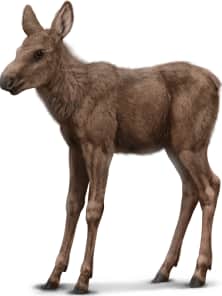
Young
At a glance
Range
Alces alces, known as the moose in North America and the Eurasian elk in Europe and Asia, has a wide distribution across the…
Habitat
Alces alces inhabit boreal forests and mixed deciduous-coniferous forests, typically in close proximity to water bodies such…
Guide
Mammals of North America
Range map
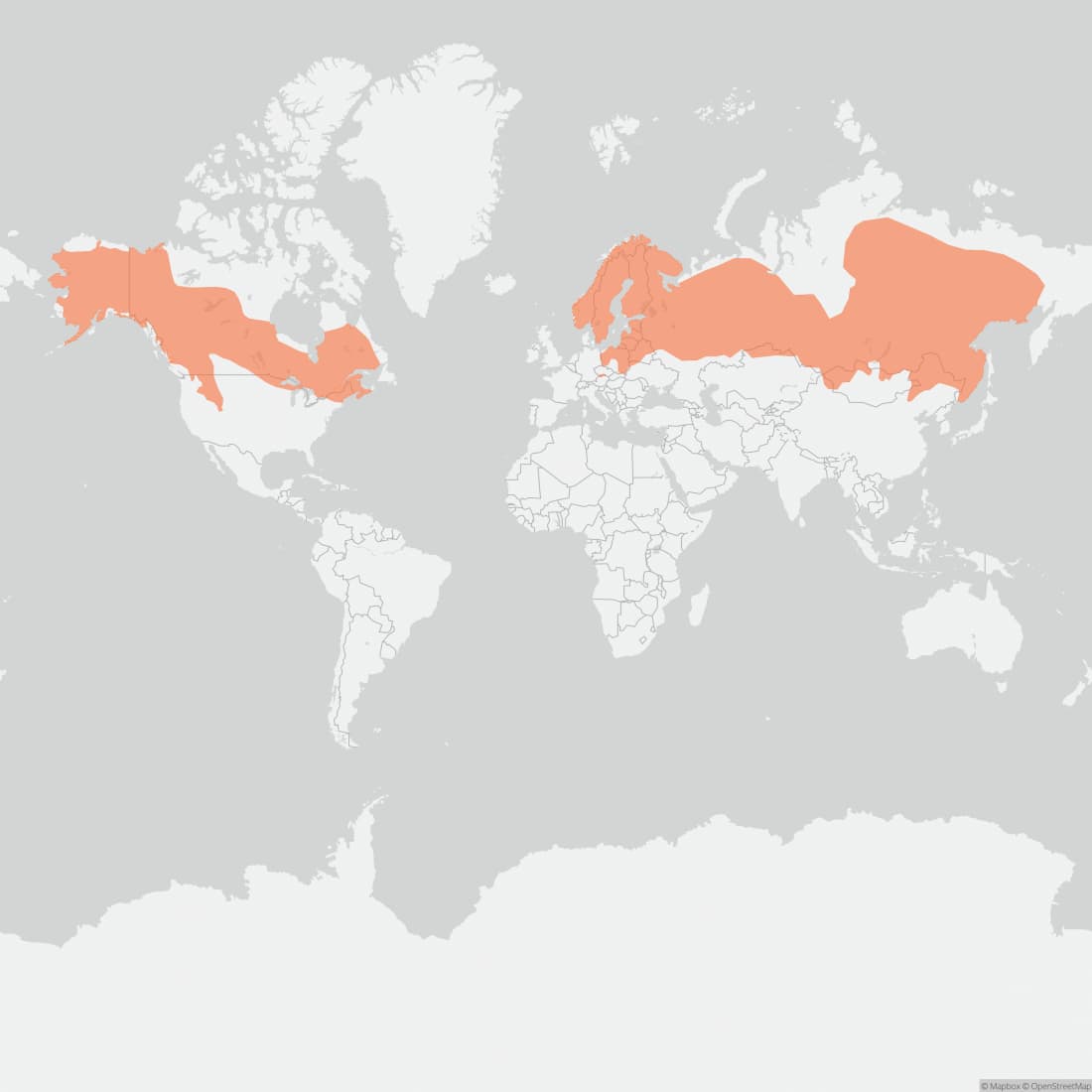
Approximate range. © Mapbox © OpenStreetMap