Pronghorn
Antilocapra americana
A. americana is a medium-sized ungulate with a reddish-tan to brown coat. Distinctive markings include a white belly, chest, and throat, along with prominent white patche…
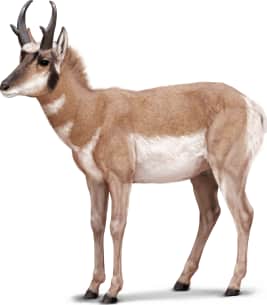
How to identify
A. americana is a medium-sized ungulate with a reddish-tan to brown coat. Distinctive markings include a white belly, chest, and throat, along with prominent white patches on the cheeks. The males are characterized by black horns that are sharply pronged and can grow up to 12-20 inches long, with a forward-pointing prong. Females also possess horns, though they are generally smaller, less pronged, or may be absent altogether. Both sexes exhibit a conspicuous white rump patch that can be flared as a visual signal. The face is marked with a black nose and often black markings on the lower jaw.
Range
A. americana occupies a wide range across western and central North America. Their distribution extends from southern regions of Canada, throughout the western United States, and into northern Mexico. They are prevalent throughout the Great Plains, the sagebrush steppe of the Intermountain West, the southwestern deserts, and portions of the Rocky Mountains. While populations have fluctuated due to habitat loss and hunting in the past, A. americana has shown resilience, and their range currently encompasses a significant portion of their historical distribution, thanks to conservation and management efforts. They can be found in states such as Montana, Wyoming, Colorado, New Mexico, Texas, Arizona, California, and Oregon, among others, as well as in the Canadian provinces of Alberta and Saskatchewan and the northern Mexican states of Sonora and Chihuahua.
Habitat
A. americana are primarily adapted to open, expansive habitats. They thrive in grasslands, prairies, and sagebrush steppe environments, which provide ample forage and visibility to detect predators. They also inhabit open woodlands, semi-deserts, and shrublands. A critical habitat component for A. americana is access to water sources. While they are adapted to arid environments, water availability influences their distribution and habitat use. They utilize a variety of elevations, from low-lying plains to higher elevation plateaus and foothills. The commonality across their habitats is the prevalence of open terrain with good visibility and sufficient herbaceous vegetation and shrubs for sustenance.
Similar species
Within their range, A. americana are most likely to be confused with deer species, particularly mule deer (Odocoileus hemionus) and white-tailed deer (Odocoileus virginianus). However, several key features distinguish A. americana. Deer possess antlers, which are bony structures that are shed and regrown annually and are typically branched, unlike the pronged horns of A. americana.
Name and etymology
Genus
Antilocapra
Greek for antelope (Antilo) and Latin for goat (capra)
Origin
Sources
- Palmer, Index Generum Mammalium (1904) ↗
Palmer, T. S. 1904. Index Generum Mammalium: a list of the genera and families of mammals. North American Fauna 23. Government Printing Office, Washington. https://doi.org/10.5962/bhl.title.39809
Species epithet
americana
Latin for "of America"
Origin
Sources
- Wikipedia: Antilocapra americana ↗
“Antilocapra americana.” Wikipedia. https://en.wikipedia.org/wiki/Pronghorn
Explore more names in the etymology index.
More illustrations
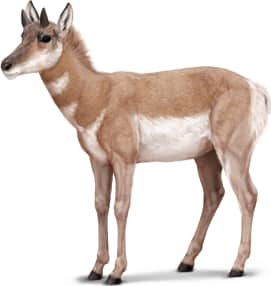
Female
At a glance
Range
A. americana occupies a wide range across western and central North America. Their distribution extends from southern region…
Habitat
A. americana are primarily adapted to open, expansive habitats. They thrive in grasslands, prairies, and sagebrush steppe en…
Guide
Mammals of North America
Range map
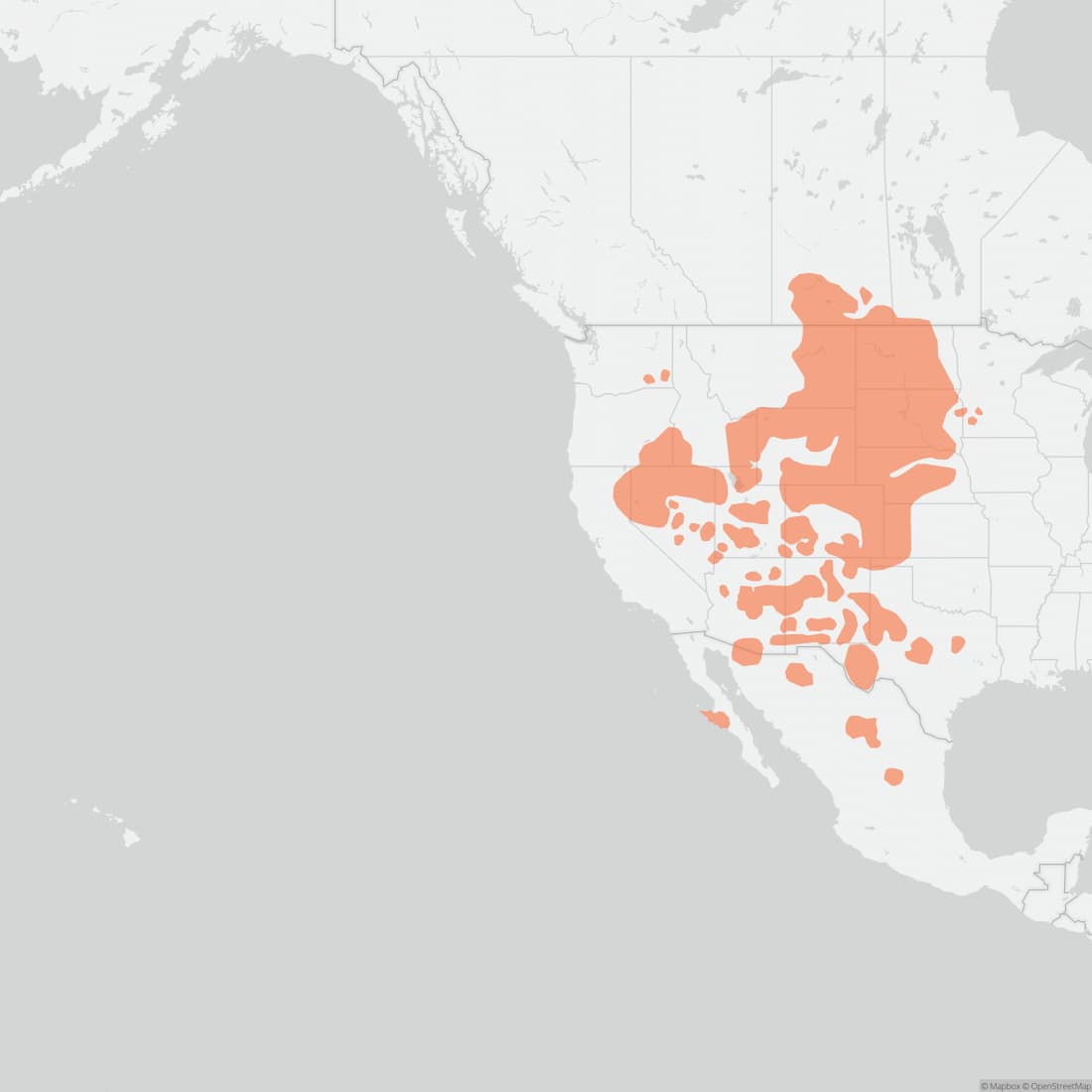
Approximate range. © Mapbox © OpenStreetMap