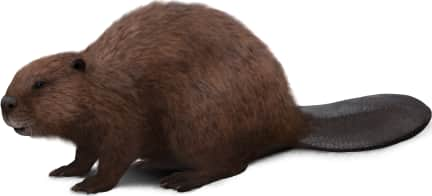
American Beaver
Castor canadensis
C. canadensis is a large rodent, typically measuring 70-100 cm in length (including the tail) and weighing 16-32 kg. They have a robust body covered in dense, waterproof…
How to identify
C. canadensis is a large rodent, typically measuring 70-100 cm in length (including the tail) and weighing 16-32 kg. They have a robust body covered in dense, waterproof fur that ranges in color from reddish-brown to dark brown or nearly black. The broad, flat tail is covered in scales and sparsely haired. The hind feet are large and webbed, while the forepaws are smaller and used for manipulating objects.
Range
C. canadensis is widely distributed throughout North America, from northern Canada and Alaska south through the United States and into northern Mexico. They occupy a wide variety of aquatic habitats across this extensive range.
Habitat
C. canadensis inhabits a variety of freshwater habitats, including rivers, streams, lakes, ponds, and wetlands. They prefer areas with slow-moving water and abundant trees for food and construction materials. They are well-adapted to aquatic environments and spend a significant portion of their time in water.
Similar species
In North America, there are no other native species with which C. canadensis is easily confused. Their large size, flat tail, and aquatic lifestyle are unique.
Name and etymology
Genus
Castor
Latin for beaver
Origin
Sources
- Palmer, Index Generum Mammalium (1904) ↗
Palmer, T. S. 1904. Index Generum Mammalium: a list of the genera and families of mammals. North American Fauna 23. Government Printing Office, Washington. https://doi.org/10.5962/bhl.title.39809
Species epithet
canadensis
Neo-Latin for of Canada
Origin
Sources
- Wikipedia: Castor canadensis ↗
“Castor canadensis.” Wikipedia. https://en.wikipedia.org/wiki/North_American_beaver
Explore more names in the etymology index.
At a glance
Range
C. canadensis is widely distributed throughout North America, from northern Canada and Alaska south through the United States…
Habitat
C. canadensis inhabits a variety of freshwater habitats, including rivers, streams, lakes, ponds, and wetlands. They prefer a…
Guide
Mammals of North America