
Elk
Cervus canadensis
Cervus canadensis are large members of the deer family, second in size only to moose in North America. They have a reddish-brown to brown coat with a characteristic buff-…
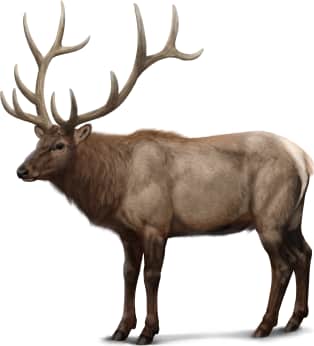
How to identify
Cervus canadensis are large members of the deer family, second in size only to moose in North America. They have a reddish-brown to brown coat with a characteristic buff-colored rump patch. Only males (bulls) grow antlers, which are large and branching, typically with a main beam from which several tines (points) extend. Antler size and complexity increase with age and are shed and regrown annually. Females (cows) are smaller and lack antlers. Calves are born with a reddish-brown coat covered in white spots, which they lose by late summer.
Range
Cervus canadensis, commonly known as elk in North America and wapiti in Eurasia, has a historical range that spanned much of North America and parts of Eurasia and North Africa. Today, their distribution in North America is concentrated in the western United States and Canada, with smaller reintroduced populations in the eastern United States. In Eurasia, they are found in parts of Central Asia.
Habitat
Cervus canadensis are adaptable and inhabit a variety of habitats, including forests (deciduous, coniferous, and mixed), grasslands, and alpine meadows. They often utilize different elevations seasonally, moving to higher elevations with abundant forage in the summer and lower, more sheltered areas in the winter. They are primarily grazers, feeding on grasses, forbs, and browse.
Similar species
Moose (Alces alces) are significantly larger and males possess palmate antlers. White-tailed deer (Odocoileus virginianus) and mule deer (Odocoileus hemionus) are smaller and have different antler configurations in males.
Name and etymology
Genus
Cervus
Latin for deer or stag
Origin
Sources
- Palmer, Index Generum Mammalium (1904) ↗
Palmer, T. S. 1904. Index Generum Mammalium: a list of the genera and families of mammals. North American Fauna 23. Government Printing Office, Washington. https://doi.org/10.5962/bhl.title.39809
Species epithet
canadensis
Latin for of Canada
Origin
Sources
- Wikipedia: Ovis canadensis ↗
“Ovis canadensis.” Wikipedia. https://en.wikipedia.org/wiki/Bighorn_sheep
- Wikipedia: Cervus canadensis ↗
“Cervus canadensis.” Wikipedia. https://en.wikipedia.org/wiki/Elk
Explore more names in the etymology index.
More illustrations
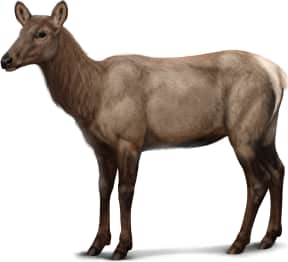
Female
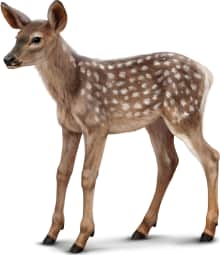
Fawn
At a glance
Range
Cervus canadensis, commonly known as elk in North America and wapiti in Eurasia, has a historical range that spanned much of…
Habitat
Cervus canadensis are adaptable and inhabit a variety of habitats, including forests (deciduous, coniferous, and mixed), gras…
Guide
Mammals of North America
Range map
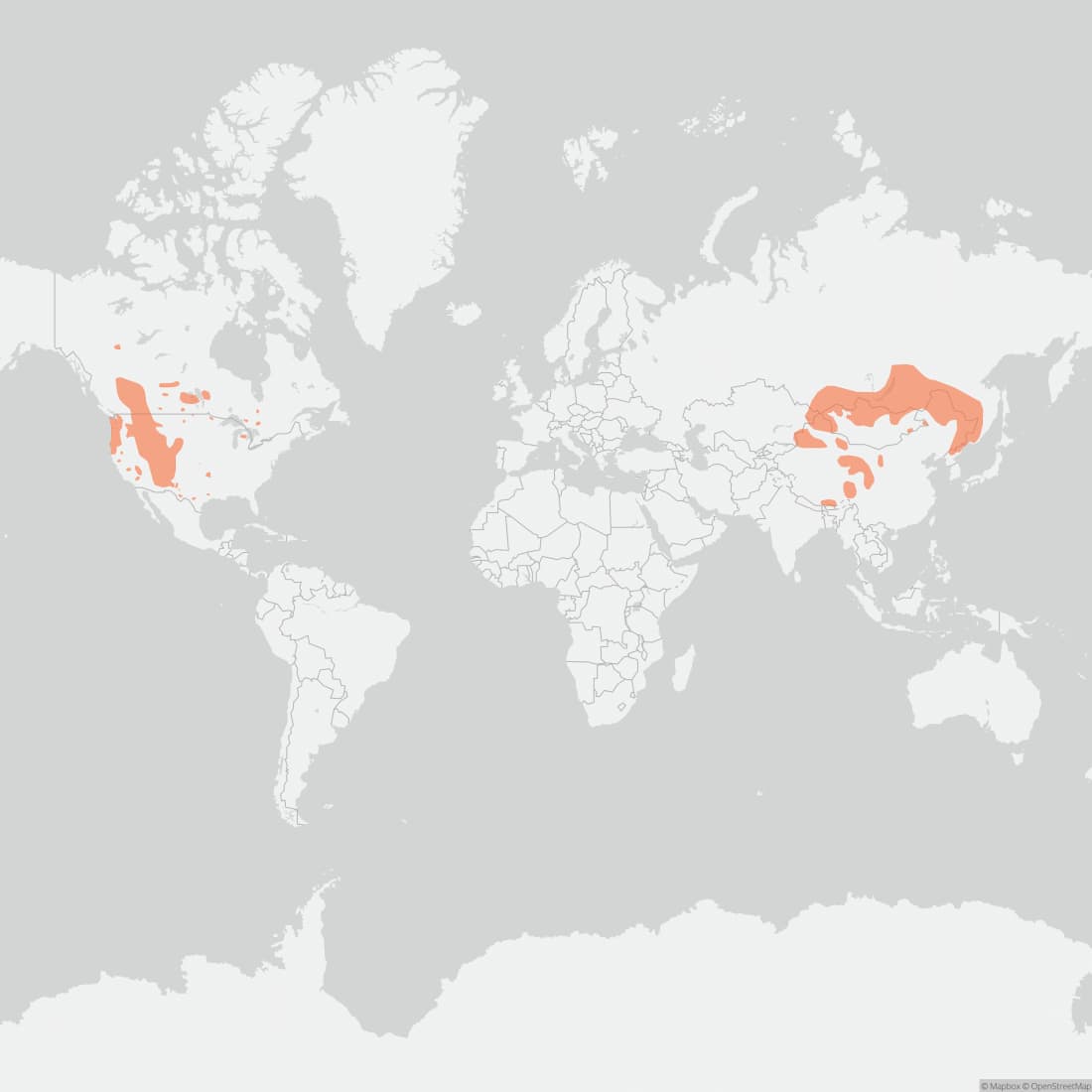
Approximate range. © Mapbox © OpenStreetMap