
Mule Deer
Odocoileus hemionus
Odocoileus hemionus are characterized by their large, mule-like ears, from which their common name is derived. Their tail is relatively short and white with a black tip.…
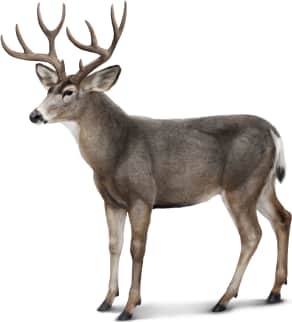
How to identify
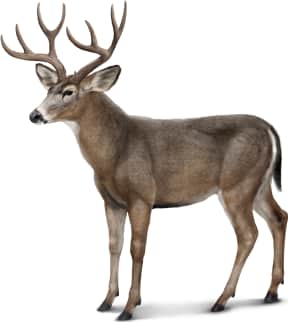
Odocoileus hemionus are characterized by their large, mule-like ears, from which their common name is derived. Their tail is relatively short and white with a black tip. Their coat color is generally grayish-brown in winter and a lighter, more reddish-brown in summer. Males grow forked antlers that branch into two main beams, which then may have additional points. The number of points is not a reliable indicator of age. Females do not have antlers. Fawns are reddish-brown with white spots.
Range
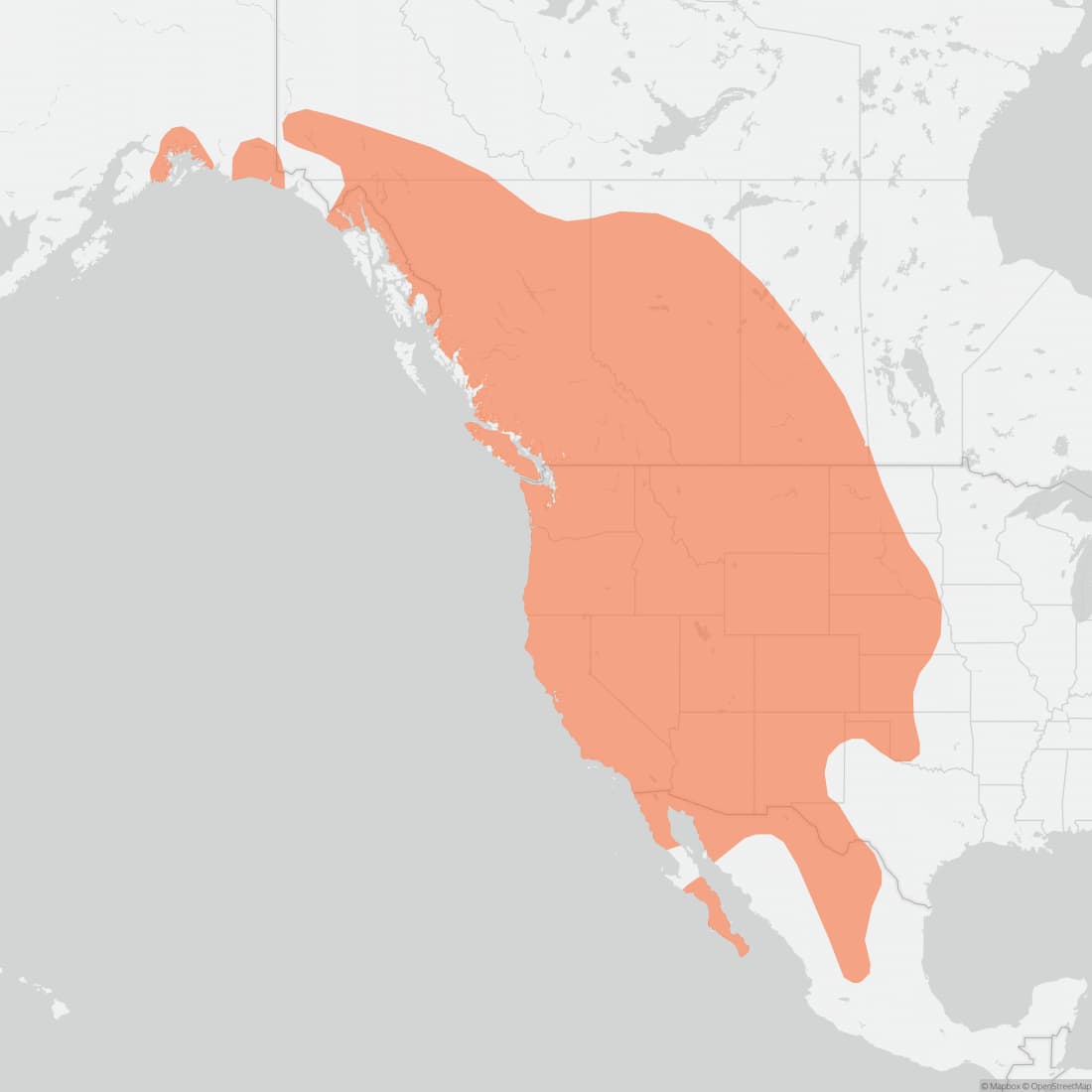
Odocoileus hemionus, the mule deer, is primarily found in western North America. Their range extends from southern Yukon and Northwest Territories in Canada, south through the western United States (including the Great Plains and Southwest), and into northern Mexico.
Habitat
Odocoileus hemionus are adapted to a variety of western habitats, including coniferous forests, chaparral, grasslands, and deserts. They are often found in more rugged and arid terrain than white-tailed deer. They tend to browse on woody vegetation, forbs, and grasses.
Similar species
White-tailed deer (O. virginianus) overlap in range in some areas but have smaller ears, a longer tail that is brown on top and white underneath, and antlers that typically have a main beam with tines branching off it, rather than forking. Elk are much larger with a more uniform brown coat and large, branching antlers in males.
Name and etymology
Genus
Odocoileus
Greek for tooth (odous) hollow (koilos)
Origin
Sources
- Palmer, Index Generum Mammalium (1904) ↗
Palmer, T. S. 1904. Index Generum Mammalium: a list of the genera and families of mammals. North American Fauna 23. Government Printing Office, Washington. https://doi.org/10.5962/bhl.title.39809
Species epithet
hemionus
Greek for half (hemi) donkey (onos)
Origin
Sources
- Wikipedia: Odocoileus hemionus ↗
“Odocoileus hemionus.” Wikipedia. https://en.wikipedia.org/wiki/Mule_deer
Explore more names in the etymology index.
More illustrations
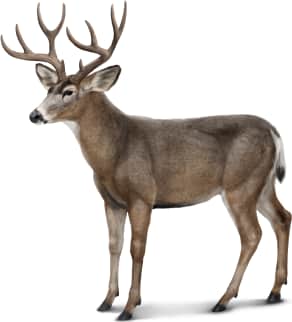
Summer (Male)
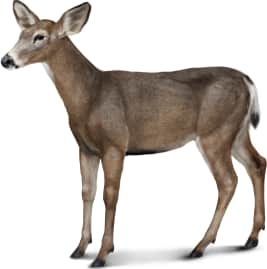
Female
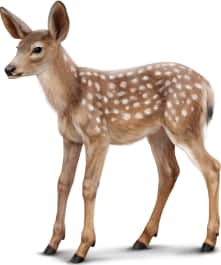
Fawn
Black-tailed Deer
At a glance
Range
Odocoileus hemionus, the mule deer, is primarily found in western North America. Their range extends from southern Yukon and…
Habitat
Odocoileus hemionus are adapted to a variety of western habitats, including coniferous forests, chaparral, grasslands, and de…
Guide
Mammals of North America
Range map
Approximate range. © Mapbox © OpenStreetMap