White-tailed Deer
Odocoileus virginianus
O. virginianus are medium-sized deer with a reddish-brown coat in the summer that transitions to a grayish-brown in the winter. A key identifying feature is the white und…
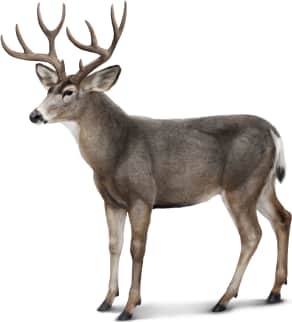
How to identify
O. virginianus are medium-sized deer with a reddish-brown coat in the summer that transitions to a grayish-brown in the winter. A key identifying feature is the white underside of their tail, which is prominently displayed when they flee, hence their name. Males grow branched antlers that are shed and regrown annually. The size and configuration of antlers vary with age, nutrition, and genetics. Females do not have antlers. Young fawns are reddish-brown with white spots, providing camouflage.
Range
O. virginianus, the white-tailed deer, boasts the widest distribution of any North American ungulate. Their range extends from southern Canada throughout the United States (excluding much of the far Southwest) and south through Mexico, Central America, and into northern South America.
Habitat
Odocoileus virginianus are highly adaptable and inhabit a wide variety of habitats, including forests (deciduous, coniferous, and mixed), grasslands, brushlands, swamps, and even suburban and agricultural areas. They prefer areas with dense cover for protection and a variety of browse and herbaceous vegetation for food.
Similar species
Mule deer (O. hemionus) share parts of their range in western North America but have larger ears, a black-tipped tail, and characteristically "forked" antlers. Elk are significantly larger and have a more uniform brown coat and larger, branching antlers in males. In areas where their ranges overlap with moose, moose are much larger with palmate antlers in males and a distinctive snout.
Name and etymology
Genus
Odocoileus
Greek for tooth (odous) hollow (koilos)
Origin
Sources
- Palmer, Index Generum Mammalium (1904) ↗
Palmer, T. S. 1904. Index Generum Mammalium: a list of the genera and families of mammals. North American Fauna 23. Government Printing Office, Washington. https://doi.org/10.5962/bhl.title.39809
Species epithet
virginianus
Latin for of Virginia
Origin
Sources
- Wikipedia: Odocoileus virginianus ↗
“Odocoileus virginianus.” Wikipedia. https://en.wikipedia.org/wiki/White-tailed_deer
Explore more names in the etymology index.
More illustrations
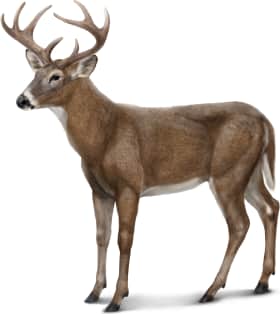
Summer (Male)
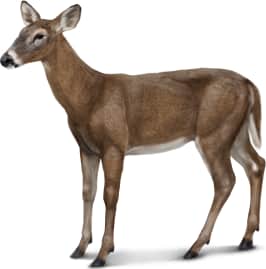
Female
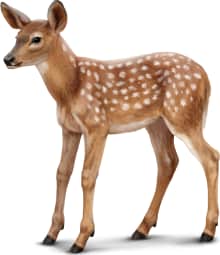
Fawn
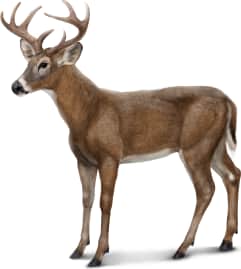
Key Deer (small)
At a glance
Range
O. virginianus, the white-tailed deer, boasts the widest distribution of any North American ungulate. Their range extends fro…
Habitat
Odocoileus virginianus are highly adaptable and inhabit a wide variety of habitats, including forests (deciduous, coniferous,…
Guide
Mammals of North America
Range map
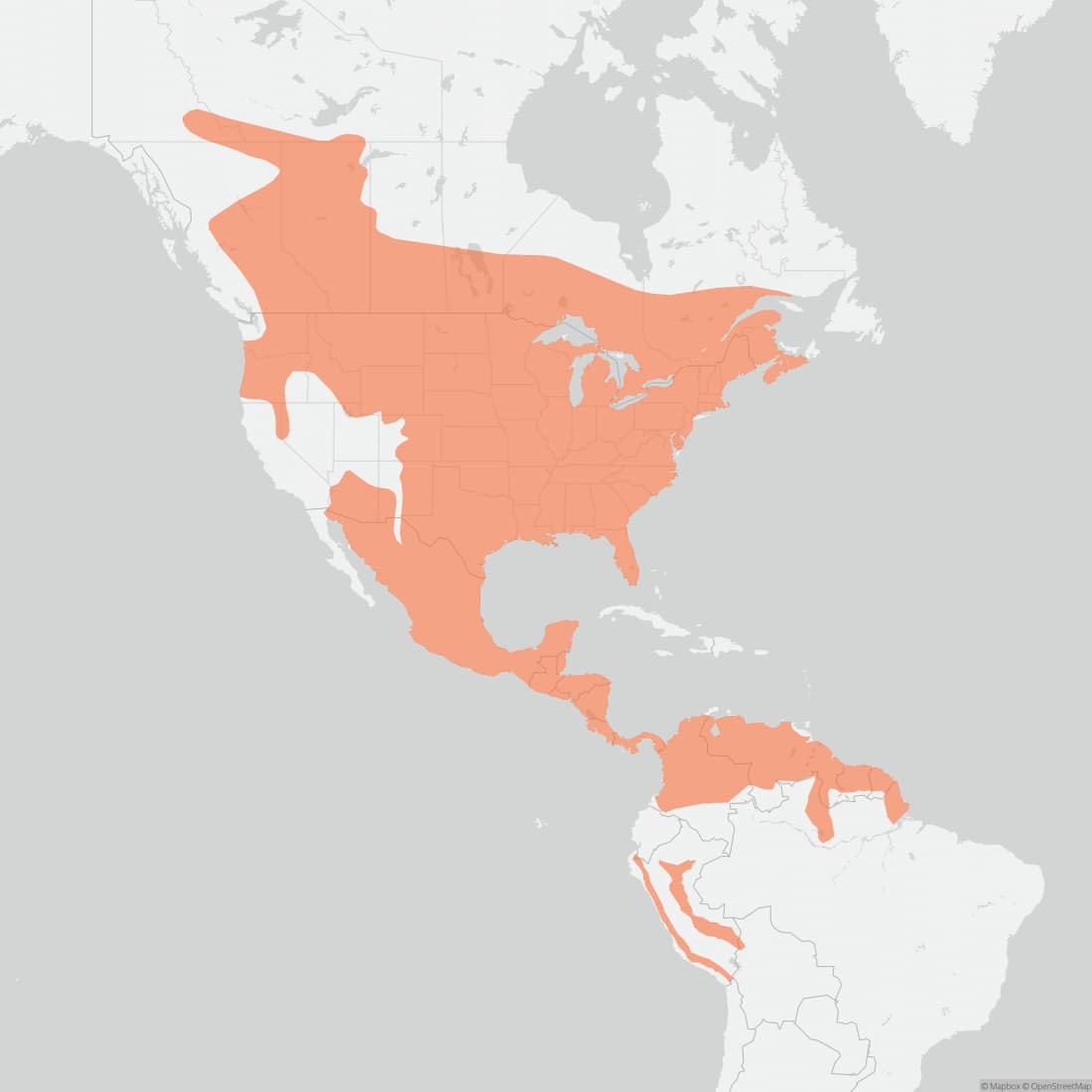
Approximate range. © Mapbox © OpenStreetMap