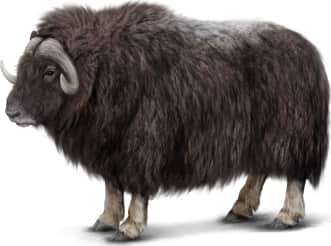
Muskox
Ovibos moschatus
Ovibos moschatus are large, stocky mammals adapted to extreme cold. They are covered in a long, shaggy, dark brown coat that provides excellent insulation. A distinctive…
How to identify
Ovibos moschatus are large, stocky mammals adapted to extreme cold. They are covered in a long, shaggy, dark brown coat that provides excellent insulation. A distinctive feature is their heavy, curved horns, present in both sexes. Male horns are larger and meet in a thick boss on the forehead before curving downwards and outwards. Females have smaller, less massive horns with a less prominent boss.
Range
Ovibos moschatus inhabits the Arctic regions of North America and Greenland. Introduced populations also exist in parts of Scandinavia and Russia. In North America, their native range includes northern Alaska, the Canadian Arctic Archipelago, and parts of mainland Canada.
Habitat
Ovibos moschatus occupy treeless Arctic tundra, including lowlands and uplands. They prefer areas with sufficient forage, such as grasses, sedges, lichens, and mosses. During winter, they may move to areas with shallower snow to access food.
Similar species
Within their Arctic range, Ovibos moschatus are quite distinctive. Caribou (Rangifer tarandus) share some of the same habitat but are leaner, longer-legged, and possess branching antlers (in both sexes, though smaller in females). Bighorn sheep (Ovis canadensis) and Ovis dalli are found in more southerly, mountainous regions and lack the thick, shaggy coat and characteristic horns of the muskox. Mountain goats (Oreamnos americanus) have a white coat and slender, black horns, distinguishing them from Ovibos moschatus.
Name and etymology
Genus
Ovibos
"sheep-ox" - Latin for sheep (ovis) and Greek for ox (bous)
Origin
Sources
- Palmer, Index Generum Mammalium (1904) ↗
Palmer, T. S. 1904. Index Generum Mammalium: a list of the genera and families of mammals. North American Fauna 23. Government Printing Office, Washington. https://doi.org/10.5962/bhl.title.39809
Species epithet
moschatus
Latin for musk-scented
Origin
Sources
- Wikipedia: Ovibos moschatus ↗
“Ovibos moschatus.” Wikipedia. https://en.wikipedia.org/wiki/Muskox
Explore more names in the etymology index.
At a glance
Range
Ovibos moschatus inhabits the Arctic regions of North America and Greenland. Introduced populations also exist in parts of Sc…
Habitat
Ovibos moschatus occupy treeless Arctic tundra, including lowlands and uplands. They prefer areas with sufficient forage, suc…
Guide
Mammals of North America
Range map
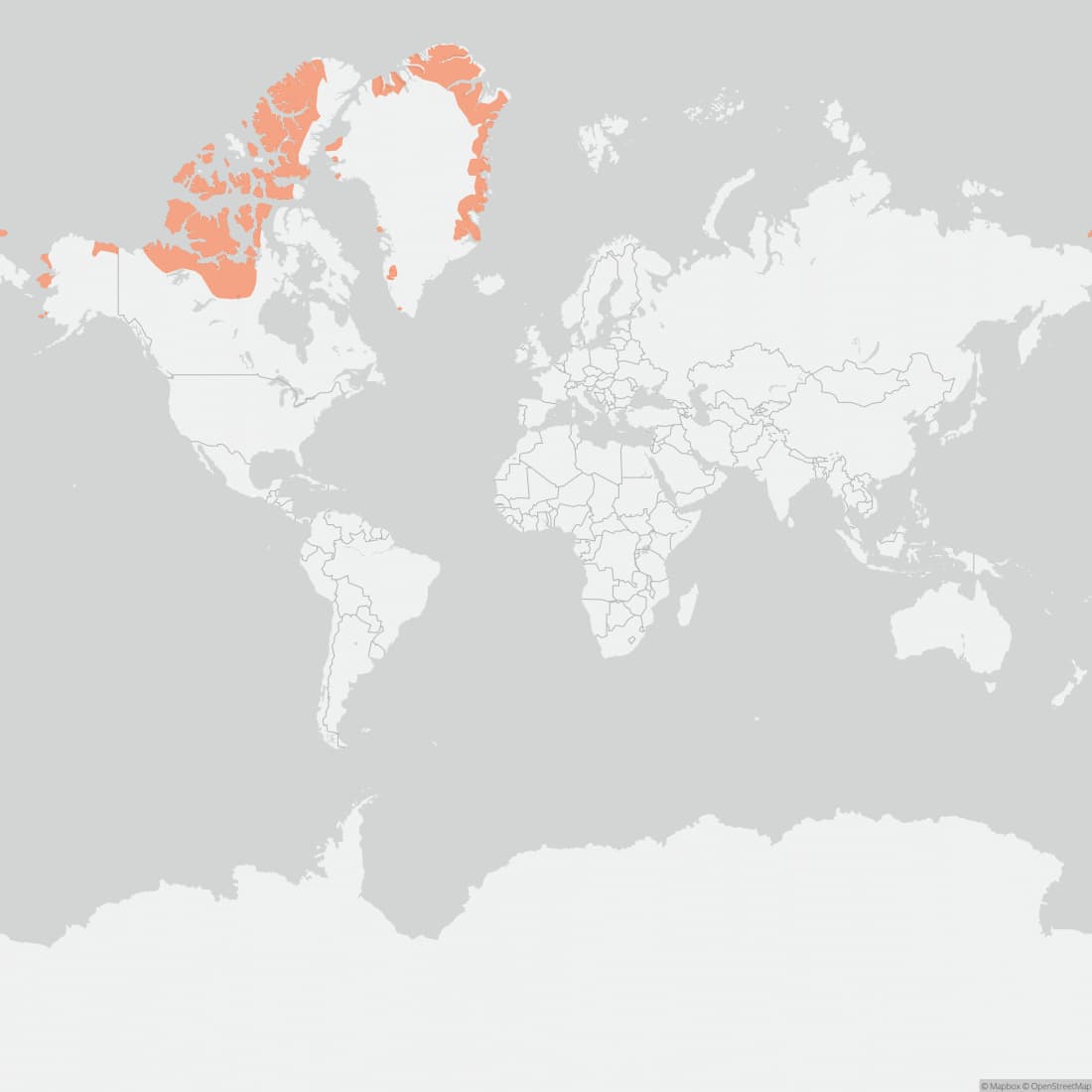
Approximate range. © Mapbox © OpenStreetMap