Bighorn Sheep
Ovis canadensis
This is a large, stocky sheep with a coat typically ranging from grayish-brown to dark brown, featuring a distinct, large white patch on the rump. The tail is short and d…
How to identify
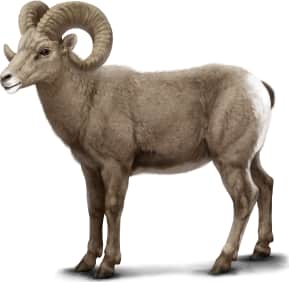
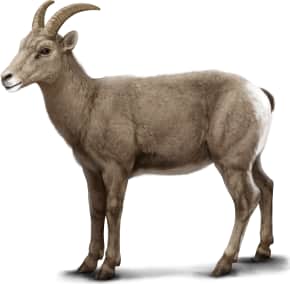
This is a large, stocky sheep with a coat typically ranging from grayish-brown to dark brown, featuring a distinct, large white patch on the rump. The tail is short and dark. Rams (males) are easily recognized by their massive, brown, curling horns which spiral backwards, outwards, and then forwards close to the face, sometimes exceeding 30 pounds in weight. Ewes (females) also possess horns, but they are much shorter, more slender, and curve slightly backward, never forming a full curl. Both sexes have keen eyesight.
Range
Ovis canadensis inhabits mountainous regions of western North America. Its range extends from southern British Columbia and Alberta in Canada, south through the Rocky Mountains and intermountain west of the United States, including states like Washington, Oregon, Idaho, Montana, Wyoming, Colorado, Utah, Nevada, and California. Distinct populations, often referred to as desert bighorn sheep (sometimes classified as subspecies like O. c. nelsoni), extend into the arid regions of the southwestern U.S. (Arizona, New Mexico, Texas) and northern Mexico (Baja California, Sonora, Chihuahua). Populations are often fragmented due to habitat loss and disease.
Habitat
The preferred habitats for O. canadensis include alpine meadows, grassy mountain slopes, and foothills near rugged, rocky terrain such as cliffs, canyons, and outcrops. This precipitous terrain provides crucial escape routes from predators. Elevation use varies seasonally, often moving to higher elevations in summer and lower slopes in winter to avoid deep snow and find forage. Desert populations utilize steep slopes and canyons within arid mountain ranges, often staying relatively close to available water sources.
Similar species
Ovis canadensis may be confused with the Mountain Goat (Oreamnos americanus) where their ranges overlap in high mountains. However, Mountain Goats are distinguished by their entirely white coat, black, slender, dagger-like horns that curve slightly backward, and prominent shoulder hump and beard. In the northern extent of its range (northern BC/Alberta), O. canadensis can overlap with Dall's Sheep (Ovis dalli); Dall's Sheep are typically all white (O. d. dalli) or dark grey/black with white patches (O. d. stonei) and possess horns that tend to be more slender and flare outwards more widely than those of O. canadensis. Feral domestic sheep (Ovis aries) are typically much woollier, vary greatly in color, and often have differently shaped horns or are polled (hornless).
Name and etymology
Genus
Ovis
Latin for sheep
Origin
Sources
- Palmer, Index Generum Mammalium (1904) ↗
Palmer, T. S. 1904. Index Generum Mammalium: a list of the genera and families of mammals. North American Fauna 23. Government Printing Office, Washington. https://doi.org/10.5962/bhl.title.39809
Species epithet
canadensis
Latin for of Canada
Origin
Sources
- Wikipedia: Ovis canadensis ↗
“Ovis canadensis.” Wikipedia. https://en.wikipedia.org/wiki/Bighorn_sheep
- Wikipedia: Cervus canadensis ↗
“Cervus canadensis.” Wikipedia. https://en.wikipedia.org/wiki/Elk
Explore more names in the etymology index.
More illustrations
Female
At a glance
Range
Ovis canadensis inhabits mountainous regions of western North America. Its range extends from southern British Columbia and A…
Habitat
The preferred habitats for O. canadensis include alpine meadows, grassy mountain slopes, and foothills near rugged, rocky ter…
Guide
Mammals of North America
Range map
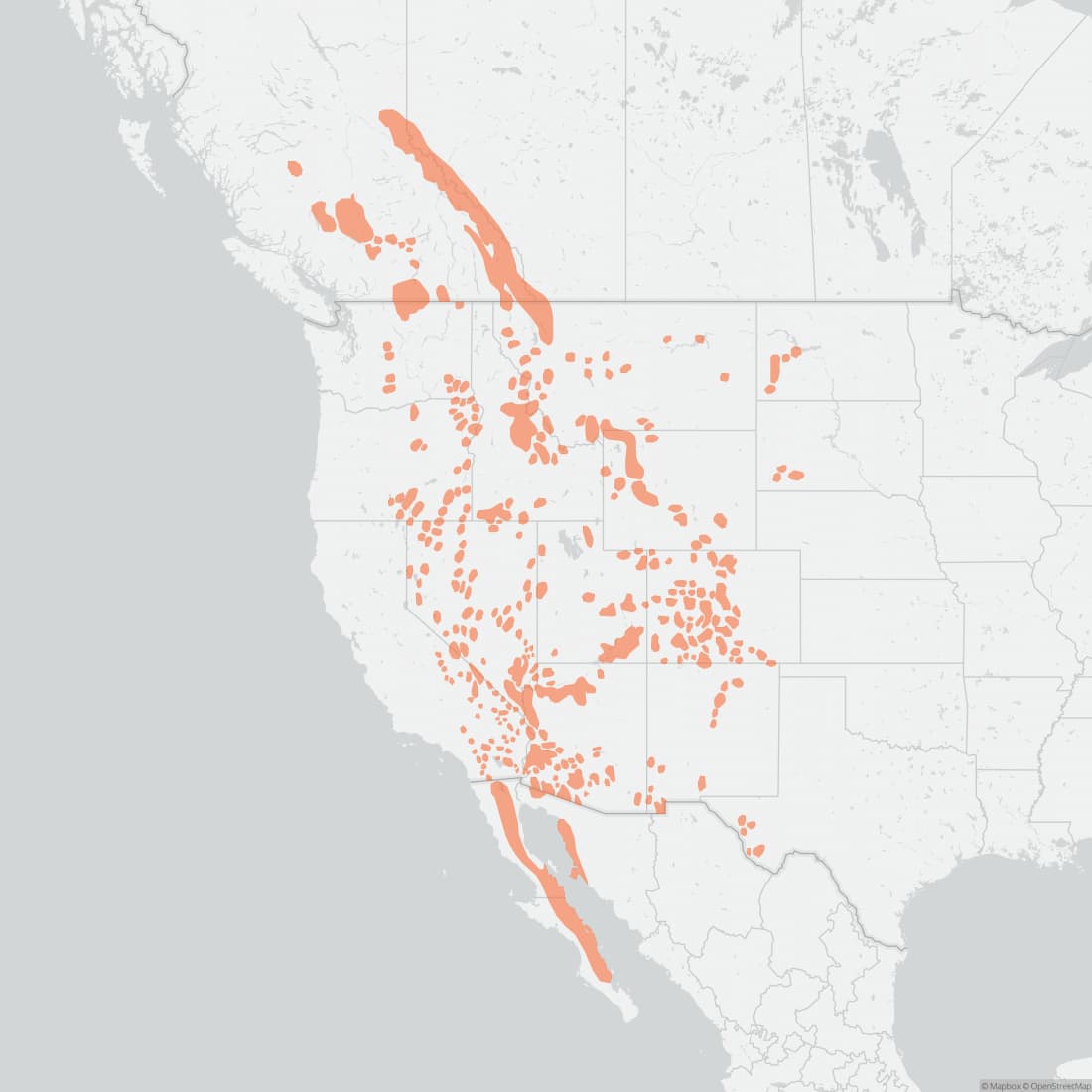
Approximate range. © Mapbox © OpenStreetMap