Thinhorn Sheep
Ovis dalli
Ovis dalli are medium-sized ungulates characterized by their slender build and relatively short legs. Both sexes possess horns, although those of the males are significan…
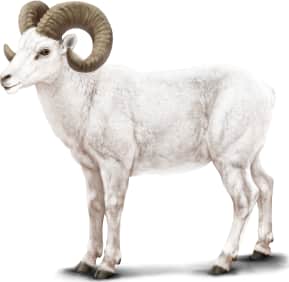
How to identify
Ovis dalli are medium-sized ungulates characterized by their slender build and relatively short legs. Both sexes possess horns, although those of the males are significantly larger and more curled, often forming a complete circle or more. Females have shorter, more slender, and slightly curved horns. Their coat is typically white, though some populations exhibit a slate gray to black coloration (Dall's sheep and Stone's sheep, respectively, were once considered separate species).
Range
Ovis dalli inhabits the mountainous regions of northwestern North America. Their distribution extends across Alaska and into the Yukon and Northwest Territories of Canada. Smaller, isolated populations can also be found in northern British Columbia.
Habitat
Ovis dalli are adapted to rugged alpine and subalpine environments. They prefer open grasslands, meadows, and steep, rocky slopes that provide forage and protection from predators. They often utilize higher elevations during summer months, descending to lower slopes with less snow cover in the winter.
Similar species
In their range, Ovis dalli are generally distinct due to their coloration. Bighorn sheep (Ovis canadensis) occupy more southerly mountainous regions and typically have a brown or tan coat. Mountain goats (Oreamnos americanus) share similar alpine habitats but are easily distinguished by their shaggy white coat, black horns, and stockier build.
Name and etymology
Genus
Ovis
Latin for sheep
Origin
Sources
- Palmer, Index Generum Mammalium (1904) ↗
Palmer, T. S. 1904. Index Generum Mammalium: a list of the genera and families of mammals. North American Fauna 23. Government Printing Office, Washington. https://doi.org/10.5962/bhl.title.39809
Species epithet
dalli
Honoring American naturalist William Healey Dall
Origin
Honors
Sources
- Wikipedia: Ovis dalli ↗
“Ovis dalli.” Wikipedia. https://en.wikipedia.org/wiki/Dall_sheep
Explore more names in the etymology index.
More illustrations
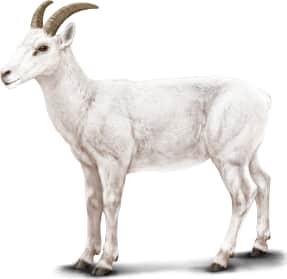
Dall's Sheep (Female)
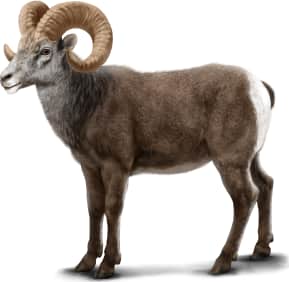
Stone's Sheep (Male)
At a glance
Range
Ovis dalli inhabits the mountainous regions of northwestern North America. Their distribution extends across Alaska and into…
Habitat
Ovis dalli are adapted to rugged alpine and subalpine environments. They prefer open grasslands, meadows, and steep, rocky sl…
Guide
Mammals of North America
Range map
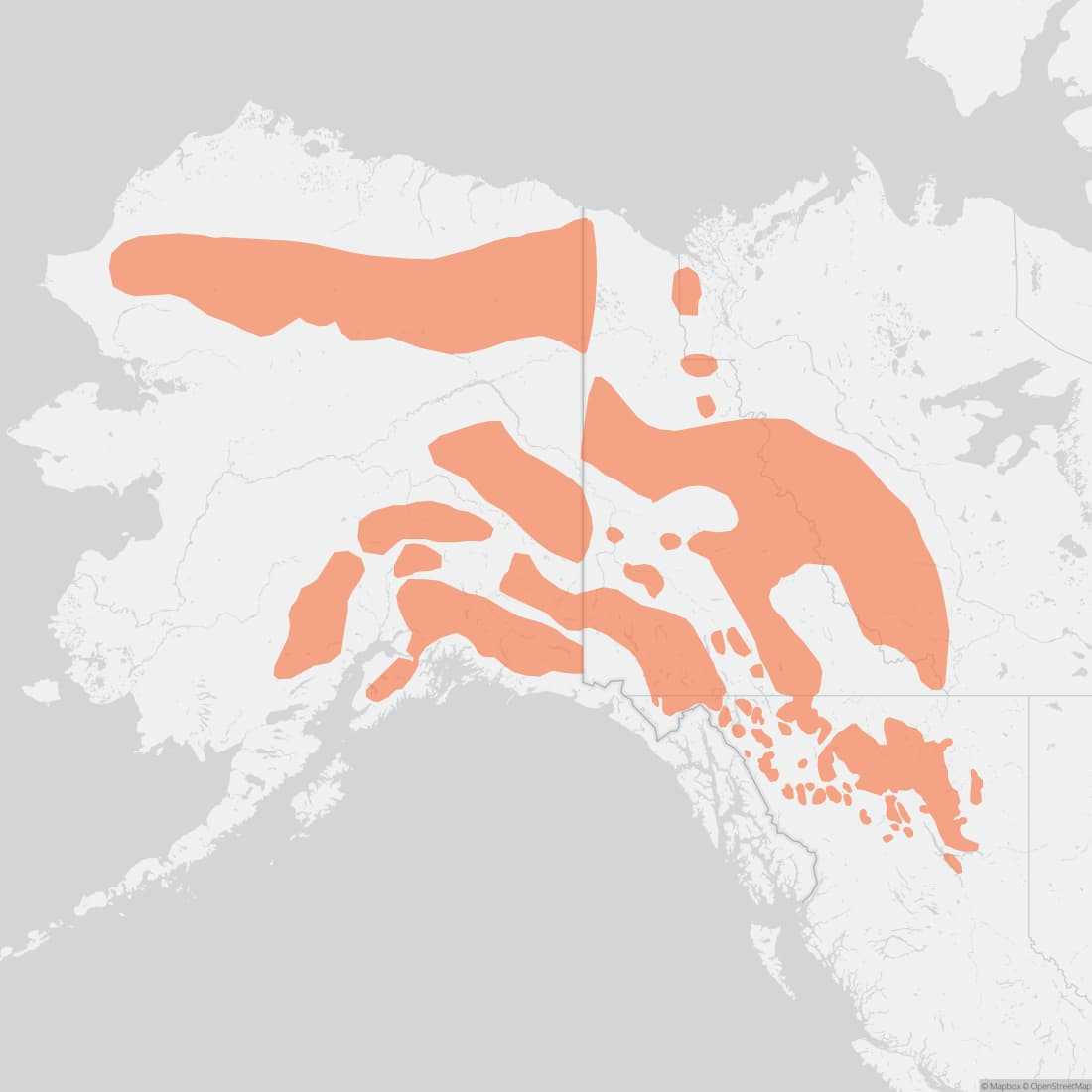
Approximate range. © Mapbox © OpenStreetMap