
Caribou
Rangifer tarandus
R. tarandus are medium-sized members of the deer family, with both sexes possessing antlers, a unique trait within Cervidae. Male antlers are typically larger and more co…
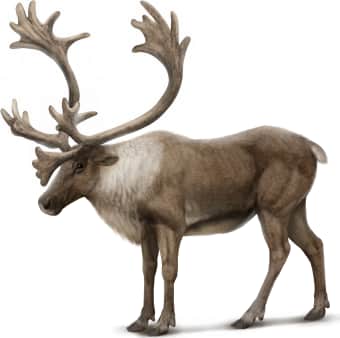
How to identify
R. tarandus are medium-sized members of the deer family, with both sexes possessing antlers, a unique trait within Cervidae. Male antlers are typically larger and more complex, while female antlers are usually smaller and more slender. Their coat color varies by subspecies, region, and season, ranging from dark brown to grayish or even nearly white. They have large, concave hooves adapted for walking on snow and soft tundra, and these hooves also aid in swimming.
Range
R. tarandus has a circumpolar distribution. They inhabit Arctic, subarctic, tundra, boreal, and mountainous regions of northern North America (Alaska and Canada), Greenland, Scandinavia, Russia, and parts of northern China and Mongolia.
Habitat
R. tarandus occupy a wide variety of habitats, including treeless Arctic and alpine tundra, as well as boreal forests (taiga). They are adapted to cold climates and undertake migrations, sometimes over long distances, between summer grazing grounds and wintering areas. Their diet consists primarily of lichens, especially in winter, as well as grasses, sedges, leaves, and shrubs depending on the season and habitat.
Similar species
In North America, moose (Alces alces) are significantly larger and have palmate antlers in males. Elk (Cervus canadensis) are also larger and possess branching antlers only in males. White-tailed deer (Odocoileus virginianus) and mule deer (Odocoileus hemionus) are smaller and have different antler configurations.
Name and etymology
Genus
Rangifer
Latinized Norse for reindeer (hreinn) animal (dyri)
Origin
Sources
- Palmer, Index Generum Mammalium (1904) ↗
Palmer, T. S. 1904. Index Generum Mammalium: a list of the genera and families of mammals. North American Fauna 23. Government Printing Office, Washington. https://doi.org/10.5962/bhl.title.39809
Species epithet
tarandus
Latin for reindeer
Origin
Sources
- Wikipedia: Rangifer tarandus ↗
“Rangifer tarandus.” Wikipedia. https://en.wikipedia.org/wiki/Reindeer
Explore more names in the etymology index.
More illustrations
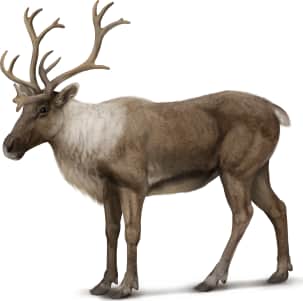
Woodland Caribou (Female)
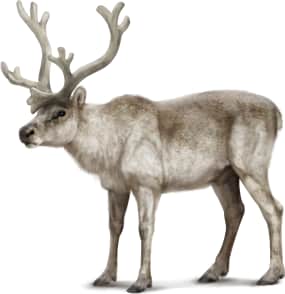
Peary Caribou
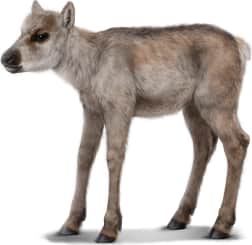
Calf
At a glance
Range
R. tarandus has a circumpolar distribution. They inhabit Arctic, subarctic, tundra, boreal, and mountainous regions of northe…
Habitat
R. tarandus occupy a wide variety of habitats, including treeless Arctic and alpine tundra, as well as boreal forests (taiga)…
Guide
Mammals of North America
Range map
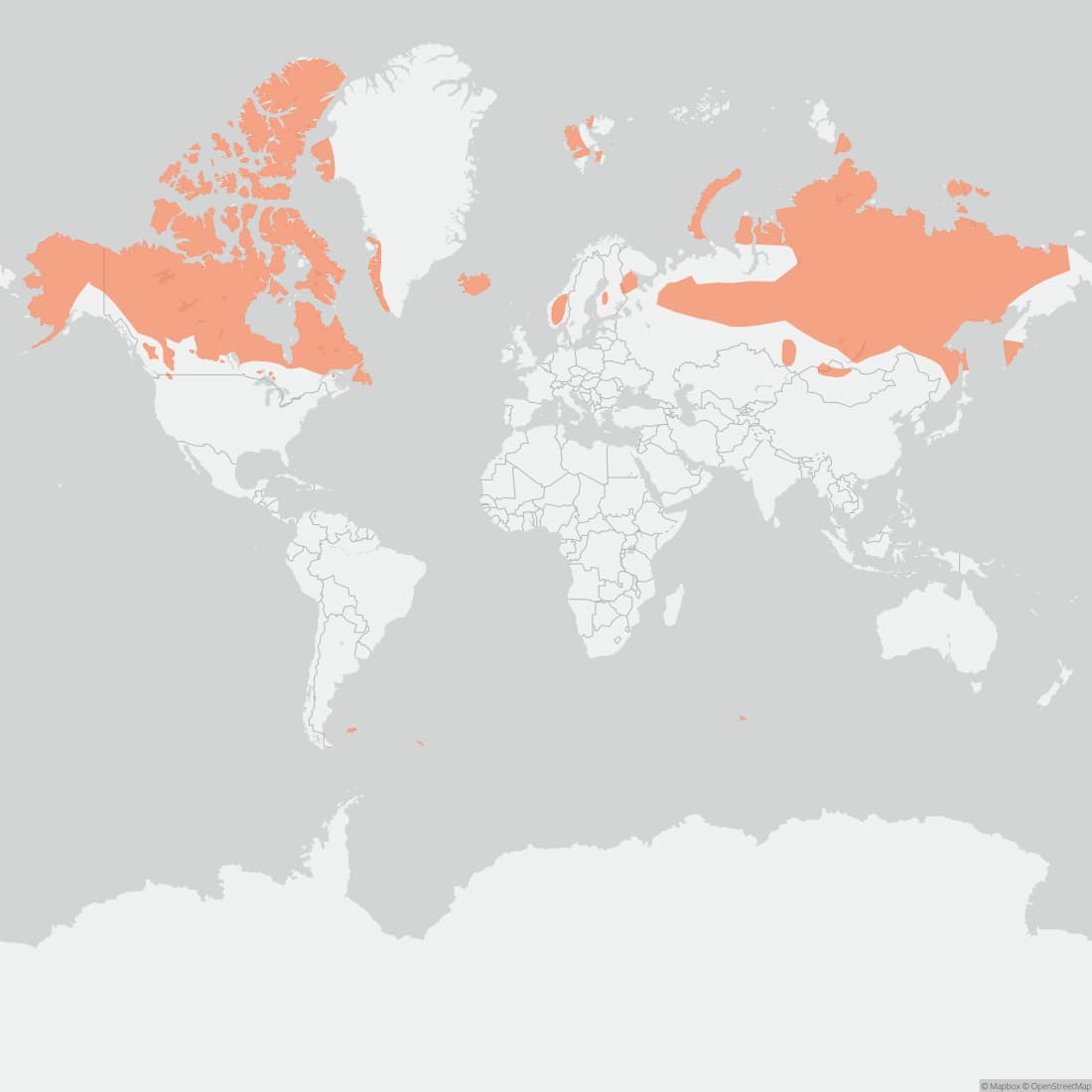
Approximate range. © Mapbox © OpenStreetMap