West Indian Manatee
Trichechus manatus
T. manatus is a large, gray to brownish-gray aquatic mammal with a robust, torpedo-shaped body. It possesses a paddle-like tail and two forelimb flippers used for propuls…
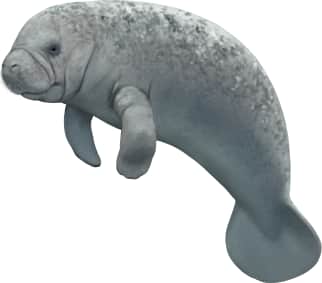
How to identify
T. manatus is a large, gray to brownish-gray aquatic mammal with a robust, torpedo-shaped body. It possesses a paddle-like tail and two forelimb flippers used for propulsion and maneuvering. Adults typically measure between 2.5 and 4 meters in length and can weigh between 400 and 550 kilograms. The skin is thick, wrinkled, and often covered with algae or barnacles. A key identifying feature is the presence of only forelimb flippers and the complete absence of external hind limbs. The face is blunt with a flexible, whiskered snout.
Range
T. manatus inhabits coastal waters, rivers, and estuaries of the western Atlantic Ocean. Its range extends from the southeastern United States (primarily Florida) southward through the Caribbean islands, including Cuba, Jamaica, Puerto Rico, and Hispaniola, and along the coasts of Central and South America as far south as Brazil. This distribution is discontinuous, reflecting the availability of suitable warm water habitats.
Habitat
T. manatus prefers warm, shallow coastal waters, estuaries, and slow-moving rivers with abundant aquatic vegetation. They are highly dependent on warm water, as they have a low metabolic rate and are susceptible to cold stress. They often inhabit areas with seagrass beds, mangrove forests, and freshwater springs. These habitats provide both food and shelter from predators.
Similar species
Within its range, T. manatus may be confused with other marine mammals like dolphins or seals, however, their morphology is distinct. Dolphins have a dorsal fin and a horizontally flattened tail fluke, whereas T. manatus has a paddle shaped tail and no dorsal fin. The only other manatee species which has overlapping range is Trichechus senegalensis which is found on the western coast of Africa.
Name and etymology
Genus
Trichechus
Latin for hair (trich) + Greek for to have (echein), referencing their whiskers
Origin
Sources
- Palmer, Index Generum Mammalium (1904) ↗
Palmer, T. S. 1904. Index Generum Mammalium: a list of the genera and families of mammals. North American Fauna 23. Government Printing Office, Washington. https://doi.org/10.5962/bhl.title.39809
Species epithet
manatus
Carib for breast or udder (manti)
Sources
- Wikipedia: Trichechus manatus ↗
“Trichechus manatus.” Wikipedia. https://en.wikipedia.org/wiki/West_Indian_manatee
Explore more names in the etymology index.
At a glance
Range
T. manatus inhabits coastal waters, rivers, and estuaries of the western Atlantic Ocean. Its range extends from the southeast…
Habitat
T. manatus prefers warm, shallow coastal waters, estuaries, and slow-moving rivers with abundant aquatic vegetation. They are…
Guide
Mammals of North America
Range map
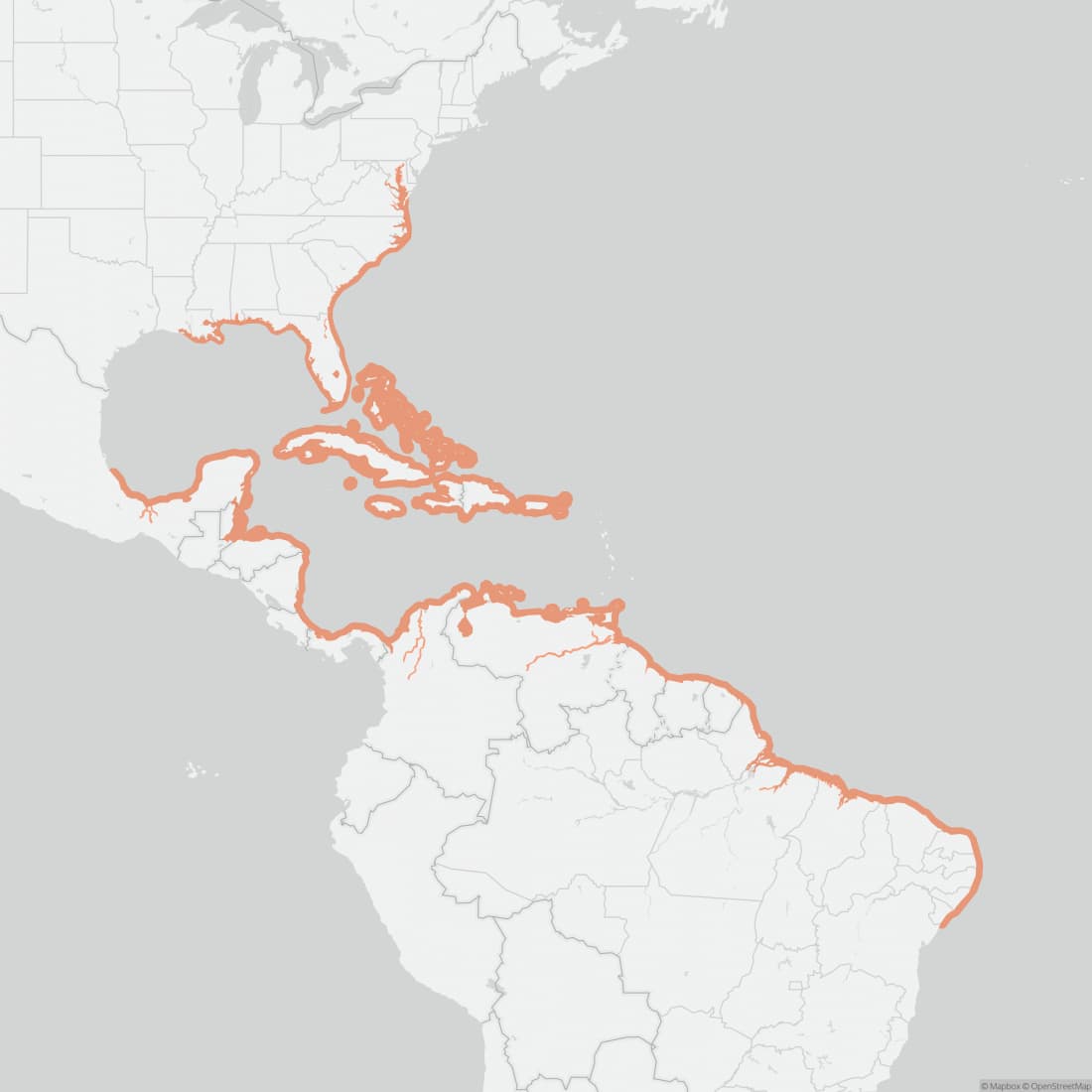
Approximate range. © Mapbox © OpenStreetMap