Ringed Salamander
Ambystoma annulatum
A chubby salamander with a somewhat long neck, and a very short, rounded snout. It has well-developed legs with long toes, and it's named for the yellow or white cross-ba…
How to identify
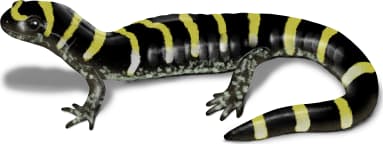
A chubby salamander with a somewhat long neck, and a very short, rounded snout. It has well-developed legs with long toes, and it's named for the yellow or white cross-bands along its dorsal surfaces, including one between its eyes. These bands look like rings, but they do not extend onto the ventrum. It has a dorsal background color of chocolate brown to black, and its ventrum is light grey to yellow with pale spots. Its tail is mildly laterally compressed, and can be equal in length or slightly longer than its body. Adults average 14-18 cm in snout to vent length.
Range
Range stretches from eastern Oklahoma through northwestern Arkansas, and from southwestern through east-central Missouri.
Habitat
This mole salamander spends much of its time underground in damp hardwood or mixed hardwood-pine forest habitats. It will sometimes be found under leaf litter or rotting logs near ponds.
Variations
Cross-bands can be separate, parallel, and spaced equally apart, or they can be merged, uneven, or broken.
Similar species
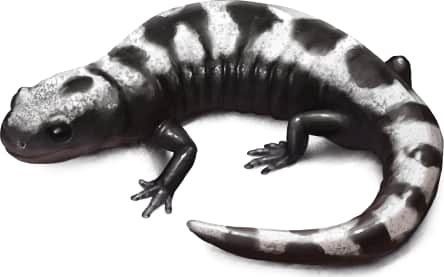
Similar to the marbled salamander (*Ambystoma opacum*) which has a much wider range across the eastern US.
Name and etymology
Genus
Ambystoma
Greek phrase meaning "to cram into the mouth".
Origin
Sources
- Tschudi, "1838" 1839. Classif. Batr., Mem. Soc. Sci. Nat. Neuchatel, p. 92 ↗
Ambystoma. Tschudi, "1838" 1839 - Classif. Batr., Mem. Soc. Sci. Nat. Neuchatel, p. 92
Species epithet
annulatum
Latin for furnished with rings.
Origin
Sources
- (Cope, 1886). Proc. Amer. Philos. Soc., Vol. 23, p. 525 ↗
Ambystoma annulatum. (Cope, 1886) - Proc. Amer. Philos. Soc., Vol. 23, p. 525
Explore more names in the etymology index.
At a glance
Size
140 to 255 mm
Range
Range stretches from eastern Oklahoma through northwestern Arkansas, and from southwestern through east-central Missouri.
Habitat
This mole salamander spends much of its time underground in damp hardwood or mixed hardwood-pine forest habitats. It will som…
Range map
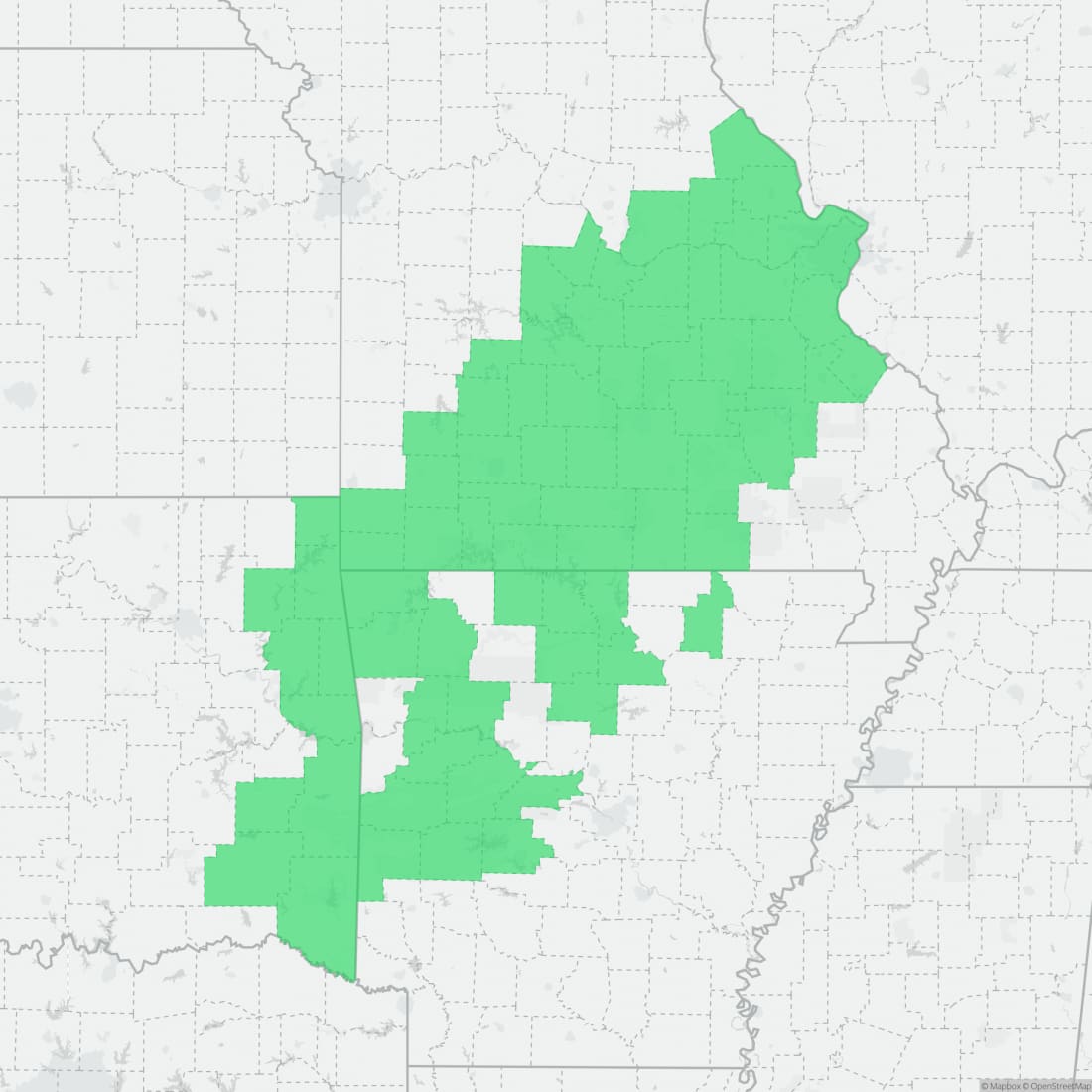
Approximate range. © Mapbox © OpenStreetMap