Florida Softshell Turtle
Apalone ferox
The largest species of softshell turtle found in North America. Females are 3-5 times larger than males and average 16 inches in length and weigh just under 15 lbs. Males…
How to identify
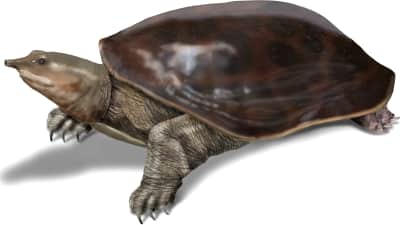
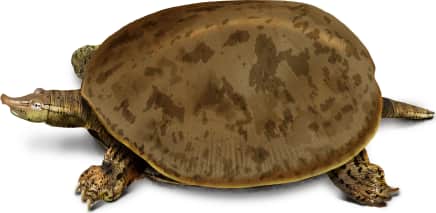
The largest species of softshell turtle found in North America. Females are 3-5 times larger than males and average 16 inches in length and weigh just under 15 lbs. Males only reach about 14 inches and weigh 6 lbs. This turtle has a flattened, leathery shell, large, wide webbed feet, a long neck, and elongated, snorkel-like nostrils. Its head is relatively large and eyes spaced close together. Adults are a uniform muddy grey or brown all over their dorsum, with faint darker mottling, and the anterior edge of their carapace is covered in bumps. The ventral surfaces are an unmarked pale cream color.
Range
Native to Florida, as well as southern Alabama, southern and eastern Georgia, and southern South Carolina. It is the only species of softshell turtle that can be found throughout the entire Florida peninsula.
Habitat
This turtle is almost entirely aquatic. It will often bury itself in the muddy substrate under water. It inhabits almost all types of natural and manmade bodies of freshwater, and will occasionally tolerate brackish water. It prefers still or slow-moving water, so it will rarely be found in rivers or streams with strong current.
Variations
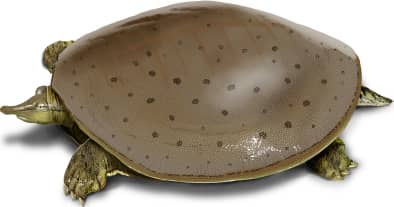
Juveniles have a few yellow markings on their face and their carapace has a yellow edge and dark reticulation pattern in the middle. Males have a longer tail than females.
Similar species
Most likely to be confused with the smooth softshell turtle (*Apalone mutica*) or the spiny softshell turtle (*Apalone spinifera*), both of which would only overlap in the most northern parts of its range.
Name and etymology
Genus
Apalone
Greek for soft or tender.
Origin
Sources
- Rafinesque, 1832. Atlantic J. Friend Knowledge Philadelphia, Vol. 2, No. 2, p. 64
Apalone. Rafinesque, 1832 - Atlantic J. Friend Knowledge Philadelphia, Vol. 2, No. 2, p. 64
Species epithet
ferox
Latin for wild or feral.
Origin
Sources
- (Schneider, 1783). Naturg. Schildkr., p. 330
Apalone ferox. (Schneider, 1783) - Naturg. Schildkr., p. 330
Explore more names in the etymology index.
At a glance
Size
15 to 73.6 cm
Range
Native to Florida, as well as southern Alabama, southern and eastern Georgia, and southern South Carolina. It is the only spe…
Habitat
This turtle is almost entirely aquatic. It will often bury itself in the muddy substrate under water. It inhabits almost all…
Range map
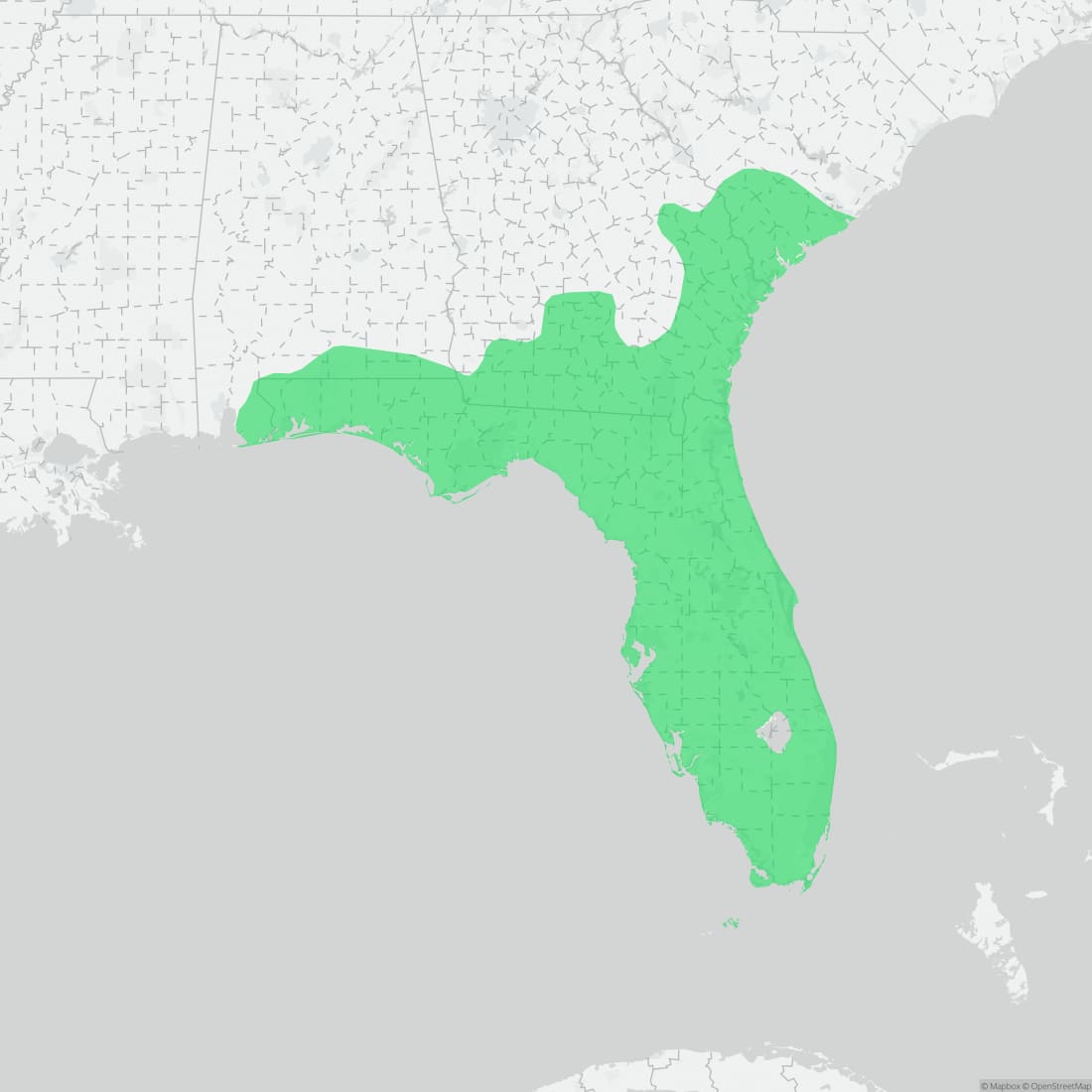
Approximate range. © Mapbox © OpenStreetMap