Channel Islands Slender Salamander
Batrachoseps pacificus
This salamander has a very long tail and tiny, under-developed legs set far apart. It has a very short snout and an average length of 4-6.5 cm from snout to vent. It is g…
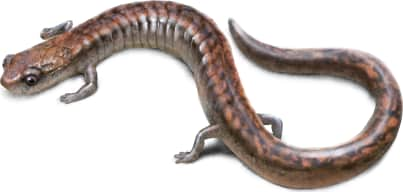
How to identify
This salamander has a very long tail and tiny, under-developed legs set far apart. It has a very short snout and an average length of 4-6.5 cm from snout to vent. It is generally pale with tiny gold and grey flecks all over its body. It has 18-20 costal grooves on its sides, and only 4 toes on each foot (front and back). They also have naso-labial grooves.
Range
Endemic to the Channel Islands off the coast of southern California.
Habitat
Lives under rocks, logs, and other natural debris in various moist temperate habitats. Active at night when the surroundings are wet and temperatures are moderate.
Variations
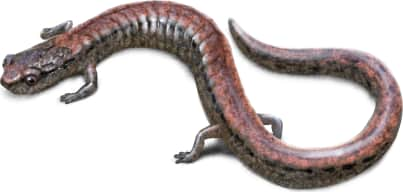
Some individuals are a much darker grey all over, with fewer gold flecks.
Similar species
The black-bellied slender salamander (*Batrachoseps nigriventris*) could be confused with this species, and is also found on the Channel Islands. But the black-bellied tends to have a more distinct stripe of coloration down its back.
Name and etymology
Genus
Batrachoseps
Greek for amphibian (batrachos) lizard (seps).
Origin
Sources
- Bonaparte, 1841. Iconogr. Fauna Italica, Vol. 2, Fasc. 26, fol. 131, not paged
Batrachoseps. Bonaparte, 1841 - Iconogr. Fauna Italica, Vol. 2, Fasc. 26, fol. 131, not paged
Species epithet
pacificus
Of the Pacific Ocean.
Sources
- (Cope, 1865). Proc. Acad. Nat. Sci. Philadelphia, Vol. 17, p. 195 ↗
Batrachoseps pacificus. (Cope, 1865) - Proc. Acad. Nat. Sci. Philadelphia, Vol. 17, p. 195
Explore more names in the etymology index.
At a glance
Range
Endemic to the Channel Islands off the coast of southern California.
Habitat
Lives under rocks, logs, and other natural debris in various moist temperate habitats. Active at night when the surroundings…
Guide
Reptiles and Amphibians of North America
Range map
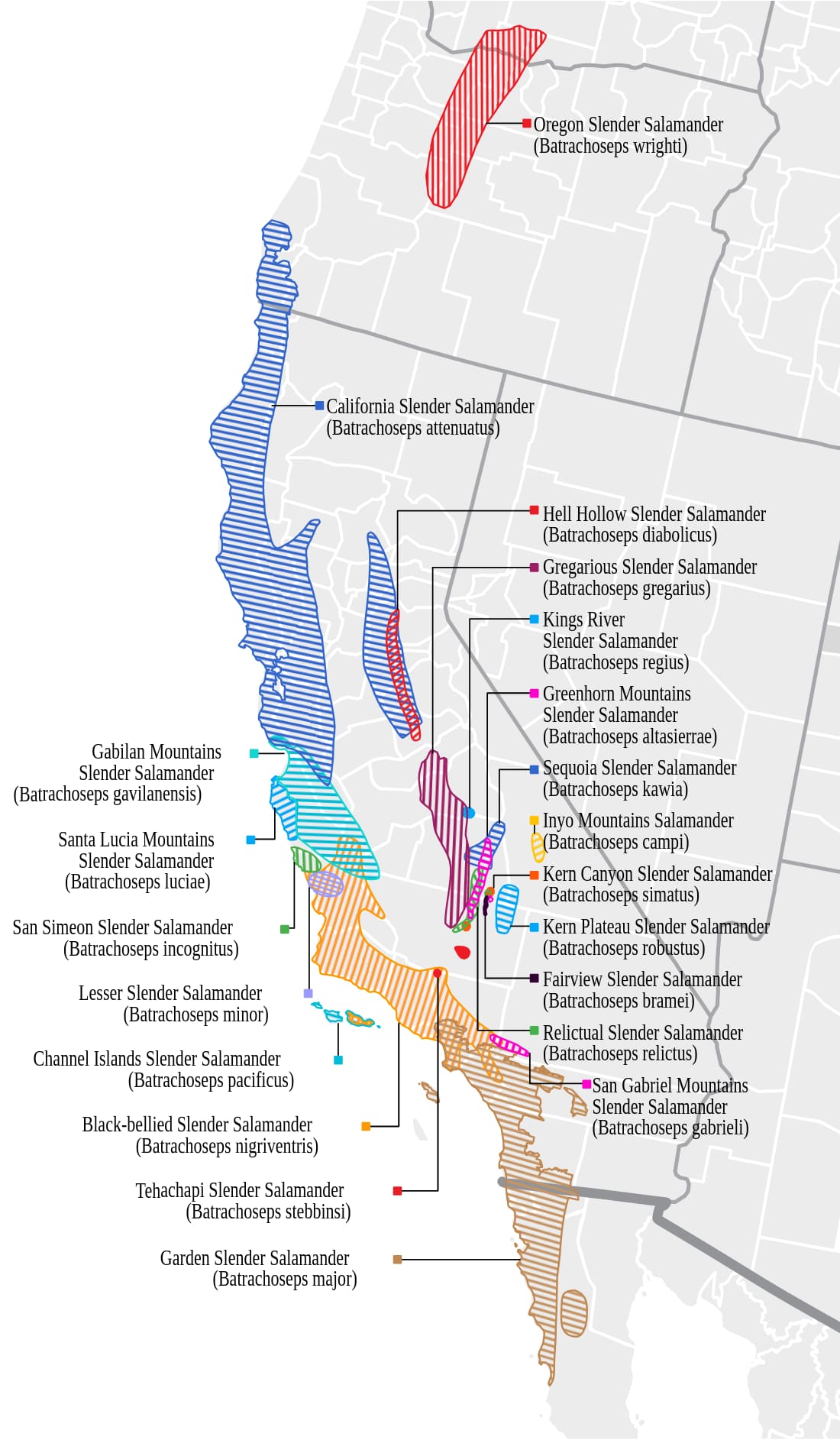
Approximate range. © Mapbox © OpenStreetMap