Arguello Slender Salamander
Batrachoseps wakei
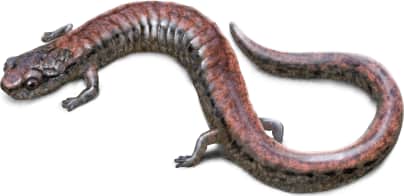
The B. wakei is a relatively large member of its genus, with adults reaching snout-vent lengths up to 2.6 inches (67.6 mm). It has a rounded head that blends smoothly in…
How to identify
The B. wakei is a relatively large member of its genus, with adults reaching snout-vent lengths up to 2.6 inches (67.6 mm). It has a rounded head that blends smoothly into the neck, and its eyes bulge slightly when viewed from below. Coloration is typically a uniform dark brown or black dorsally, with a slightly lighter underside.
Range
B. wakei occupies a narrow marine terrace centered on Point Arguello, making it one of the most geographically restricted salamanders in North America. Due to its limited range and potential threats, the B. wakei is classified as critically endangered.
Habitat
The Arguello Slender Salamander is strictly terrestrial, dwelling in moist coastal scrub and grasslands. Due to its lunglessness, it relies on constantly damp environments to absorb oxygen through its skin. It spends most of its life hidden beneath leaf litter, rocks, or shallow burrows, emerging only during wet periods to forage for small invertebrates like insects and worms.
Similar species
Other slender salamanders (Batrachoseps spp.) may be found in California, but the Arguello Slender Salamander can be distinguished by several key characteristics. It has a higher number of trunk vertebrae compared to most relatives, and its premaxillary bones are fused, unlike some other California Batrachoseps. Additionally, its larger size and location within its restricted range can aid in identification.
Name and etymology
Genus
Batrachoseps
Greek for amphibian (batrachos) lizard (seps).
Origin
Sources
- Bonaparte, 1841. Iconogr. Fauna Italica, Vol. 2, Fasc. 26, fol. 131, not paged
Batrachoseps. Bonaparte, 1841 - Iconogr. Fauna Italica, Vol. 2, Fasc. 26, fol. 131, not paged
Species epithet
wakei
NHonoring herpetologist David Burton Wake
Sources
- Wikipedia: Batrachoseps wakei ↗
“Batrachoseps wakei.” Wikipedia. https://en.wikipedia.org/wiki/Arguello_slender_salamander
Explore more names in the etymology index.
More illustrations
At a glance
Range
B. wakei occupies a narrow marine terrace centered on Point Arguello, making it one of the most geographically restricted sal…
Habitat
The Arguello Slender Salamander is strictly terrestrial, dwelling in moist coastal scrub and grasslands. Due to its lungless…
Guide
Reptiles and Amphibians of North America