Barking Frog
Craugastor augusti
The frogs’ average length is 3.75 in. The frog is peculiarly toad-like and has skin colored olive-gray to rusty gray spotting dark blotches in irregular shapes. The frog…
How to identify
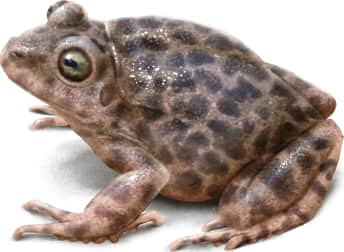
The frogs’ average length is 3.75 in. The frog is peculiarly toad-like and has skin colored olive-gray to rusty gray spotting dark blotches in irregular shapes. The frog has an intratympanic fold (a fold of skin across the back of the head). The feet end with tubercles but are not webbed. Female barking frogs are bigger than their male counterparts and possess a pink tympana and white throats all year. Unlike the males who have a darker colored tympana and have a dark throat only in the mating season. Juvenile frogs are not much different from adults but sometimes have large black patches on their heads or lower bodies.
Range
This species of frog occurs in majorly Mexico but can also be found in southern parts of the USA. In the USA, it is particularly found in Arizona and its rocky outcrops in the Patagonia, Pajarito, Santa Rita, Huachuca, and Quinlan mountains. And it might also be found in the southeastern mountains.
Habitat
Caves, outcrops, scrubby trees especially oak, serve as shelter and protection from extreme climate for the frogs. Female barking frogs lay their eggs in these moist rock crevices, outcrops, and caves. Young frogs do not go through an aquatic stage, they instead hatch directly from eggs. Barking frogs eat grasshoppers, crickets, scorpions, silverfish and a lot of other types of invertebrates.
Variations
The three major subspecies of this frog are based on region: The common barking frog Craugastor augusti augusti Western barking frog Craugastor augusti cactorum Eastern barking frog Craugastor augusti latrans
Similar species
There are no similar frogs in North America, but in the southern portions of the Barking frog's range other craugastor species can be found. Taylor’s barking frog (Craugastor occidentalis) is quite similar to its augusti cousin but a fundamental difference is that the Taylor barking frog has an angular shaped head not as rounded and curved as the barking frog. Which is also a fundamental difference between the Craugastor augusti and the Craugastor hobartsmithi. Another similar species is the Matuda’s robber frog (Craugastor matudai) which is significantly smaller than the barking frog at averagely 1.5 in.
Name and etymology
Genus
Craugastor
From the greek, meanig brittle(krauros)-belly(gastēr)
Origin
Sources
- Dumeril and Bibron, 1841. Erpet. Gen., Vol. 8, p. 620 ↗
Eleutherodactylus. Dumeril and Bibron, 1841 - Erpet. Gen., Vol. 8, p. 620
Species epithet
augusti
Honoring herpetologist Auguste H.A. Dumeril
Origin
Sources
- (Duges, 1879).
Eleutherodactylus augusti. (Duges, 1879) -
Explore more names in the etymology index.
At a glance
Range
This species of frog occurs in majorly Mexico but can also be found in southern parts of the USA. In the USA, it is particula…
Habitat
Caves, outcrops, scrubby trees especially oak, serve as shelter and protection from extreme climate for the frogs. Female bar…
Guide
Reptiles and Amphibians of North America
Range map
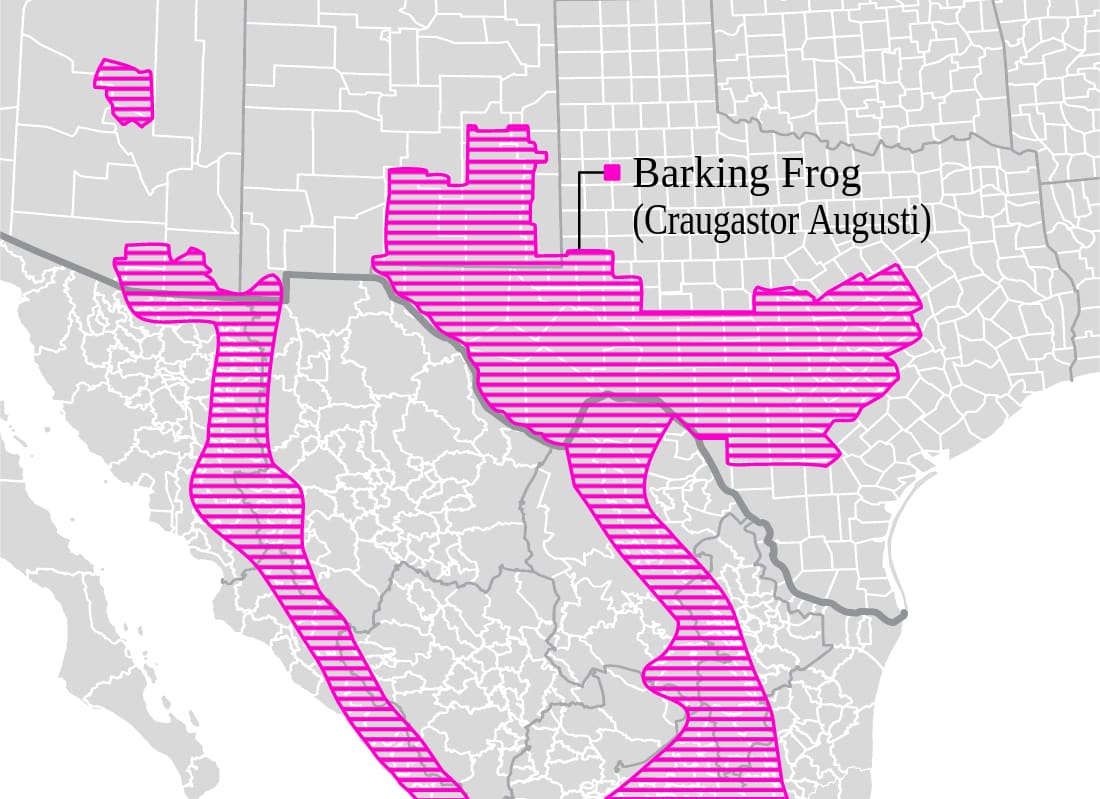
Approximate range. © Mapbox © OpenStreetMap