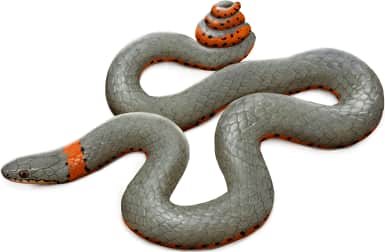
Ring-necked Snake
Diadophis punctatus
Inhabits one of the largest geographic ranges of any North American snake. Gray base color with orangish or yellowish stripe around neck and orangish or yellowish belly.…
How to identify
Inhabits one of the largest geographic ranges of any North American snake. Gray base color with orangish or yellowish stripe around neck and orangish or yellowish belly. Base color can sometimes be black or tan. Body is slender and scales are smooth. Females lay eggs from June to July; clutches range from 1 to 18 eggs.
Range
Most of the United States and parts of Canada and Mexico; from Nova Scotia, southern Quebec, and southern Ontario to San Luis Potosi.
Habitat
Inhabits a variety of regions from woodlands to grasslands to riparian corridors. Usually stay in moist areas. During the day, takes shelter under logs, rocks, and stumps. Females lay eggs in the dirt or under natural protection.
Variations
Subspecies northern ringneck snake, or *Diadophis punctatus edwardsii*, lives in mountainous terrain and exhibits an underside with no pattern and an unbroken neck ring. Subspecies southern ringneck, or *Diadophis punctatus punctatus*, inhabits the Coastal Plain and displays a belly with black spots and a broken neck ring. *Diadophis punctatus edwardsii* generally is larger than *Diadophis punctatus punctatus*.
Similar species
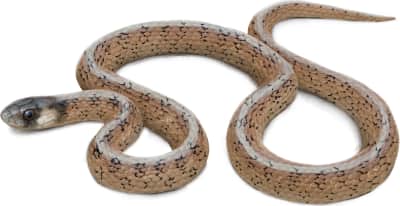
Name and etymology
Genus
Diadophis
Crowned (Latin - diadema) snake (Greek - ophis).
Origin
Sources
- Baird and Girard, 1853. Cat. N. Amer. Rept., Pt. 1, p. 112 ↗
Diadophis. Baird and Girard, 1853 - Cat. N. Amer. Rept., Pt. 1, p. 112
Species epithet
punctatus
Latin for dotted, referencing spotted pattern on the venter.
Origin
Sources
- (Linnaeus, 1766). Syst. Nat., 12th ed., Vol. 1, p. 376 ↗
Diadophis punctatus. (Linnaeus, 1766) - Syst. Nat., 12th ed., Vol. 1, p. 376
Explore more names in the etymology index.
More illustrations
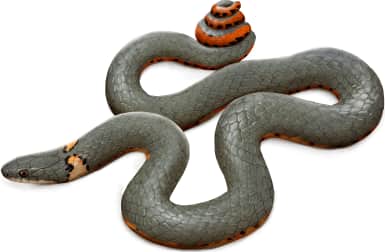
Southern Ring-necked Snake
At a glance
Size
25.5 to 46 cm
Range
Most of the United States and parts of Canada and Mexico; from Nova Scotia, southern Quebec, and southern Ontario to San Luis…
Habitat
Inhabits a variety of regions from woodlands to grasslands to riparian corridors. Usually stay in moist areas. During the day…
Range map
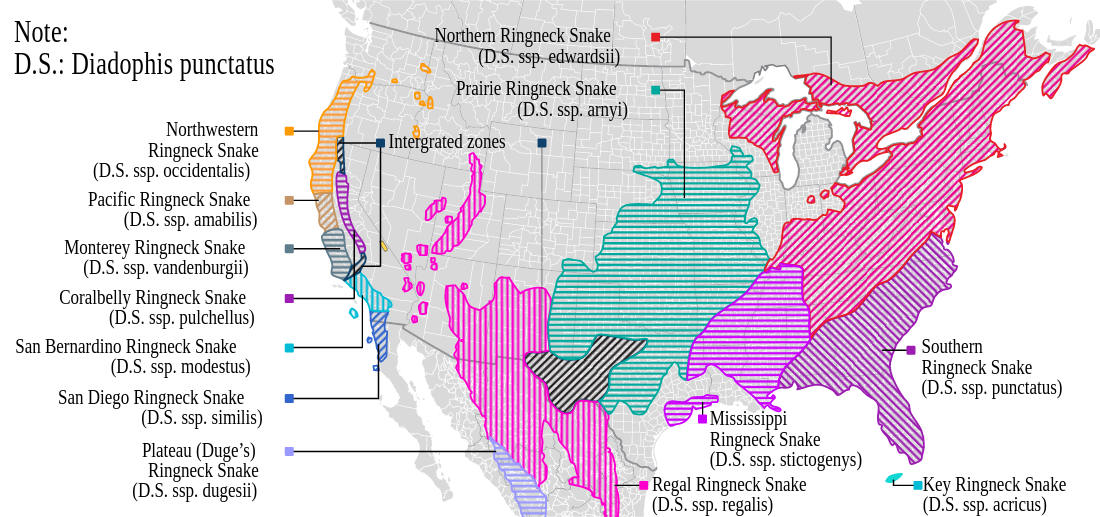
Approximate range. © Mapbox © OpenStreetMap