Eastern Indigo Snake
Drymarchon couperi
This species boasts the largest species of snake native to the United States and the largest, non-venomous species in the southeastern regions of the United States. They…
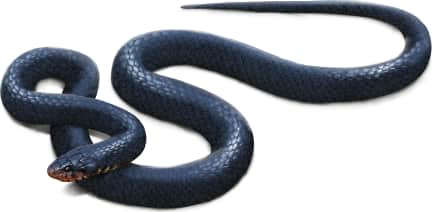
How to identify
This species boasts the largest species of snake native to the United States and the largest, non-venomous species in the southeastern regions of the United States. They reach an average length range of 60-84 inches. They are uniformly black or bluish-black, including the belly. The only exception to this uniform color is the side of the head, chin, and throat which is red or cream-colored. These snakes are sexually dimorphic because the males are larger than the females. Juveniles are similar to adults except they have more red on their heads and a white band around the body.
Range
The eastern indigo snake is found mostly in Florida and southern Georgia. They used to be found throughout Alabama, Texas, Mississippi, and South Carolina but are now rare due to habitat destruction and killing.
Habitat
These snakes can be found in a variety of habitats including, dry prairie, freshwater marshes, coastal dunes, high pine, scrubby flatwoods and habitats altered by humans. However, they thrive the most in wetland areas. Their habitat is often shared with gopher tortoises because they use the tortoise burrows to shelter. They also shelter in hollowed root channels, hollow logs, and burrows of other animals. Breeding for these species occurs from November to April. Females lay their eggs in gopher tortoise burrows (or similar) or fallen logs. They usually lay clutches of 4-12. When it comes to feeding, they also have a variety of diet; they eat frogs, lizards, fish, eggs, birds, mammals, and other snakes.
Similar species
North American Racer (Coluber constrictor) is also nonvenomous and can be uniformly black. However, they never grow up to the lengths of the D. couperi and are often thinner and have a dull black coloration with white or brown throats. Indigo Snake (Drymarchon corais) is usually distinguished from other snakes by the transitions of color from black to yellow or orange at the tail end of the body. The underside of this snake is typically the same color as the tail. Central American Indigo Snake (Drymarchon melanurus) is also a large non-venomous species that averages 70 inches in length. It is typically a glossy olive-brown that blackens at the tail with an underside of light olive-yellow with dark markings around the eyes.
Name and etymology
Genus
Drymarchon
Greek for forest (drymos) chief (archos).
Origin
Sources
- Fitzinger, 1843. Syst. Rept., p. 26 ↗
Thamnophis. Fitzinger, 1843 - Syst. Rept., p. 26
Species epithet
couperi
onoring James Hamilton Couper.
Sources
- (Holbrook, 1842). N. Amer. Herp., Ed. 2, Vol. 3, p. 75, pl. 16 ↗
Drymarchon couperi. (Holbrook, 1842) - N. Amer. Herp., Ed. 2, Vol. 3, p. 75, pl. 16
Explore more names in the etymology index.
At a glance
Size
152.4 to 213.36 cm
Range
The eastern indigo snake is found mostly in Florida and southern Georgia. They used to be found throughout Alabama, Texas, Mi…
Habitat
These snakes can be found in a variety of habitats including, dry prairie, freshwater marshes, coastal dunes, high pine, scru…
Range map
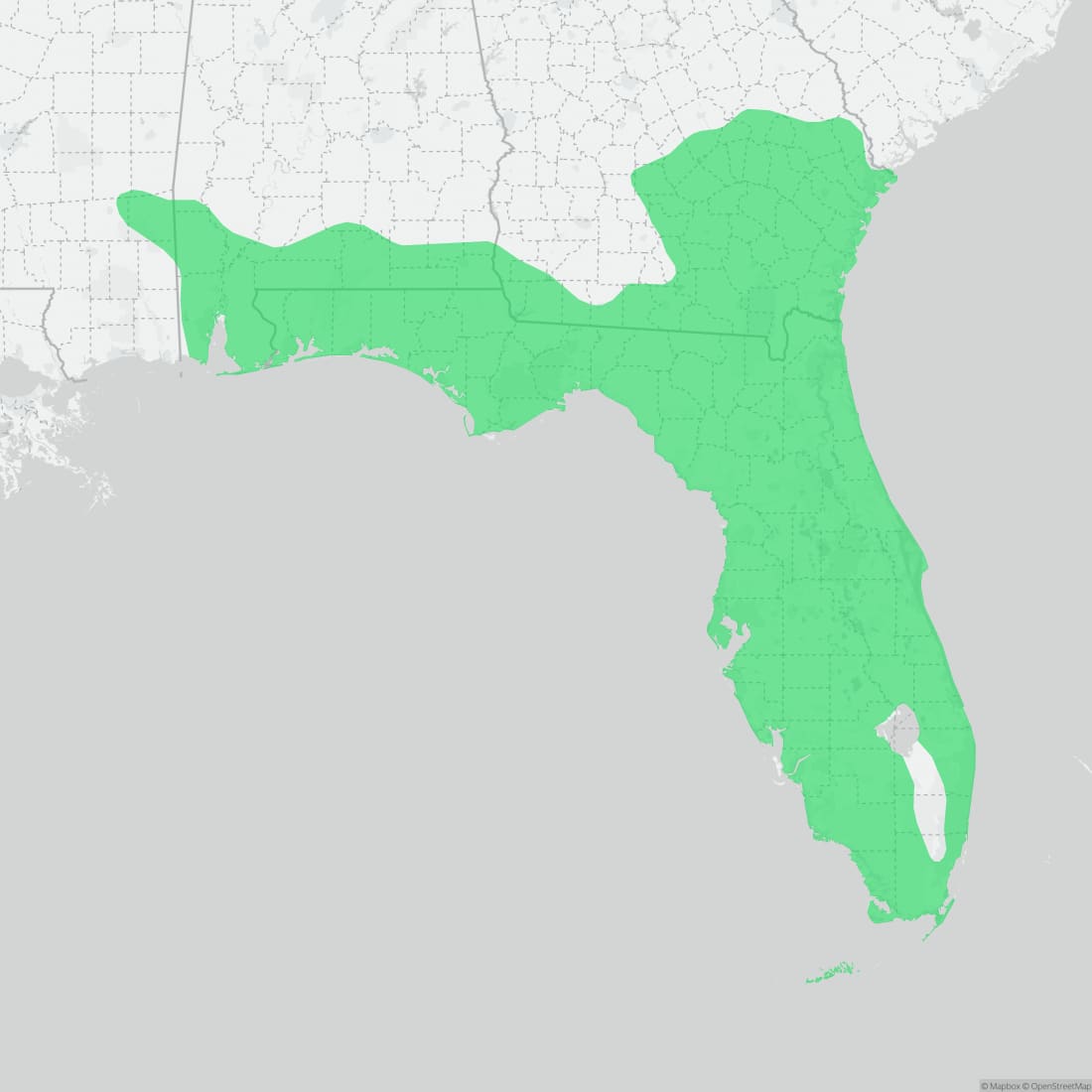
Approximate range. © Mapbox © OpenStreetMap