Azure-tailed Skink
Emoia impar
The adult emoia impar grows longer than 8 inches. It has a brownish-gray to dark gray base coloration with 3 copper lines running from its snout to its upper tail on its…
How to identify
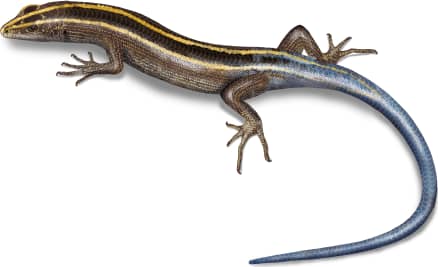
The adult emoia impar grows longer than 8 inches. It has a brownish-gray to dark gray base coloration with 3 copper lines running from its snout to its upper tail on its back. The entire length of its body is covered in shiny smooth scales. The underbelly is dark gray. The limbs have long clawed fingers and toes. The front limbs are short while the hind limbs are almost double its length. The tail is longer than its body and distinctively colored blue.
Range
It is endemic to the Pacific, particularly to Polynesia and Micronesia. It was introduced into the Hawaiian Islands by the Polynesians.
Habitat
The Azure-tailed skink can be found on land hiding from the midday sun or predators under leaves, grasses or rocks. They like to burrow and can be seen hiding in logs or loose sand substrate. They are diurnal and can shed their tails when threatened. The tail which grows back lacks the beauty of the original and is stunted. It is insectivorous and reproduces through oviparity. They were until recently considered extinct in the USA thanks to the activities of man and the invasive big-headed ant.
Similar species
The emoia cyanura also known as the Azure-tailed skink has a shiny blue tail like the Emoia impar although it has a fusion of dark stripes in a Y shape that starts from the mid-dorsal area and ends in the tail.
Name and etymology
Genus
Emoia
Etymology incomplete
The meaning of this name has not been recorded yet.
Species epithet
impar
Latin for odd.
Origin
Sources
- Wikipedia: Emoia impar ↗
“Emoia impar.” Wikipedia. https://en.wikipedia.org/wiki/Emoia_impar
Explore more names in the etymology index.
At a glance
Range
It is endemic to the Pacific, particularly to Polynesia and Micronesia. It was introduced into the Hawaiian Islands by the Po…
Habitat
The Azure-tailed skink can be found on land hiding from the midday sun or predators under leaves, grasses or rocks. They like…
Guide
Reptiles and Amphibians of North America
Range map
Approximate range. © Mapbox © OpenStreetMap