Blanding's Turtle
Emydoidea blandingii
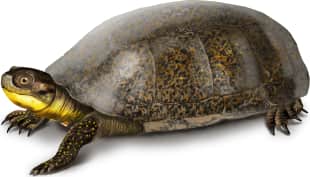
Exhibits a yellow throat, chin, and plastron. Legs and tail are either grayish, bluish, black, or brown with yellow or brown blotches. Large, flat head is black or brown…
How to identify
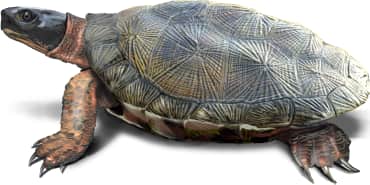
Exhibits a yellow throat, chin, and plastron. Legs and tail are either grayish, bluish, black, or brown with yellow or brown blotches. Large, flat head is black or brown and sometimes will have yellow blotches. Carapace is smooth and domed; exhibits a bluish blackish color and is not keeled or serrated. Males and females mate from March to May. Females typically lay their eggs in the evening.
Range
Great lakes region from South Dakota and North Dakota on the east to northwestern Pennsylvania on the west; as far north as southwestern Quebec and as far south as northern Missouri.
Habitat
Stays near the water in upland with grass and shrubs. This can include marshes, swamps, ponds, lakes, slow rivers, and coves. Classified as semi-aquatic, they are known to be highly mobile and can populate large areas. Females lay eggs in sandy upland areas.
Variations
Male plastrons are more concave than female plastrons. Some studies show that male plastrons only erode and exhibit pitting.
Similar species
Name and etymology
Genus
Emydoidea
Greek for similar to (-eidos) a freshwater turtle (emydos).
Origin
Sources
- Gray, 1870. Supp. Cat. Shield Rept. Brit. Mus., Pt. 1, p. 19
Emydoidea. Gray, 1870 - Supp. Cat. Shield Rept. Brit. Mus., Pt. 1, p. 19
Species epithet
blandingii
Honoring William Blanding.
Origin
Honors
Sources
- (Holbrook, 1838). N. Amer. Herp., Ed. 1, Vol. 3, p. 35, pl. 5 ↗
Emydoidea blandingii. (Holbrook, 1838) - N. Amer. Herp., Ed. 1, Vol. 3, p. 35, pl. 5
Explore more names in the etymology index.
At a glance
Size
150 to 240 mm
Range
Great lakes region from South Dakota and North Dakota on the east to northwestern Pennsylvania on the west; as far north as s…
Habitat
Stays near the water in upland with grass and shrubs. This can include marshes, swamps, ponds, lakes, slow rivers, and coves.…
Range map
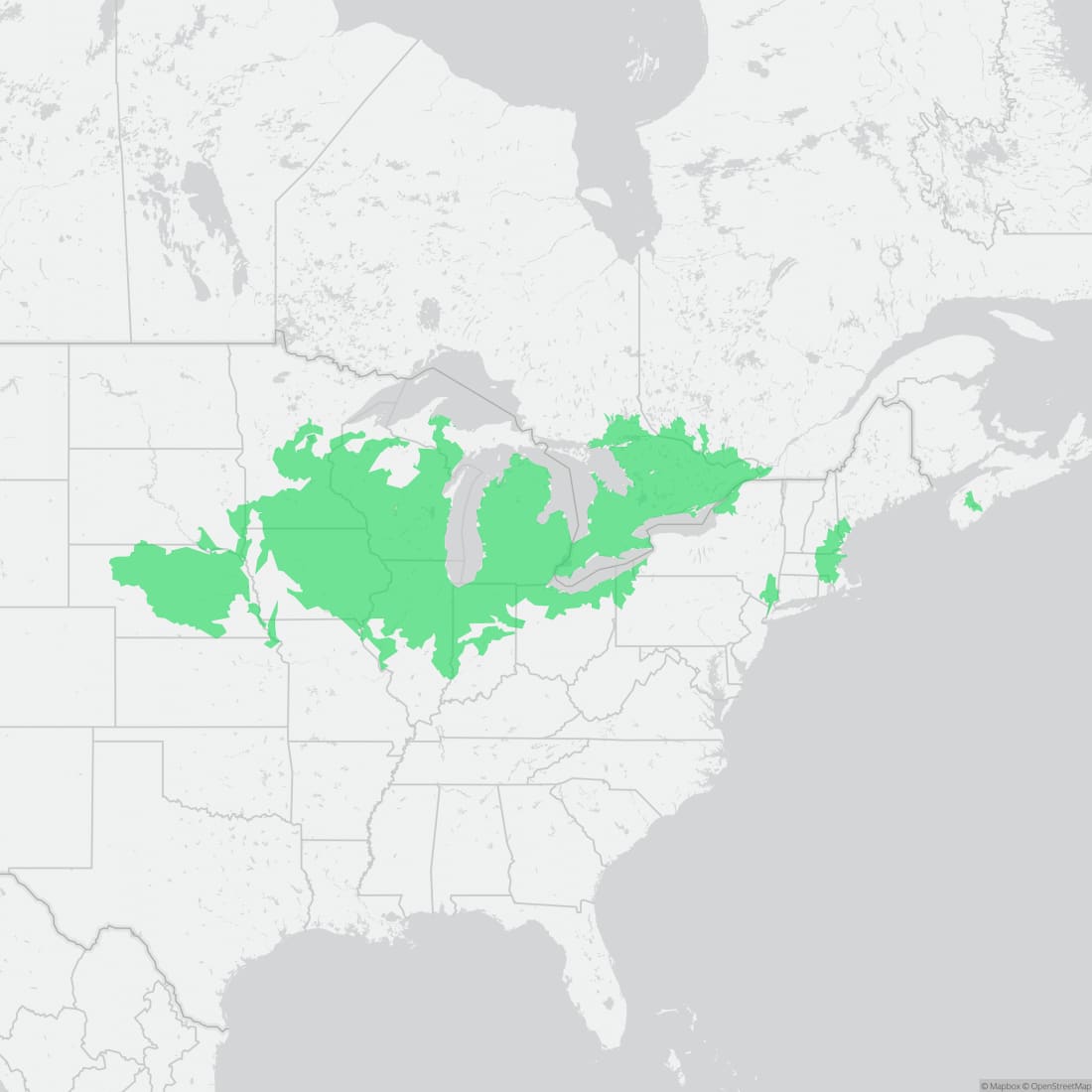
Approximate range. © Mapbox © OpenStreetMap