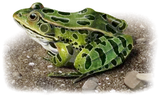
Eastern Narrow-mouthed Toad
Gastrophryne carolinensis
This unique species is not a true toad, but rather a microhylid frog. It has a very small, pointed head with no discernible neck, and a thin fold of skin across the head,…
How to identify
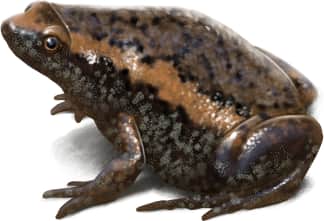
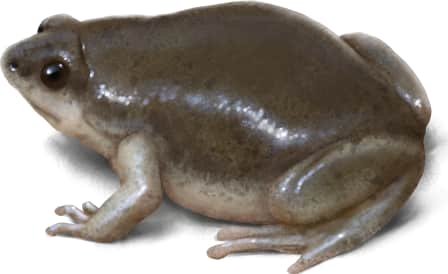
This unique species is not a true toad, but rather a microhylid frog. It has a very small, pointed head with no discernible neck, and a thin fold of skin across the head, just behind the eyes. It is small, only growing to a length of about 2 inches, and it has an egg-shaped body when viewed from above. Its front legs are thin and small compared to its hind legs, and its body is somewhat flattened dorsoventrally. It has moist skin covered in small bumps, and comes in a variety of brown or reddish shades with speckling or blotching patterns. This species does not have a tympanum, but it does have hard growths ("spades") on the heels of the hind feet for burrowing.
Range
Ranges throughout the southeastern United States; as far north as central Missouri and southern Maryland, and as far west as central Texas.
Habitat
A terrestrial species that lives in moist, shady environments in a variety of habitats. It requires lots of ground debris for hiding, and soft damp substrate for burrowing. It can be found in woodlands, swamps, suburban and urban areas.
Variations
Some are primarily one shade of brown with black and white speckles, while others have large patches of reddish brown on their backs which lack the speckling. It often has lighter brown shading down the sides of its back. Some are shades of dark grey instead of brown. Males have a dark throat and females have a pale throat.
Similar species
Most similar to the western narrow-mouthed toad (*Gastrophryne olivacea*). This unique species is difficult to confuse with other types of frog or toad.
Name and etymology
Genus
Gastrophryne
Greek for belly (gastros) toad (phryne).
Origin
Sources
- Fitzinger, 1843. Syst. Rept., p. 33 ↗
Gastrophryne. Fitzinger, 1843 - Syst. Rept., p. 33
Species epithet
carolinensis
Belonging to South Carolina.
Origin
Sources
- (Holbrook, 1836). N. Amer. Herp., Ed. 1, Vol. 1, p. 83, pl. 11 ↗
Gastrophryne carolinensis. (Holbrook, 1836) - N. Amer. Herp., Ed. 1, Vol. 1, p. 83, pl. 11
Explore more names in the etymology index.
At a glance
Range
Ranges throughout the southeastern United States; as far north as central Missouri and southern Maryland, and as far west as…
Habitat
A terrestrial species that lives in moist, shady environments in a variety of habitats. It requires lots of ground debris for…
Guide
Reptiles and Amphibians of North America
Range map
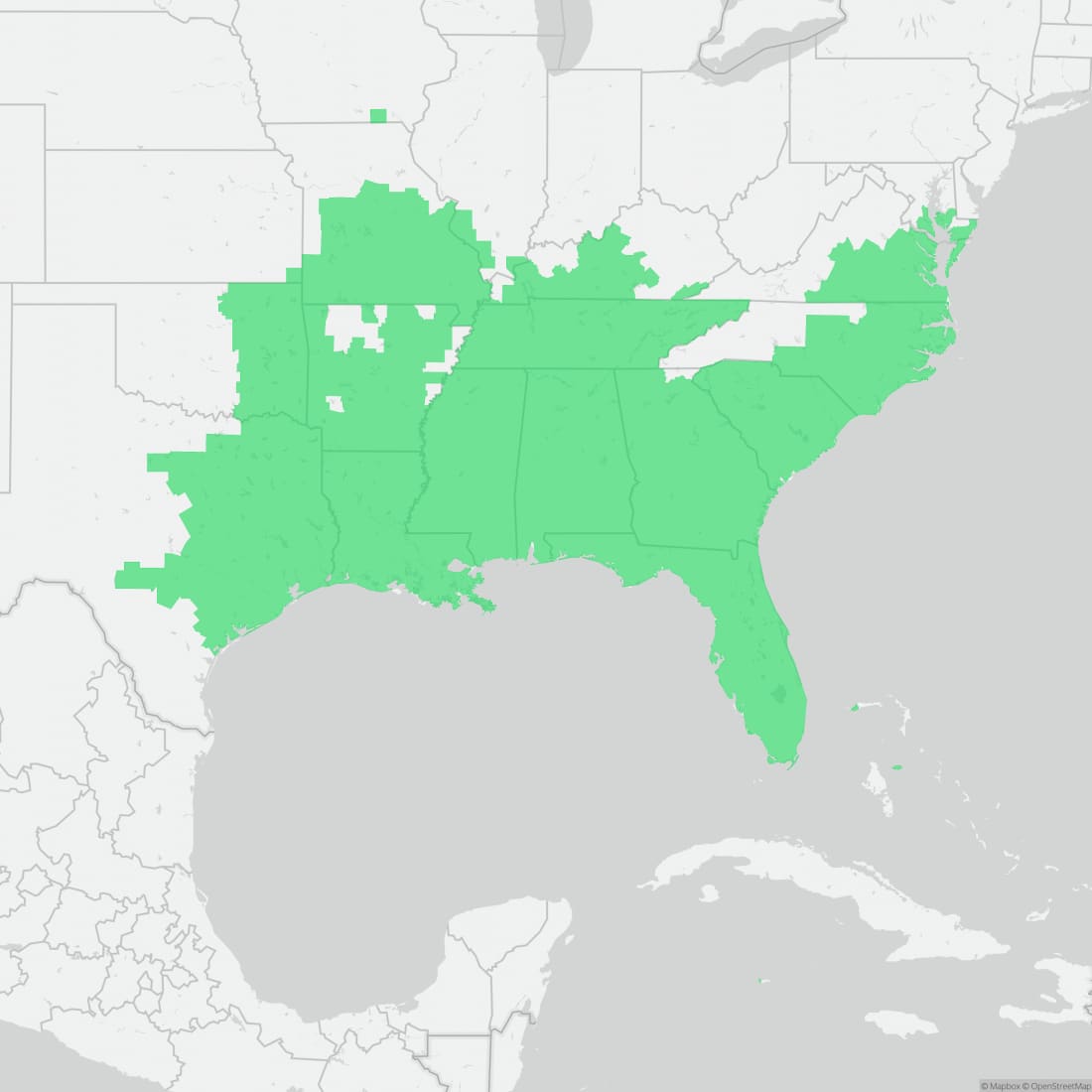
Approximate range. © Mapbox © OpenStreetMap