
Gray-banded Kingsnake
Lampropeltis alterna
A mid-sized nonvenomous snake averaging 3 feet in length, but can reach 4 feet. It has a thin body with smooth scales. Its head is slightly wider than its neck, and taper…
How to identify
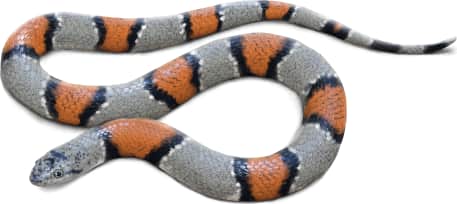
A mid-sized nonvenomous snake averaging 3 feet in length, but can reach 4 feet. It has a thin body with smooth scales. Its head is slightly wider than its neck, and tapers to a somewhat pointed snout. I has large eyes with round pupils. Its varies in color and pattern, but in general it is banded with grey, black, orange, and sometimes white. It usually has a black diagonal bar behind each eye.
Range
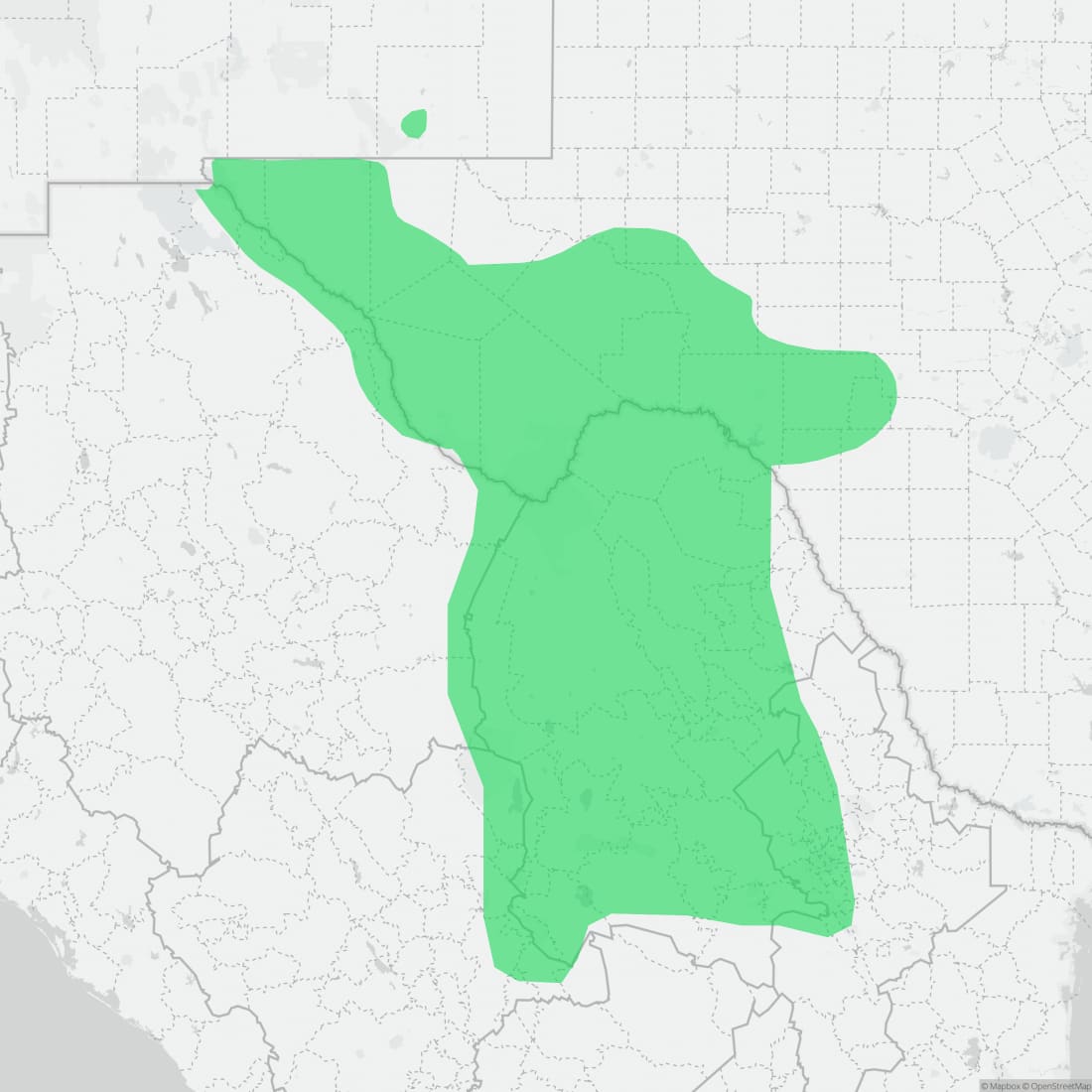
Ranges through west Texas, southwest New Mexico, and across the border into central Mexico (mostly in the state of Coahuila).
Habitat
It is a secretive nocturnal species that lives in desert habitats. Much of its range is rocky mountainous terrain with little human activity.
Variations
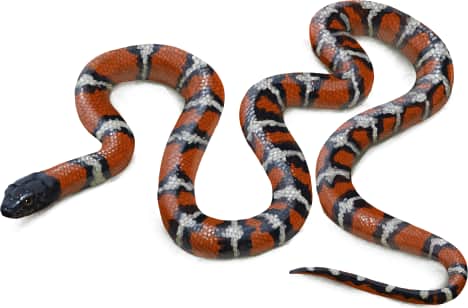
Grey coloration can be very pale or dark. Bands are irregular and sometimes incomplete or broken into spots. The bands can be solid black, or orange with black borders. The bands are sometimes thinly outlined with white. The orange coloration is sometimes more yellow.
Similar species
No other kingsnake species have the distinctive grey coloration. The coast mountain kingsnake (*Lampropeltis multifasciata*) and California mountain kingsnake (*Lampropeltis zonata*) have black, orange, and white banding, but they lack the grey.
Name and etymology
Genus
Lampropeltis
Greek for shiny (lampros) shield (pelta), referencing the shiny scales of the genus.
Origin
Sources
- Fitzinger, 1843. Syst. Rept., p. 25 ↗
Lampropeltis. Fitzinger, 1843 - Syst. Rept., p. 25
Species epithet
alterna
Latin for alternate, referencing it's alternating color pattern.
Origin
Sources
- (Brown, "1901" 1902). Proc. Acad. Nat. Sci. Philadelphia, Vol. 53, Feb. 6, 1902, p. 612 ↗
Lampropeltis alterna. (Brown, "1901" 1902) - Proc. Acad. Nat. Sci. Philadelphia, Vol. 53, Feb. 6, 1902, p. 612
Explore more names in the etymology index.
At a glance
Range
Ranges through west Texas, southwest New Mexico, and across the border into central Mexico (mostly in the state of Coahuila).…
Habitat
It is a secretive nocturnal species that lives in desert habitats. Much of its range is rocky mountainous terrain with little…
Guide
Reptiles and Amphibians of North America
Range map
Approximate range. © Mapbox © OpenStreetMap