
Chihuahuan Mountain Kingsnake
Lampropeltis knoblochi
This nonvenomous kingsnake mimics the venomous coral snake with its color pattern. It boasts a striking pattern of orange, black, and white bands, only differing from the…
How to identify
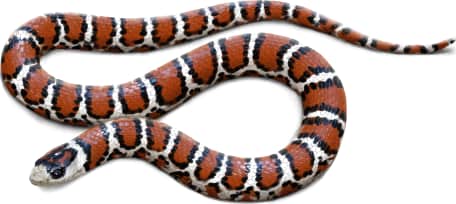
This nonvenomous kingsnake mimics the venomous coral snake with its color pattern. It boasts a striking pattern of orange, black, and white bands, only differing from the coral snake by replacing yellow bands with white bands. The bands are arranged with black bands separating the orange and white bands. It is a thin-bodied snake reaching about 3.5 feet in length. It has a narrow head with a slightly defined neck. Its ventrum is white with dark spots. Its face is typically white with a black cap on the top of the head between the eyes.
Range
Southeastern Arizona and southwestern New Mexico, stretching south into northwestern Mexico.
Habitat
This snake is primarily found in mountainous woodlands, and occasionally in surrounding semi-desert grasslands. It is a good climber, but is most often observed on the forest floor, rocky outcrops, or within rock crevices.
Variations
Bands are not always complete. Sometimes they are broken into wide patches across the back, with a chain-like pattern along the sides of the body. The black bands sometimes connect in the center of the back within the orange bands. The orange bands are sometimes more red in color.
Similar species
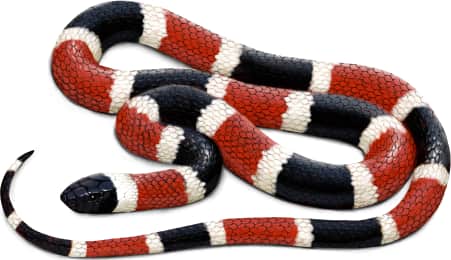
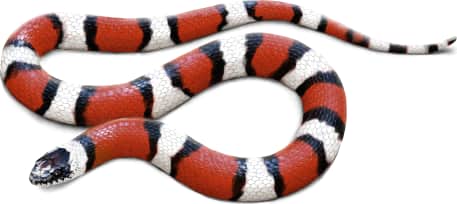
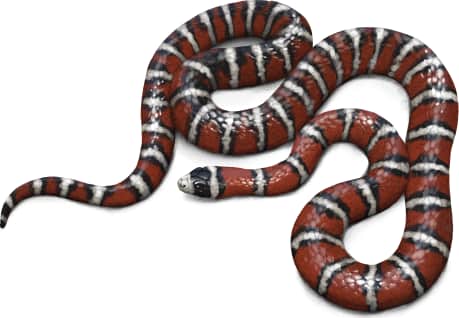
This species could easily be mistaken for the venomous Sonoran coral snake (*Micruroides euryxanthus*). The coral snake typically has a different arrangement of colors (white bands separating the orange and black bands), but there are always exceptions to this rule, so it can't be considered a reliable way to distinguish these two species. This kingsnake could also be confused with the western milksnake (*Lampropeltis gentilis*) or Arizona mountain kingsnake (*Lampropeltis pyromelana*), both of which are also nonvenomous.
Name and etymology
Genus
Lampropeltis
Greek for shiny (lampros) shield (pelta), referencing the shiny scales of the genus.
Origin
Sources
- Fitzinger, 1843. Syst. Rept., p. 25 ↗
Lampropeltis. Fitzinger, 1843 - Syst. Rept., p. 25
Species epithet
knoblochi
Honoring Irving Knobloch who collected the holotype.
Origin
Honors
Sources
- Wikipedia: Lampropeltis knoblochi ↗
“Lampropeltis knoblochi.” Wikipedia. https://en.wikipedia.org/wiki/Lampropeltis_knoblochi
Explore more names in the etymology index.
At a glance
Range
Southeastern Arizona and southwestern New Mexico, stretching south into northwestern Mexico.
Habitat
This snake is primarily found in mountainous woodlands, and occasionally in surrounding semi-desert grasslands. It is a good…
Guide
Reptiles and Amphibians of North America
Range map
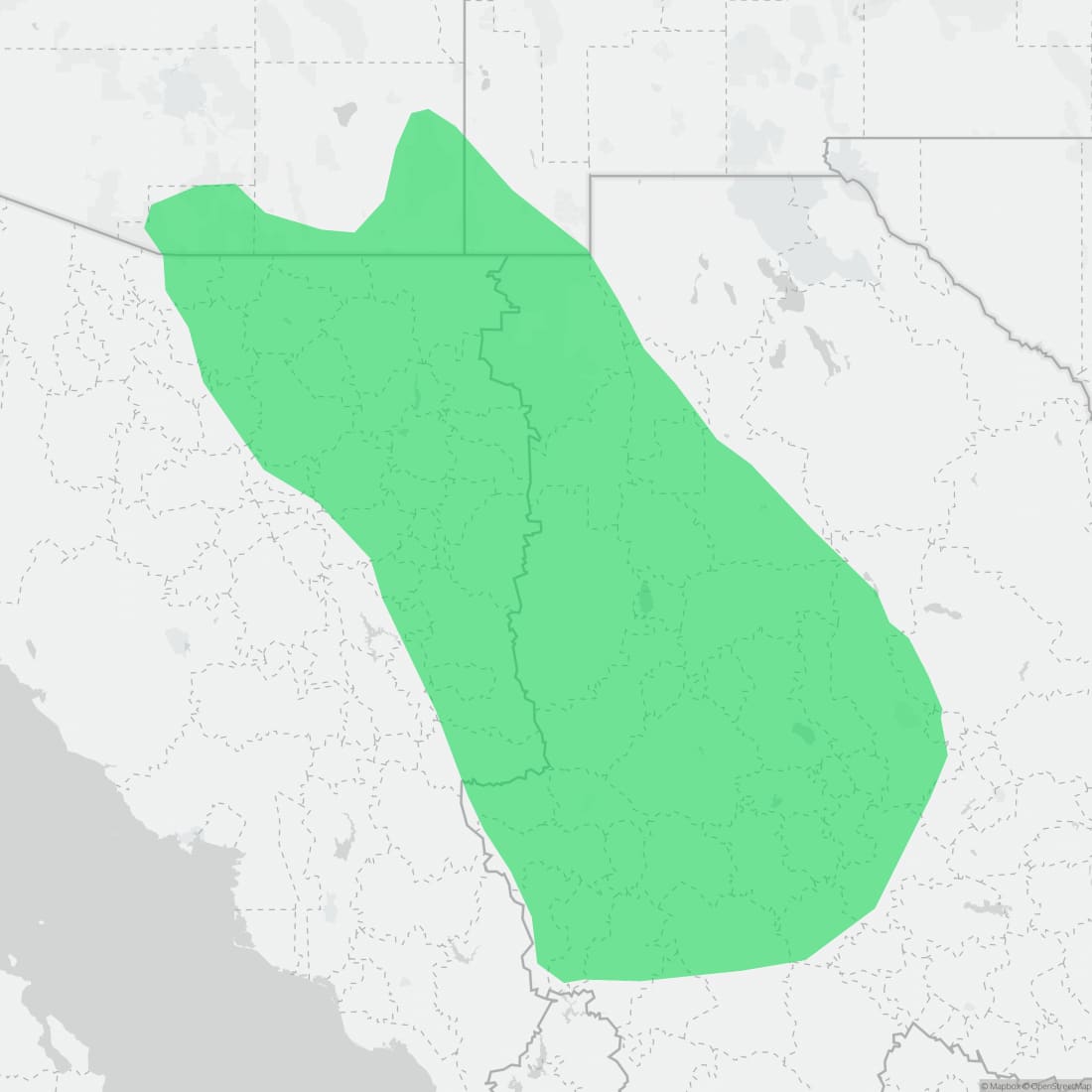
Approximate range. © Mapbox © OpenStreetMap