Mourning Gecko
Lepidodactylus lugubris
Growing to about 4 inches in total length, this gecko has a moderately flat head and body. It has large toe pads for scaling almost any surface. Its tail is narrow and li…
How to identify
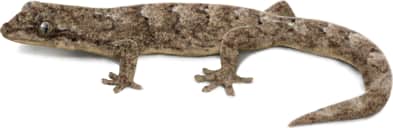
Growing to about 4 inches in total length, this gecko has a moderately flat head and body. It has large toe pads for scaling almost any surface. Its tail is narrow and lined with a single row of mildly spiked scales down each lateral side. Its coloration is usually shades of grey or tan & brown. It typically has a dark streak on each side of its face, and its dorsum has a jagged banded pattern resembling tree bark. Ventrum is pale and unmarked.
Range
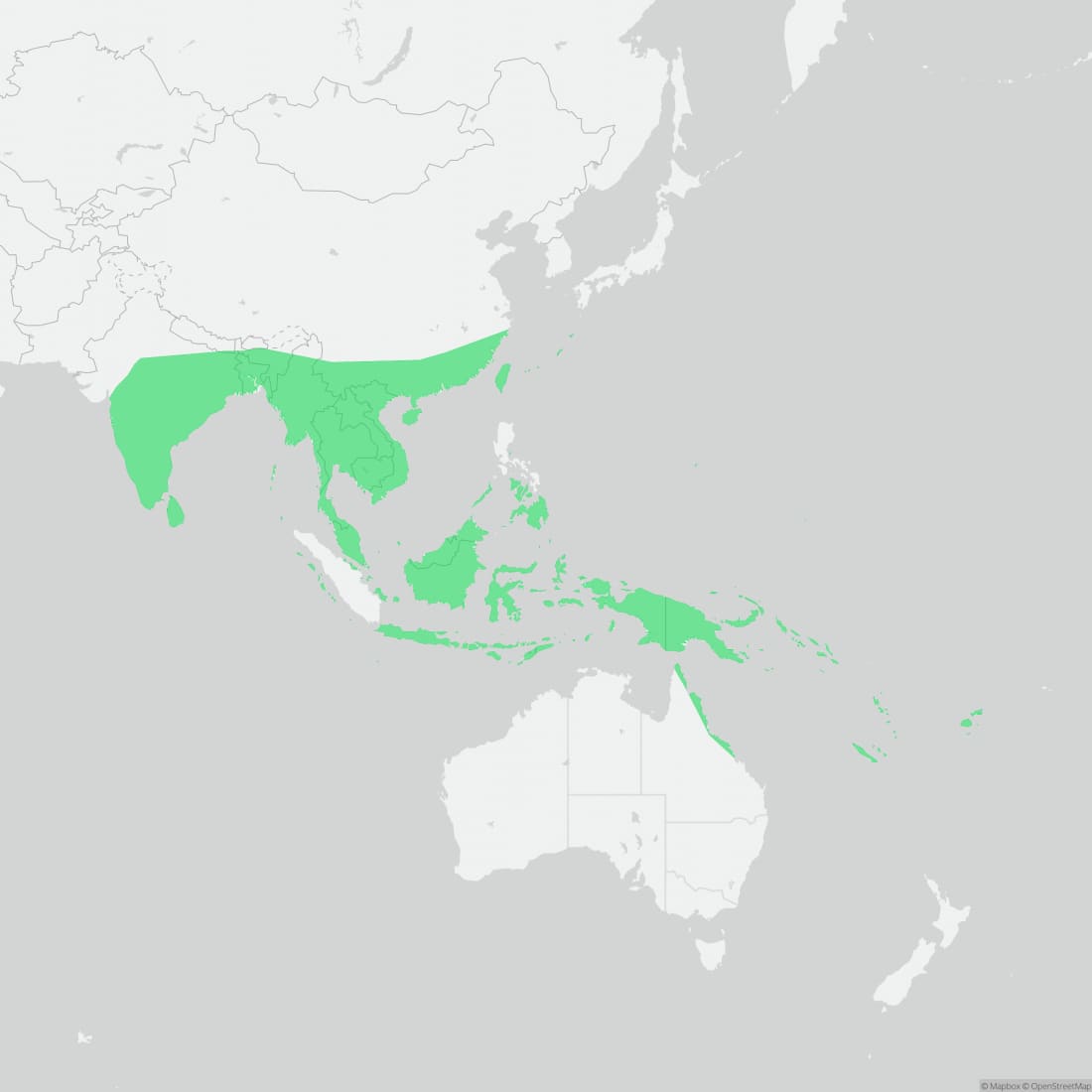
Native to coastal areas of Southeast Asia, but it has been widely introduced in tropical areas around the world. In the United States, it's been observed in Hawaii, Southern California, Texas, and Florida.
Habitat
This nocturnal species thrives in tropical climates where humans are plentiful. It is often found on exterior walls, fences, or light posts, hunting near artificial lights. It frequently lives inside buildings as well. It will hide in any natural or manmade crevice, and within leafy vegetation.
Variations
Some are very pale with dark spots or no pattern at all. Some have a lighter patterned stripe down their back, with darker grey sides.
Similar species
This gecko looks similar to several other introduced species in the United States, including the Common House Gecko (*Hemidactylus frenatus*), Flat-tailed House Gecko (*Hemidactylus platyurus*), Tropical House Gecko (*Hemidactylus mabouia*), and Indo-Pacific House Gecko (*Hemidactylus garnotii*).
Name and etymology
Genus
Lepidodactylus
Greek for scale (lepis) finger (daktylos).
Origin
Sources
- Wikipedia: Lepidodactylus ↗
“Lepidodactylus.” Wikipedia. https://en.wikipedia.org/wiki/Lepidodactylus
Species epithet
lugubris
Latin for mournful.
Origin
Sources
- (Hallowell, 1849). Proc. Acad. Nat. Sci. Philadelphia, Vol. 4, p. 126 ↗
Aneides lugubris. (Hallowell, 1849) - Proc. Acad. Nat. Sci. Philadelphia, Vol. 4, p. 126
Explore more names in the etymology index.
At a glance
Range
Native to coastal areas of Southeast Asia, but it has been widely introduced in tropical areas around the world. In the Unite…
Habitat
This nocturnal species thrives in tropical climates where humans are plentiful. It is often found on exterior walls, fences,…
Guide
Reptiles and Amphibians of North America
Range map
Approximate range. © Mapbox © OpenStreetMap