Mountain Skink
Plestiodon callicephalus
A mid-sized skink reaching about 3 inches in snout to vent length. It is distinguished by its blue tail which is retained into adulthood, whereas most other skinks lose t…
How to identify
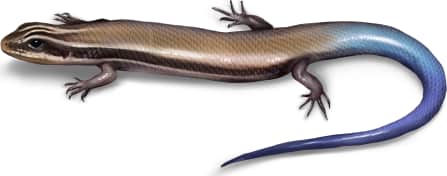
A mid-sized skink reaching about 3 inches in snout to vent length. It is distinguished by its blue tail which is retained into adulthood, whereas most other skinks lose the blue coloration with age. It also has a unique pair of light lines on the top of its head which come together on the neck, forming an elongated "Y" shape. It has a wide black lateral stripe down each side, bordered anteriorly by light lines. Its back is tan to brown. It has relatively robust legs for a skink, and the typical smooth, shiny scales and pointed face.
Range
Extreme southeastern Arizona and southwestern New Mexico, stretching down through the mountains of western Mexico.
Habitat
Occupies a wide variety of habitats within its narrow range. Despite its name, it is not restricted to mountain habitats. It prefers woodlands, grasslands, riparian corridors, and rocky canyons with abundant moist leaf litter, and can often be found under rocks or logs.
Variations
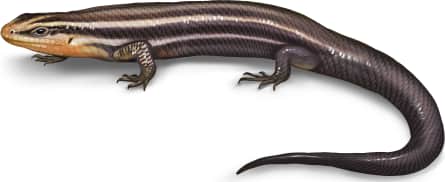
The blue tail coloration fades a bit with age. Some breeding males develop orange coloration in the lines on their head. Some individuals do not have the "Y" design on their head.
Similar species
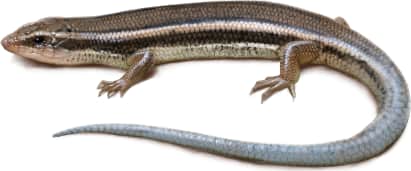
Most similar in appearance to the western skink (*Plestiodon skiltonianus*) and four-lined skink (*Plestiodon tetragrammus*), neither of which overlap in range.
Name and etymology
Genus
Plestiodon
Greek for most (pleistos) teeth (odontos).
Origin
Sources
- Wiegmann, 1834. Herp. Mex., p. 36
Eumeces. Wiegmann, 1834 - Herp. Mex., p. 36
Species epithet
callicephalus
Greek for beautiful (kalos) head (kephale).
Origin
Sources
- Bocourt, 1879. Miss. Sci. Mex., Vol. 3, Pt. 6, p. 431, pl. 22 D, fig. 2, pl. 22 E, fig. 2
Eumeces callicephalus. Bocourt, 1879 - Miss. Sci. Mex., Vol. 3, Pt. 6, p. 431, pl. 22 D, fig. 2, pl. 22 E, fig. 2
Explore more names in the etymology index.
At a glance
Range
Extreme southeastern Arizona and southwestern New Mexico, stretching down through the mountains of western Mexico.
Habitat
Occupies a wide variety of habitats within its narrow range. Despite its name, it is not restricted to mountain habitats. It…
Guide
Reptiles and Amphibians of North America
Range map
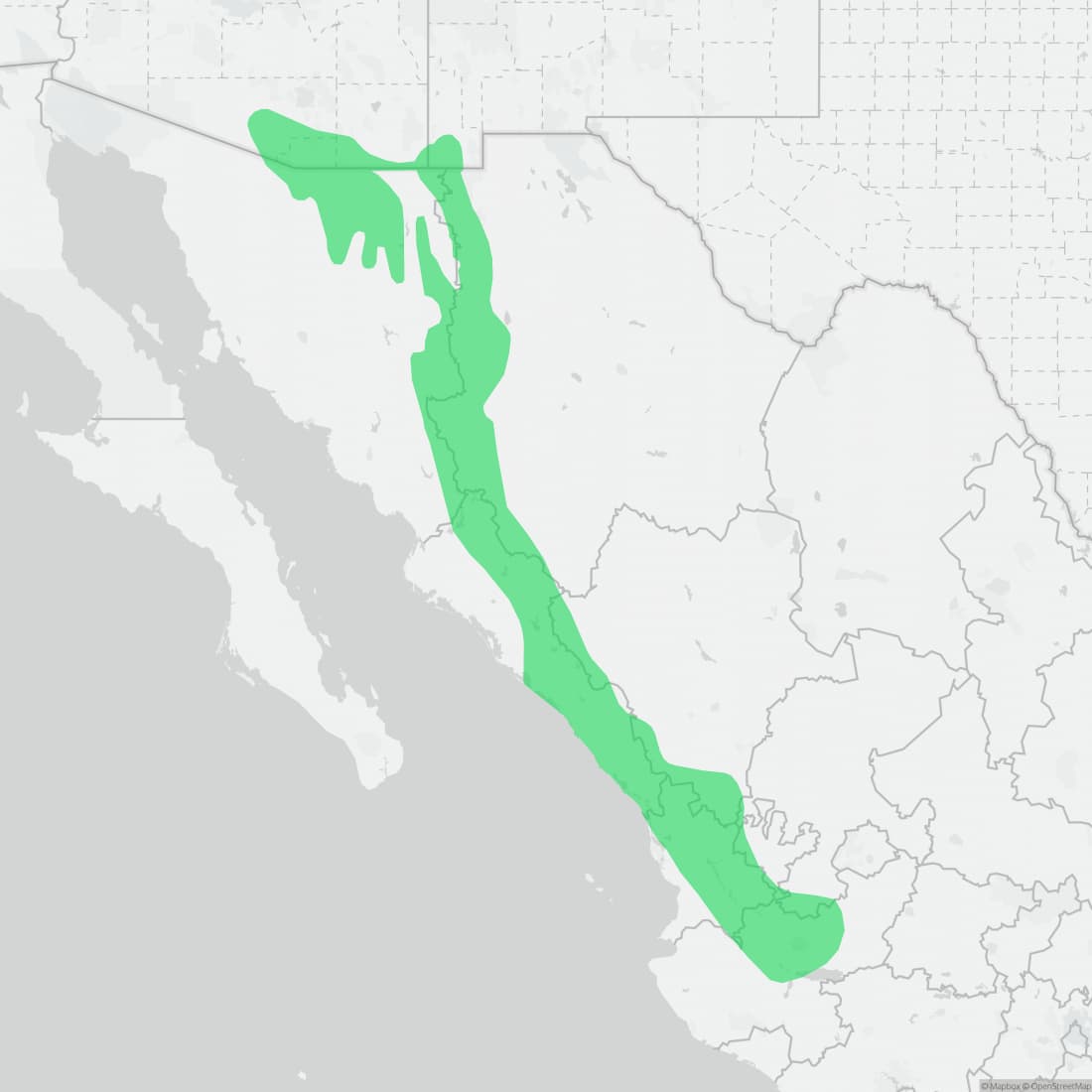
Approximate range. © Mapbox © OpenStreetMap