Giant Garter Snake
Thamnophis gigas
This largest species of garter snake reaches 3-5.4 feet in length. It has mildly keeled scales and distinct pattern of 3 light longitudinal stripes running from the neck…
How to identify
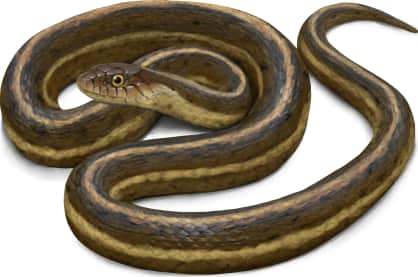
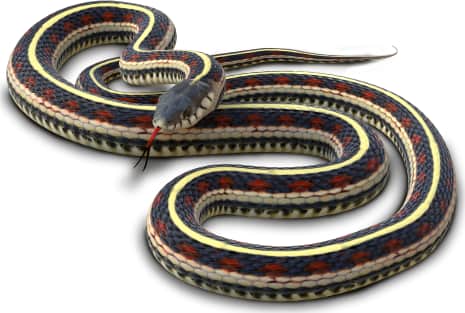
This largest species of garter snake reaches 3-5.4 feet in length. It has mildly keeled scales and distinct pattern of 3 light longitudinal stripes running from the neck to the tip of the tail on a dark background. The central stripe over the spine is brighter, while the 2 lateral stripes are more faded. It has broad jaws and a distinct neck. Its eyes are somewhat large with round pupils. Ventrum is pale and unmarked and tinted the same color as the stripes. Juveniles lack the distinct stripes which become brighter with age. This species is mildly venomous, but virtually harmless to humans.
Range
Found in central California between the Coastal and Sierra Nevada mountain ranges.
Habitat
A semi-aquatic species that prefers wetland habitats. Due to habitat loss, it is now often found in artificial wetlands made for growing rice. They are only found near still or slow-moving water with emergent vegetation. On land, they spend much of their time burrowed underground or within leaf litter. They avoid open or rocky habitats.
Variations
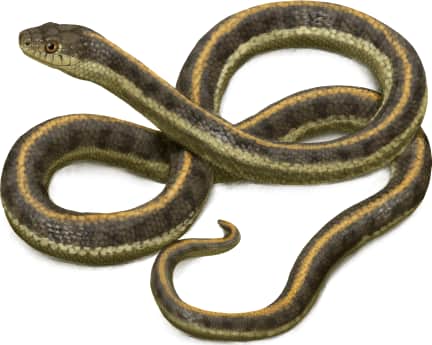
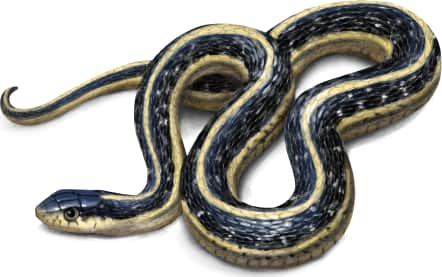
Background color ranges from olive to dark brown to black. Stripes range from cream to yellow to orange. Rarely the stripes are absent and checkered patterns have been observed.
Similar species
Most similar to the aquatic garter snake (*Thamnophis atratus*) which ranges further west and north, or the western terrestrial garter snake (*Thamnophis elegans*) which may overlap in range. It is much larger than the common garter snake (*Thamnophis sirtalis*) which may also overlap.
Name and etymology
Genus
Thamnophis
Greek for bush (thamnos) snake (ophis).
Origin
Sources
- Fitzinger, 1843. Syst. Rept., p. 26 ↗
Thamnophis. Fitzinger, 1843 - Syst. Rept., p. 26
Species epithet
gigas
Latin for giant.
Origin
Sources
- Fitch, 1940. Univ. California Publ. Zool., Vol. 44, p. 69 ↗
Thamnophis gigas. Fitch, 1940 - Univ. California Publ. Zool., Vol. 44, p. 69
Explore more names in the etymology index.
At a glance
Range
Found in central California between the Coastal and Sierra Nevada mountain ranges.
Habitat
A semi-aquatic species that prefers wetland habitats. Due to habitat loss, it is now often found in artificial wetlands made…
Guide
Reptiles and Amphibians of North America
Range map
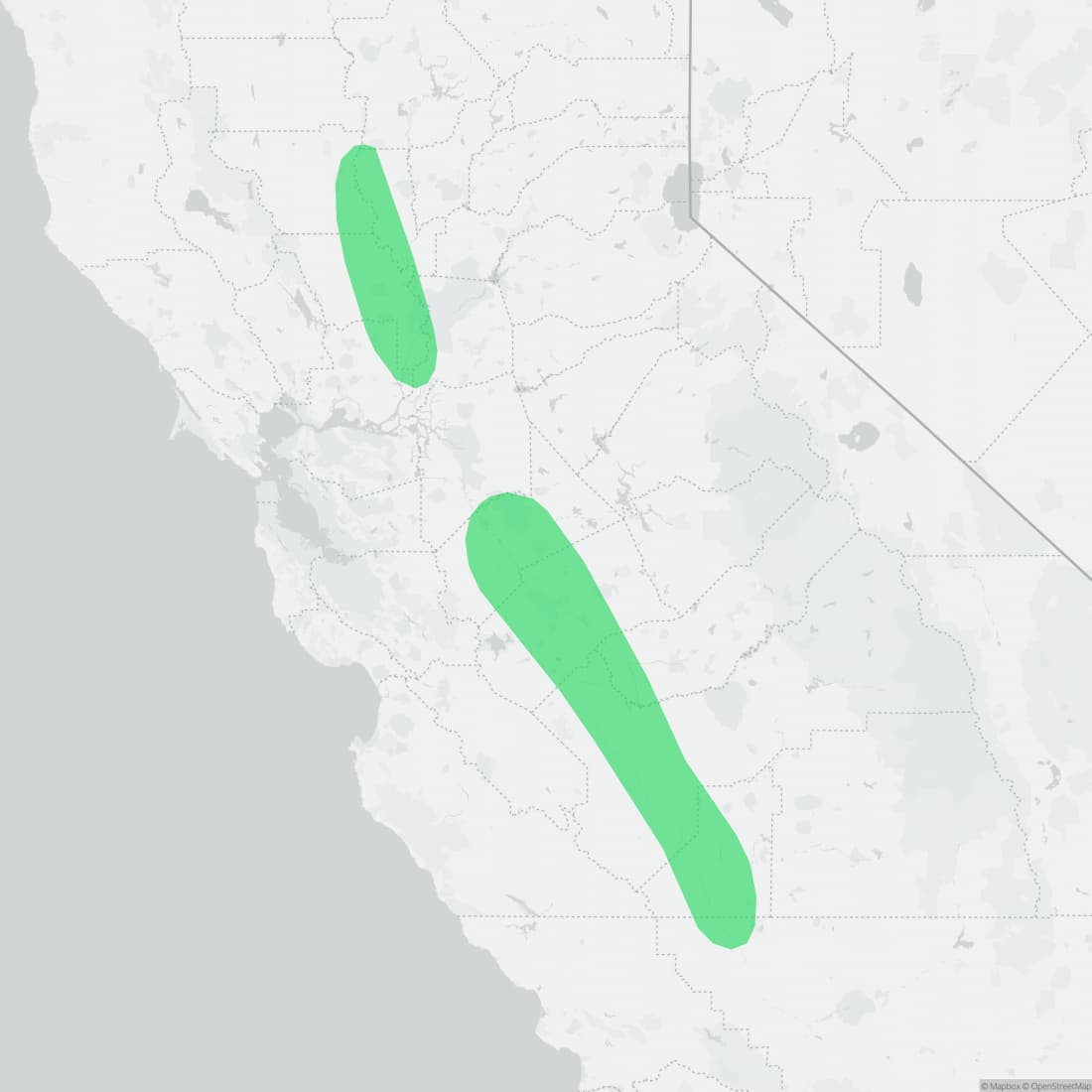
Approximate range. © Mapbox © OpenStreetMap