Patch-nosed Salamander
Urspelerpes brucei
A very small, slender salamander reaching just 2.5 cm in snout to vent length, with a laterally compressed tail of about the same length. It is named for a patch of pale…
How to identify
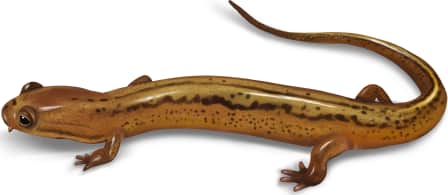
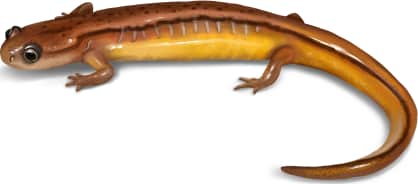
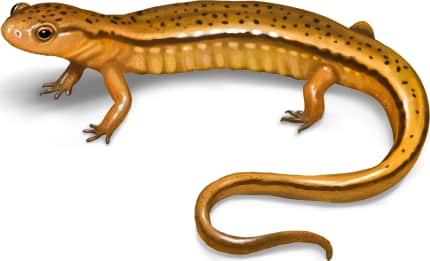
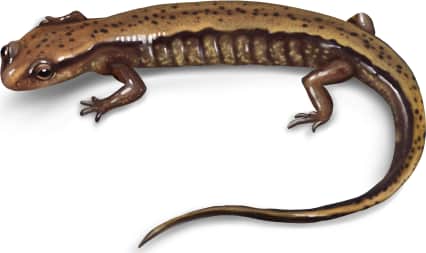
A very small, slender salamander reaching just 2.5 cm in snout to vent length, with a laterally compressed tail of about the same length. It is named for a patch of pale coloration on the top of its snout between its eyes, which is more distinguishable on light grey juveniles. Adults are yellow/orange or greenish brown with a yellowish nose patch, and a bright yellow stripe on the dorsal edge of the tail. It has a small head with large, bulging eyes, and its legs are skinny. Its ventrum is yellow and unmarked.
Range
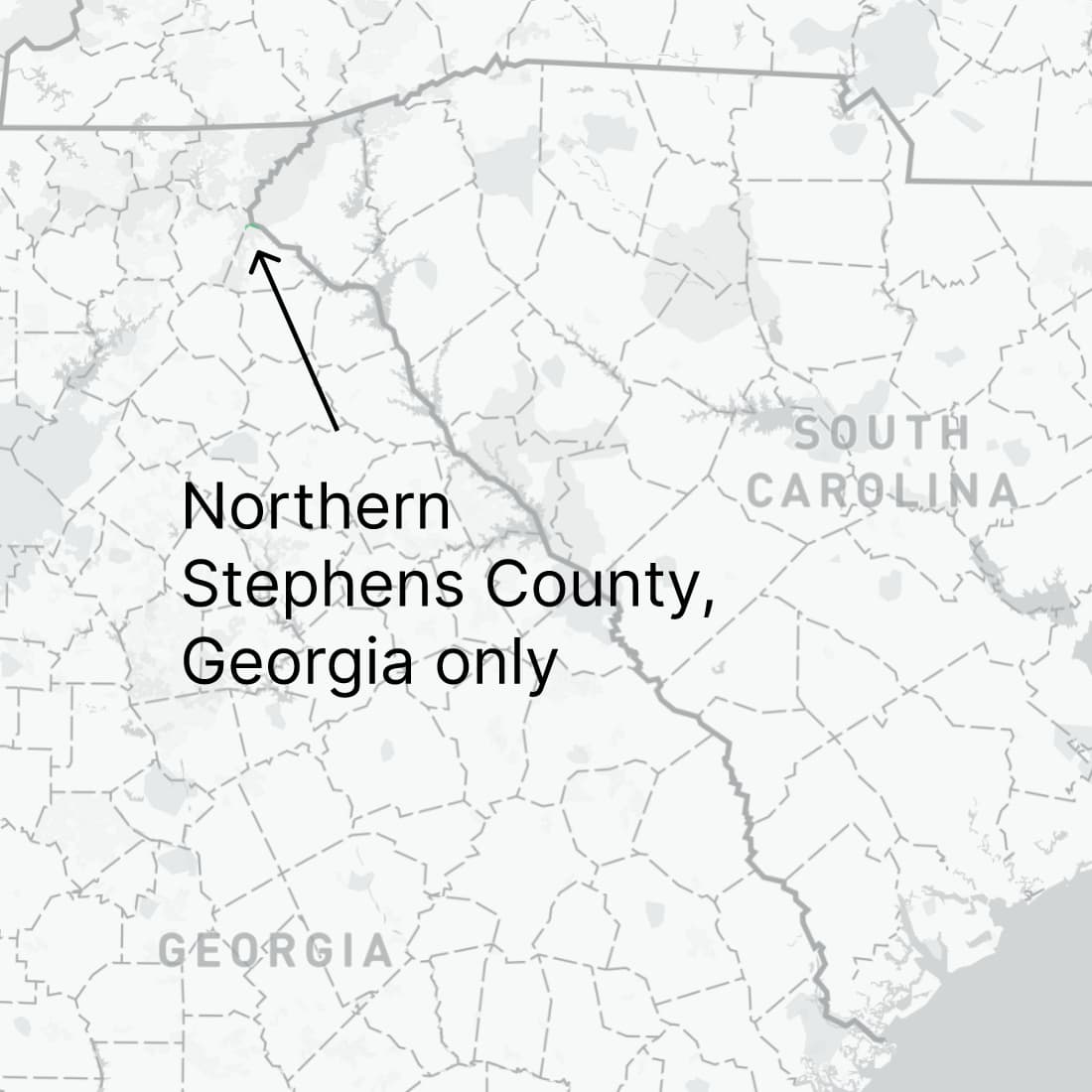
Extremely small range on the border of Georgia and South Carolina, at the northeastern corner of Georgia.
Habitat
Little is known about this rare species. It has been found hiding under rocks or leaf litter on the banks of first-order streams. It is thought to spend a good amount of time underground.
Variations
Males have a bright yellow back with dark dorsolateral lines and a broken central line, mental glands, and nasal cirri. Females are a more uniform muddy yellow color.
Similar species
Most similar in appearance to the Chamberlain's dwarf salamander (*Eurycea chamberlaini*), southern two-lined salamander (*Eurycea cirrigera*), or brown-backed salamander (*Eurycea aquatica*).
Name and etymology
Genus
Urspelerpes
Meaning original (German - ur) cave creeper (Greek - spelerpes).
Origin
Sources
- Wikipedia: Urspelerpes brucei ↗
“Urspelerpes brucei.” Wikipedia. https://en.wikipedia.org/wiki/Urspelerpes
Species epithet
brucei
Honoring Richard Bruce.
Origin
Honors
Sources
- Wikipedia: Urspelerpes brucei ↗
“Urspelerpes brucei.” Wikipedia. https://en.wikipedia.org/wiki/Urspelerpes
Explore more names in the etymology index.
More illustrations
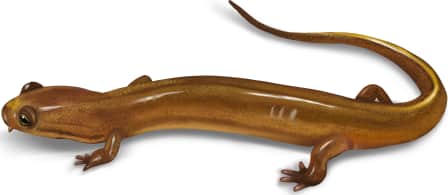
Female Patch-nosed Salamander
At a glance
Range
Extremely small range on the border of Georgia and South Carolina, at the northeastern corner of Georgia.
Habitat
Little is known about this rare species. It has been found hiding under rocks or leaf litter on the banks of first-order stre…
Guide
Reptiles and Amphibians of North America
Range map
Approximate range. © Mapbox © OpenStreetMap