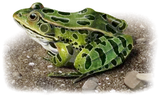
African Clawed Frog
Xenopus laevis
These are toothless, tongueless frogs that are completely aquatic. These frogs have claws that are designed for feeding. They have a flattened body and a wedge-shaped hea…
How to identify
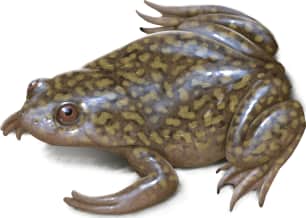
These are toothless, tongueless frogs that are completely aquatic. These frogs have claws that are designed for feeding. They have a flattened body and a wedge-shaped head. They do not have eyelids and the eyes are located on the top of the head. It had unwebbed forefeet but the hind feet are ebbed and large. The skin is smooth and slippery with a multicolored background and blotches of brown or olive-gray and plain gray. The back has lateral lines. The underside is a creamy white with a yellowish tinge. They suck the food into their mouths through a hyobranchial pump. Xenopus laevis do not possess external eardrums, instead, they have subcutaneous cartilaginous disks that provide the same uses. There is sexual dimorphism in this species because the males are 20% smaller than females (average length of 2-2.4 inches) and have slim legs and bodies. The females appear plumper (average length of 4.7 inches) and have bulges just above the hind legs – this is where the eggs are internally located.
Range
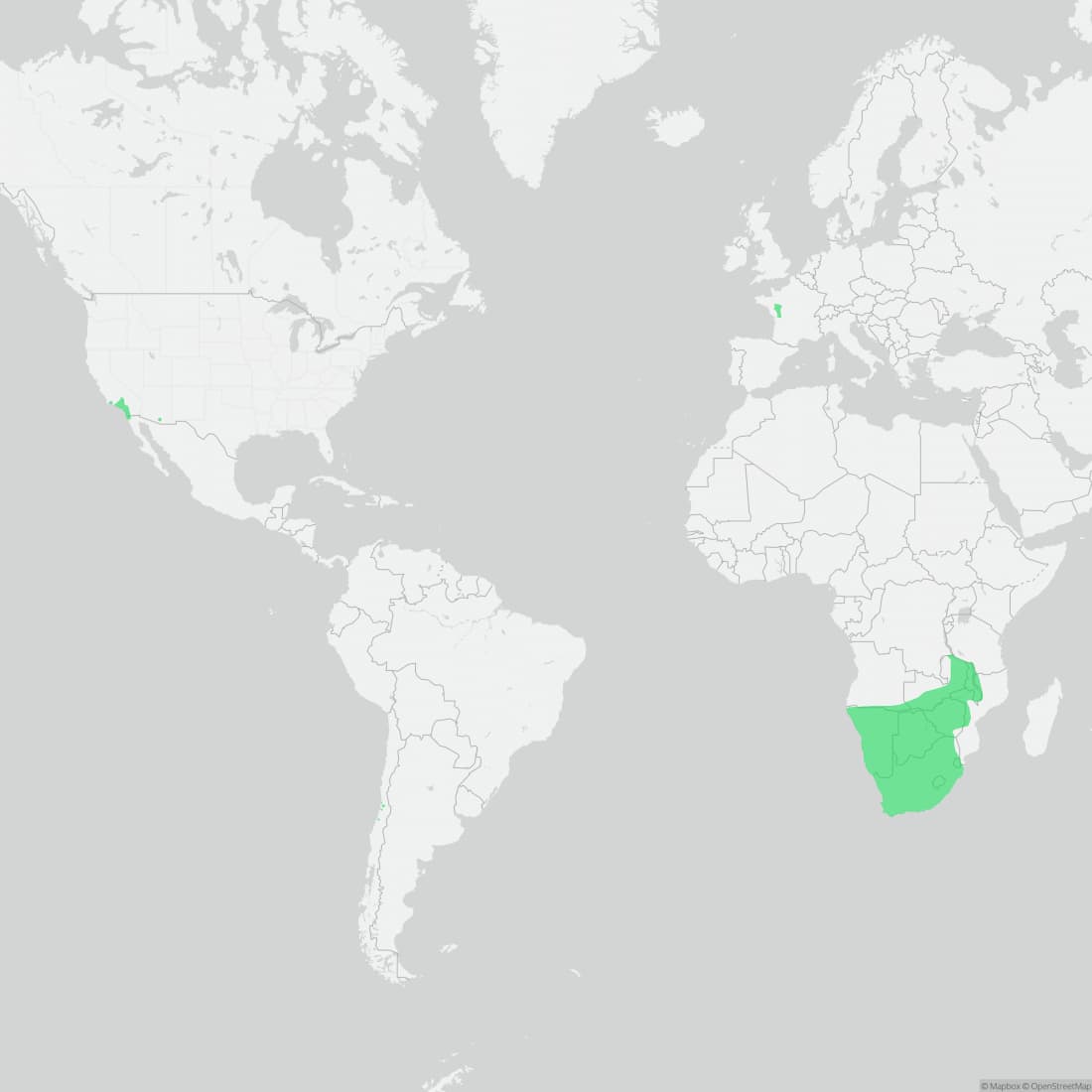
This frog can be found through most of Sub-Saharan Africa including Nigeria, Sudan, and South Africa. They were introduced in North America, South America, and Europe.
Habitat
They thrive in stagnant ponds with warm temperatures. The ponds typically do not have higher plant vegetation and are full of green algae. Xenopus laevis can be found in temperatures between 60-80 degrees Fahrenheit. These frogs are completely aquatic and only leave the water when they have to migrate. Females attach their eggs to plants and other anchors underwater. These frogs are scavengers and eat almost any type of organic waste as well as anything that passes in front of it.
Similar species
The Congo dwarf clawed frog (Hymenochirus boettgeri) is one of the African dwarf frogs that are often mistaken for the African clawed frog. However, this frog has four webbed feet. The dwarf frog also has eyes positioned at the side of the head not at the top like the African clawed frog has. However, the coloration and claws are similar which may be the root of the misidentification. Western dwarf clawed frog (Hymenochirus curtipes) is small (at 0.9-1.1 inches in average snout-to-vent length). The females are larger and can reach a snout-to-vent length of up to 1.3 inches. The snout is pointed and the eyes are positioned upwards on the head. The forefeet are half webbed but the hind feet are completely webbed. Müller's platanna (Xenopus muelleri) has an average snout-to-vent length ranging between 1.5-2.4 inches. It has smooth skin and the hind feet have fully webbed with 3-5 horny claws. The females are larger than males. They have a dull olive coloration with black patches.
Name and etymology
Genus
Xenopus
Latin for strange (xeno) foot (-pus).
Origin
Sources
- Wikipedia: Xenopus ↗
“Xenopus.” Wikipedia. https://en.wikipedia.org/wiki/Xenopus
Species epithet
laevis
Latin for smooth.
Origin
Sources
- Wikipedia: Xenopus laevis ↗
“Xenopus laevis.” Wikipedia. https://en.wikipedia.org/wiki/African_clawed_frog
Explore more names in the etymology index.
At a glance
Size
5 to 12 cm
Range
This frog can be found through most of Sub-Saharan Africa including Nigeria, Sudan, and South Africa. They were introduced in…
Habitat
They thrive in stagnant ponds with warm temperatures. The ponds typically do not have higher plant vegetation and are full of…
Range map
Approximate range. © Mapbox © OpenStreetMap