Black-tailed Jackrabbit
Lepus californicus
L. californicus is a large jackrabbit with grayish-brown fur. The key identifying feature is the prominent black stripe that runs along the top of the tail, extending ont…
How to identify
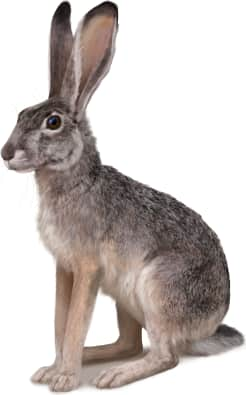
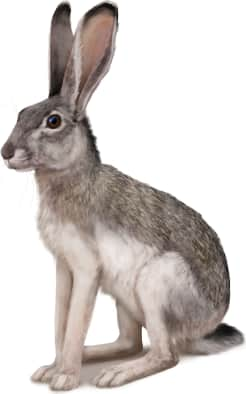
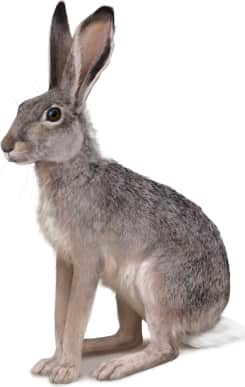
L. californicus is a large jackrabbit with grayish-brown fur. The key identifying feature is the prominent black stripe that runs along the top of the tail, extending onto the rump. The ears are very long, and the insides of the ears are white with black tips. They have powerful hind legs adapted for running and leaping.
Range
L. californicus is widely distributed throughout the western United States and Mexico. Its range extends from Oregon and Washington south through California, Nevada, Utah, Arizona, New Mexico, Texas, and into Baja California and other parts of Mexico.
Habitat
L. californicus inhabits a variety of open habitats, including grasslands, deserts, scrublands, and agricultural areas. They prefer areas with sparse vegetation and open spaces for running and avoiding predators.
Similar species
L. callotis (White-sided Jackrabbit) overlaps in parts of its range. L. californicus is distinguished by the black stripe on the tail, which L. callotis lacks. L. townsendii (White-tailed Jackrabbit) can also overlap in some areas, but L. californicus does not turn white in winter and has a black stripe on the tail.
Name and etymology
Genus
Lepus
Latin for hare
Origin
Sources
- Palmer, Index Generum Mammalium (1904) ↗
Palmer, T. S. 1904. Index Generum Mammalium: a list of the genera and families of mammals. North American Fauna 23. Government Printing Office, Washington. https://doi.org/10.5962/bhl.title.39809
Species epithet
californicus
Latin for of California
Origin
Sources
- Wikipedia: Lepus californicus ↗
“Lepus californicus.” Wikipedia. https://en.wikipedia.org/wiki/Black-tailed_jackrabbit
Explore more names in the etymology index.
At a glance
Range
L. californicus is widely distributed throughout the western United States and Mexico. Its range extends from Oregon and Wash…
Habitat
L. californicus inhabits a variety of open habitats, including grasslands, deserts, scrublands, and agricultural areas. They…
Guide
Mammals of North America