
American Pika
Ochotona princeps
O. princeps is a small lagomorph, typically measuring 16-21 cm in length and weighing between 120 and 170 grams. They have a compact body, rounded ears, and a short, inco…
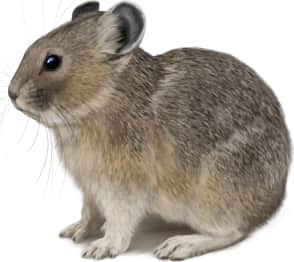
How to identify
O. princeps is a small lagomorph, typically measuring 16-21 cm in length and weighing between 120 and 170 grams. They have a compact body, rounded ears, and a short, inconspicuous tail. Their fur is grayish-brown, providing excellent camouflage among the rocks. They lack the long ears and powerful hind legs characteristic of rabbits and hares. A key identifying feature is their high-pitched "pip" call, which is often used as an alarm call.
Range
O. princeps is found in mountainous regions of western North America, from southern British Columbia and Alberta in Canada, south through the mountains of the western United States, including the Cascades, Rocky Mountains, and Sierra Nevada. Their distribution is fragmented, limited to isolated patches of suitable high-elevation habitat.
Habitat
O. princeps inhabits rocky slopes, talus fields, and alpine meadows at high elevations, typically above the tree line. They require areas with abundant crevices and spaces between rocks for shelter and nesting. These rocky habitats provide protection from predators and offer microclimates that buffer against extreme temperature fluctuations.
Similar species
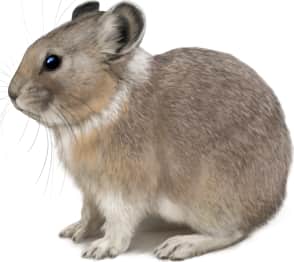
In areas where their ranges overlap, O. princeps could potentially be confused with O. collaris (Collared Pika). However, O. collaris typically has a more distinct pale collar around its neck, especially in summer pelage. Subtle differences in skull morphology and vocalizations also exist. Other small mammals inhabiting similar rocky environments, such as voles or chipmunks, are easily distinguished by their longer tails and different body proportions.
Name and etymology
Genus
Ochotona
Mongolian (ochodona) for pikas
Origin
Sources
- Palmer, Index Generum Mammalium (1904) ↗
Palmer, T. S. 1904. Index Generum Mammalium: a list of the genera and families of mammals. North American Fauna 23. Government Printing Office, Washington. https://doi.org/10.5962/bhl.title.39809
Species epithet
princeps
Latin for chief (primus)
Origin
Sources
- Wikipedia: Ochotona princeps ↗
“Ochotona princeps.” Wikipedia. https://en.wikipedia.org/wiki/American_pika
Explore more names in the etymology index.
At a glance
Range
O. princeps is found in mountainous regions of western North America, from southern British Columbia and Alberta in Canada, s…
Habitat
O. princeps inhabits rocky slopes, talus fields, and alpine meadows at high elevations, typically above the tree line. They r…
Guide
Mammals of North America
Range map
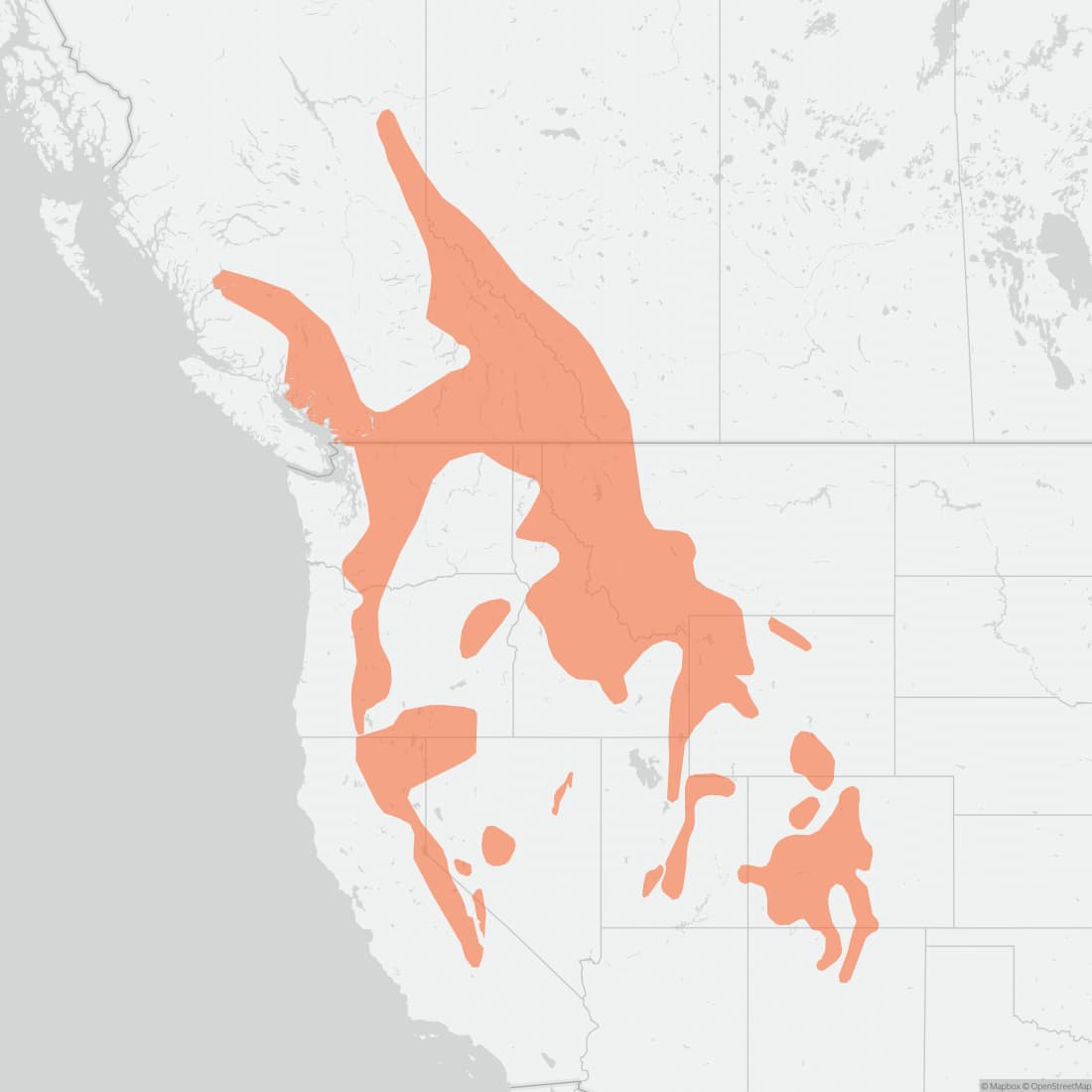
Approximate range. © Mapbox © OpenStreetMap