
New England Cottontail
Sylvilagus transitionalis
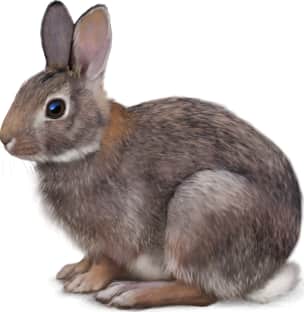
S. transitionalis is a medium-sized cottontail, slightly smaller than the Eastern Cottontail. They have grayish-brown fur with a white underside and a rusty-brown patch o…
How to identify
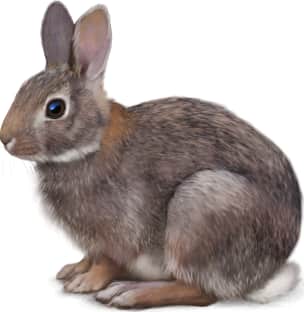
S. transitionalis is a medium-sized cottontail, slightly smaller than the Eastern Cottontail. They have grayish-brown fur with a white underside and a rusty-brown patch on the nape of the neck. The ears are relatively long, and the tail is short and fluffy white. Distinguishing them from Eastern Cottontails can be difficult, often requiring skull measurements or genetic analysis.
Range
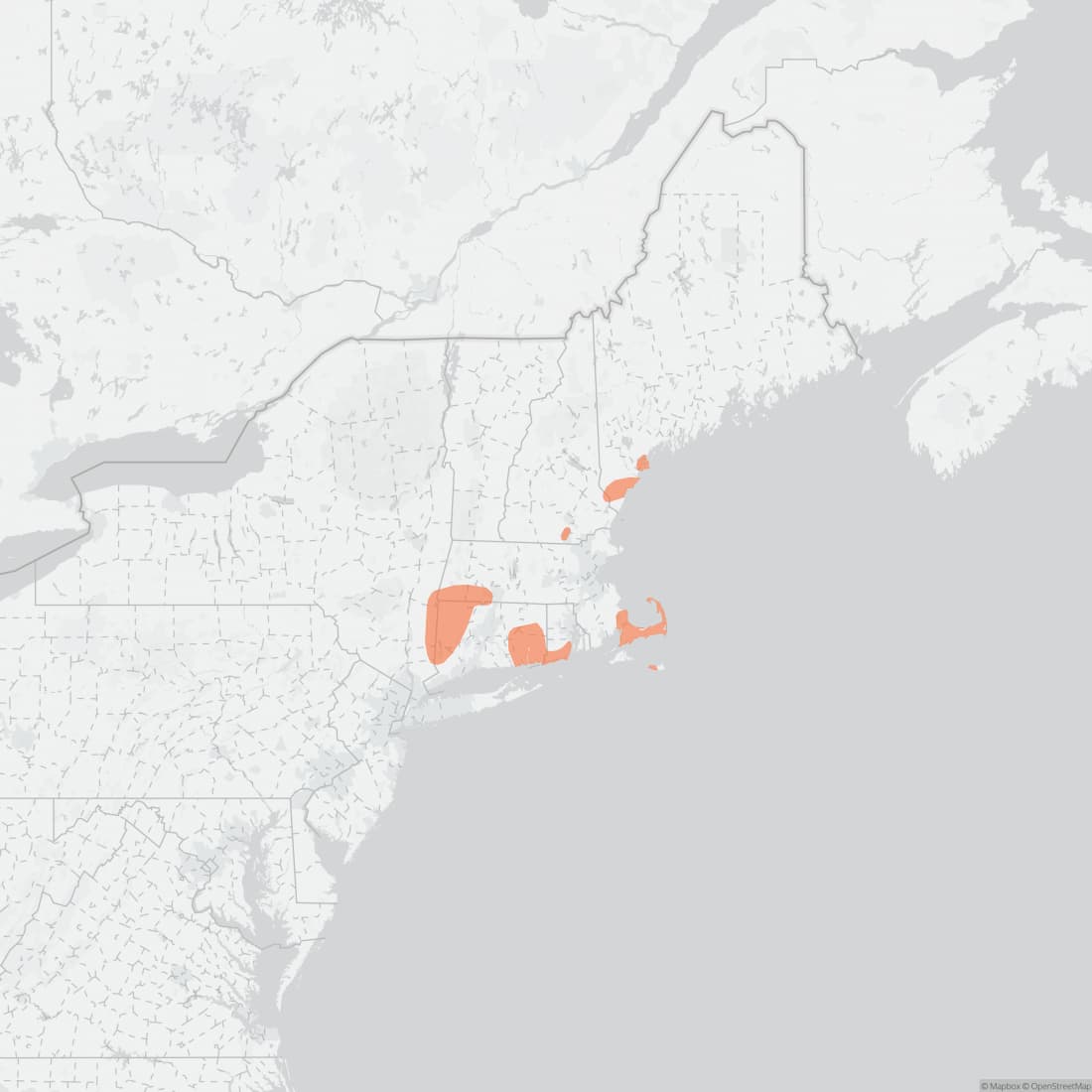
S. transitionalis has a restricted distribution in the northeastern United States, including parts of Maine, New Hampshire, Massachusetts, Connecticut, Rhode Island, and southeastern New York.
Habitat
S. transitionalis prefers dense, shrubby thickets, early successional forests, and areas with dense undergrowth. They require thick cover for protection from predators and nesting sites. These habitats are often found in areas recovering from logging or other disturbances.
Similar species
The primary similar species is S. floridanus (Eastern Cottontail), which overlaps significantly in range. Subtle differences in skull morphology, such as the shape of the nasal bones, are used for definitive identification. Habitat preferences can also be helpful, as S. transitionalis prefers dense thickets and early successional forests.
Name and etymology
Genus
Sylvilagus
Latin for forest (silva) and Greek for hare (lagos_
Origin
Sources
- Palmer, Index Generum Mammalium (1904) ↗
Palmer, T. S. 1904. Index Generum Mammalium: a list of the genera and families of mammals. North American Fauna 23. Government Printing Office, Washington. https://doi.org/10.5962/bhl.title.39809
Species epithet
transitionalis
Latin for transition
Origin
Sources
- Wikipedia: Sylvilagus transitionalis ↗
“Sylvilagus transitionalis.” Wikipedia. https://en.wikipedia.org/wiki/New_England_cottontail
Explore more names in the etymology index.
At a glance
Range
S. transitionalis has a restricted distribution in the northeastern United States, including parts of Maine, New Hampshire, M…
Habitat
S. transitionalis prefers dense, shrubby thickets, early successional forests, and areas with dense undergrowth. They require…
Guide
Mammals of North America
Range map
Approximate range. © Mapbox © OpenStreetMap