Northern Cottonmouth
Agkistrodon piscivorus
Venomous. Venom may be fatal to humans. Adult length 26-35 inches, occasionally up to 71 inches long in eastern range. Broad triangular head with blunt snout. Pupils vert…
How to identify
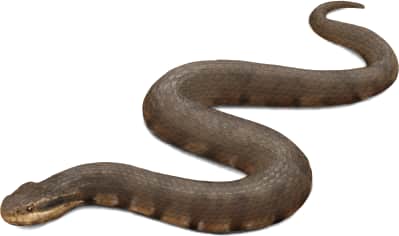
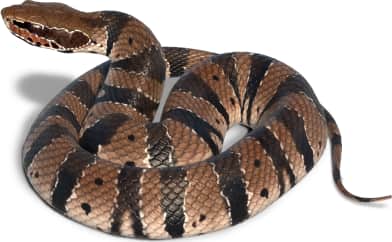
Venomous. Venom may be fatal to humans. Adult length 26-35 inches, occasionally up to 71 inches long in eastern range. Broad triangular head with blunt snout. Pupils vertical & cat-like. Heat-sensing pits between eyes and under nostrils. Coloration varies from yellow to olive to black with dark dumbbell-shaped cross bands. Outer edges of bands are darker than center, bands on tail are completely black in color. Markings fade to solid color in adulthood. Inside of mouth is cream colored, from where the common name is derived. Ventral side cream colored with patterns of black varying from patches to streaks. Also known as water moccasins.
Range
Southeastern United States. Range extends west to Texas, east to the Atlantic Ocean, south to Florida, and north to Indiana.
Habitat
Semi-aquatic. Found in lowland habitats including swamps, marshes, ditches, streams, rivers, forests, grasslands, and ponds. Often find cover under foliage, grasses, or man-made shelters like boards. Adults not typically found far from water sources, however juveniles may be found a distance from water.
Variations
Males: Considerably larger than females. Juveniles: Patterns much more visible and with striking coloration, much more vibrant than adults. Bright yellow tail tips.
Similar species
Name and etymology
Genus
Agkistrodon
Greek for fishhook (ankistron) tooth (odontos), referencing curved fangs.
Origin
Sources
- Palisot de Beauvois, 1799. Trans. Amer. Philos. Soc., Vol. 4, p. 381 ↗
Agkistrodon. Palisot de Beauvois, 1799 - Trans. Amer. Philos. Soc., Vol. 4, p. 381
Species epithet
piscivorus
Latin for fish (piscis) eater (voro).
Origin
Sources
- (Lacepede, 1789). Hist. Nat. Serp., Vol. 2, table meth. p. 130
Agkistrodon piscivorus. (Lacepede, 1789) - Hist. Nat. Serp., Vol. 2, table meth. p. 130
Explore more names in the etymology index.
More illustrations
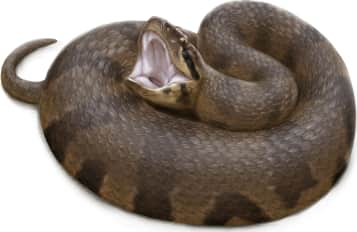
Cottonmouth showing it's "cotton" mouth
At a glance
Size
66 to 188 cm
Range
Southeastern United States. Range extends west to Texas, east to the Atlantic Ocean, south to Florida, and north to Indiana.
Habitat
Semi-aquatic. Found in lowland habitats including swamps, marshes, ditches, streams, rivers, forests, grasslands, and ponds.…
Range map
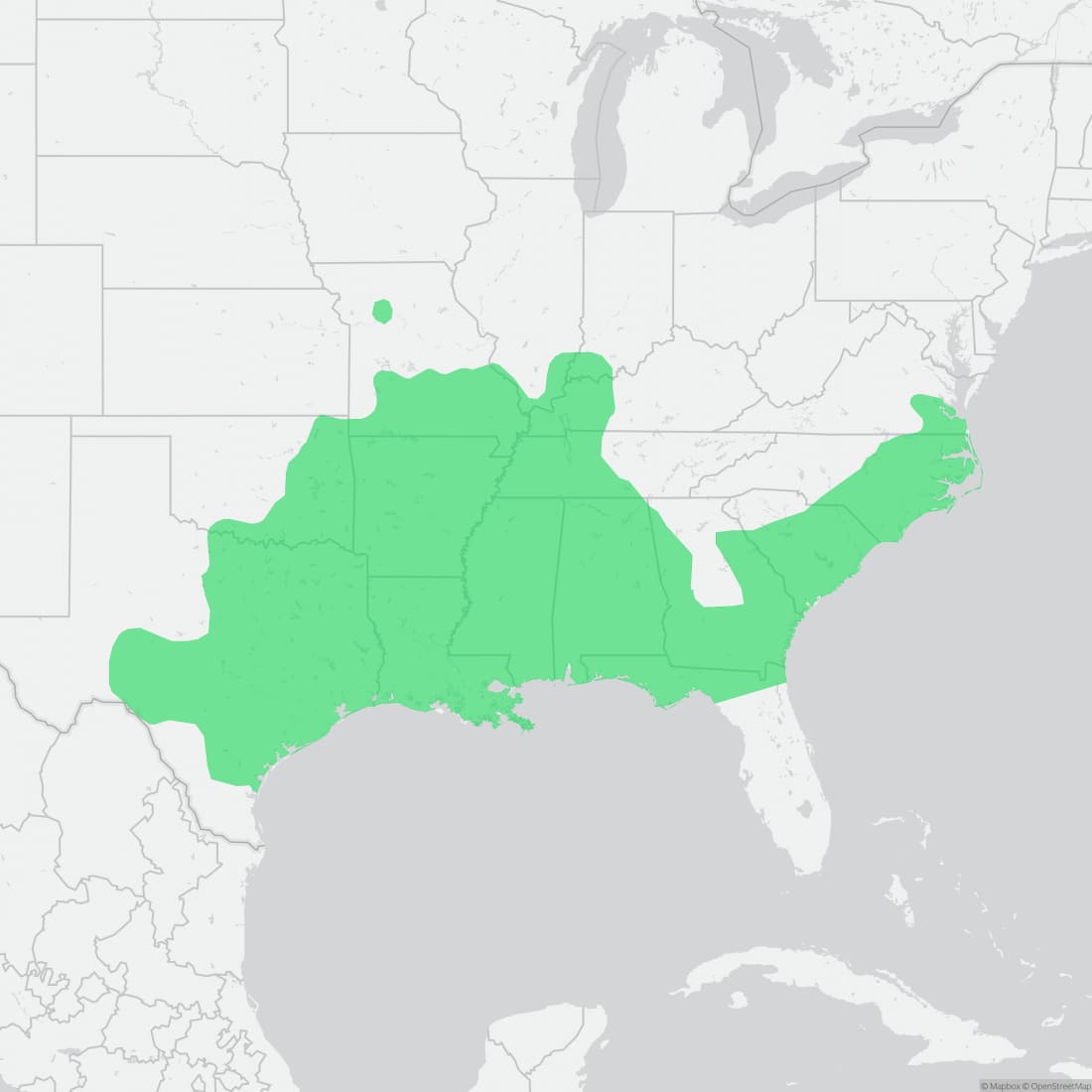
Approximate range. © Mapbox © OpenStreetMap