Tiger Salamander
Ambystoma tigrinum
A ‘mole’ species, this particular amphibian is identified chiefly by its size and coloring. Adults are dark-skinned and striped with the (yellow or olive) bars that give…
How to identify
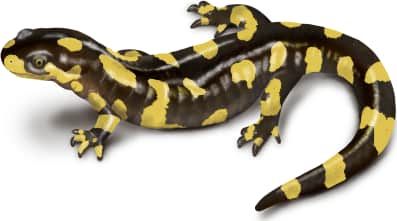
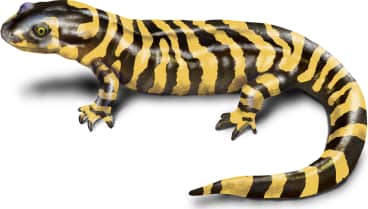
A ‘mole’ species, this particular amphibian is identified chiefly by its size and coloring. Adults are dark-skinned and striped with the (yellow or olive) bars that give the species its name. Usually 6 to 8 inches long, they have broad heads, bulging eyes, and 4 legs with 5 toes on each foot. Larvae and juveniles are tiny, almost transparent, and legless. They have external gills in the form of long, feathery plumes that extract oxygen from the water.
Range
Eastern tiger salamanders can be found, appropriately enough, in the east. Aside from a handful of states in which they’re noticeably absent (NY, VA, PA, WV, MA, CT, RI, VT, NH, MN, NB, LA, AK, MI ) this species lives in thick profusion across what basically amounts to North America’s entire eastern seaboard. They are more populous in some states than others, though, likely due to human disturbance.
Habitat
As a rule, tiger salamanders prefer forested areas with running fresh water and thick, moist soil. Their larval forms, being entirely aquatic, grow and develop in ponds, streams and roadside ditches – anywhere likely to have a fresh water supply. As adults, they’re fossorial, spending most of their lives in burrows that can reach as deep as two feet underground.
Variations
Males are proportionally longer, w/ a more compressed tail and stalk-like hind legs.
Similar species
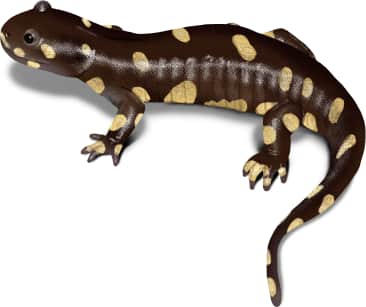
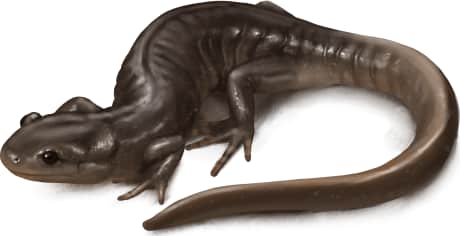
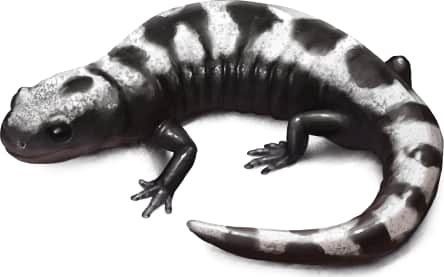
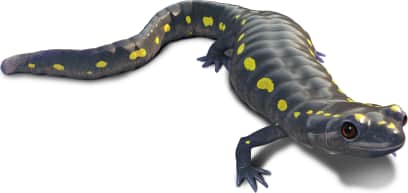
Several other species are easily confusable for your basic tiger salamander. They include - The Jefferson Salamander, Ambystoma Jeffersonianum The Marbled Salamander, Ambystoma opacum The Northern Dusky Salamander, Desmognathus fuscus The Spotted Salamander, Ambystoma maculatum It also has a few subspecies and close relatives, like: Blotched Tiger Salamander: Ambystoma mavortium ssp. melanostictum California Tiger Salamander: Ambystoma californiense Mexican Tiger Salamander: Ambystoma velasci Plateau Tiger Salamander: Ambystoma subsalsum Western Tiger Salamander: Ambystoma mavortium
Name and etymology
Genus
Ambystoma
Greek phrase meaning "to cram into the mouth".
Origin
Sources
- Tschudi, "1838" 1839. Classif. Batr., Mem. Soc. Sci. Nat. Neuchatel, p. 92 ↗
Ambystoma. Tschudi, "1838" 1839 - Classif. Batr., Mem. Soc. Sci. Nat. Neuchatel, p. 92
Species epithet
tigrinum
Latin for tiger.
Origin
Sources
- Baird, 1850. Journ. Acad. Nat. Sci. Philadelphia, Ser. 2, No. 1, p. 284 and p. 292 ↗
Ambystoma tigrinum mavortium. Baird, 1850 - Journ. Acad. Nat. Sci. Philadelphia, Ser. 2, No. 1, p. 284 and p. 292
Explore more names in the etymology index.
At a glance
Range
Eastern tiger salamanders can be found, appropriately enough, in the east. Aside from a handful of states in which they’re no…
Habitat
As a rule, tiger salamanders prefer forested areas with running fresh water and thick, moist soil. Their larval forms, being…
Guide
Reptiles and Amphibians of North America
Range map
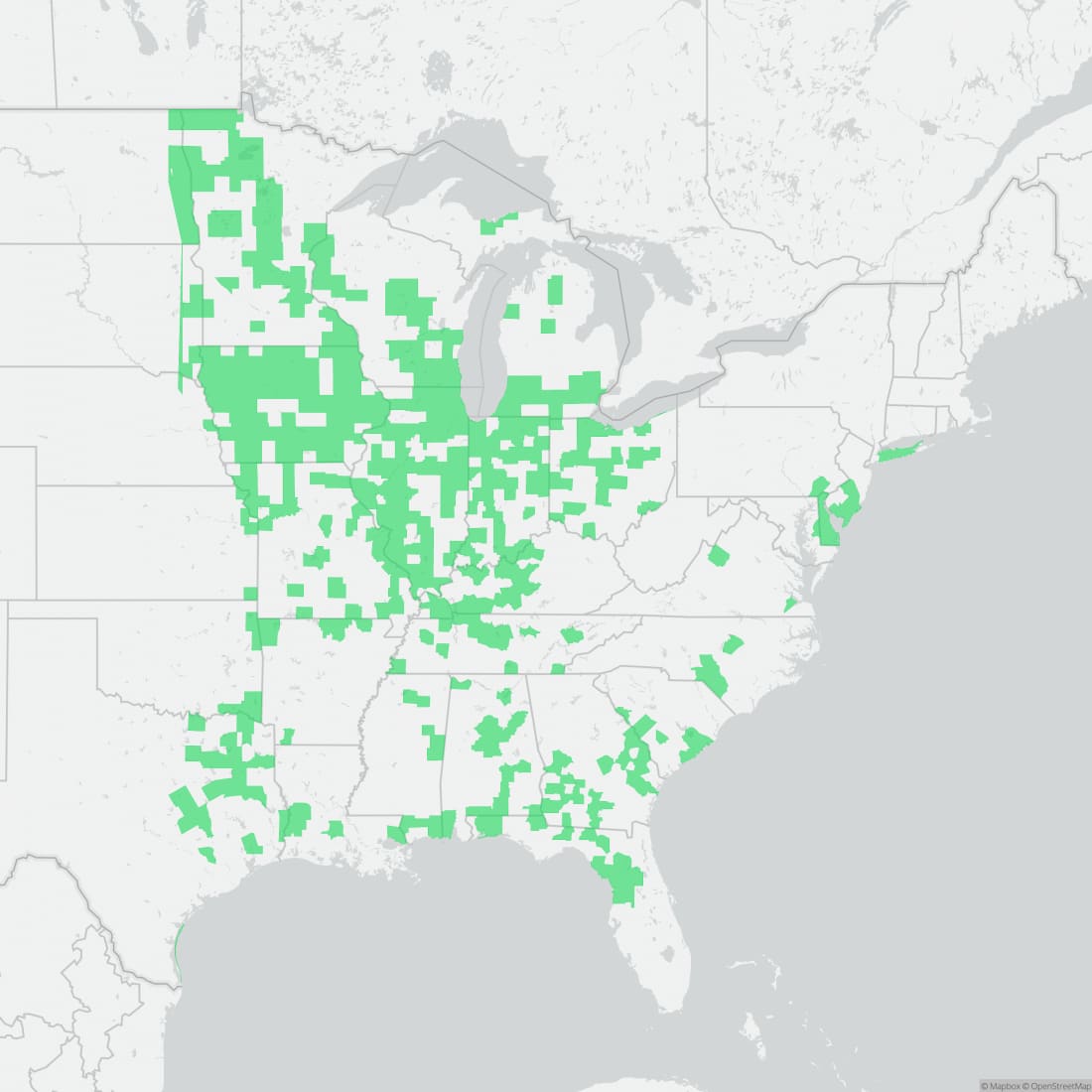
Approximate range. © Mapbox © OpenStreetMap