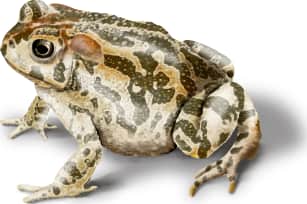
Great Plains Toad
Anaxyrus cognatus
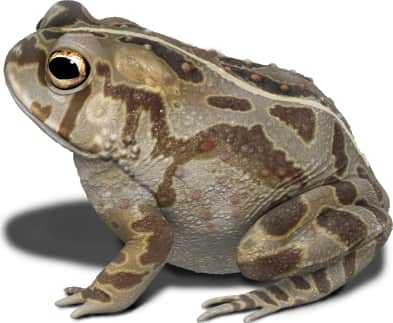
Skin has many small warts and upper surface relatively symmetrical pattern of large dark spots with light edges. Cranial crests, or hard ridges, prominent between eyes an…
How to identify
Skin has many small warts and upper surface relatively symmetrical pattern of large dark spots with light edges. Cranial crests, or hard ridges, prominent between eyes and come to hard lump on snout. Long parotid glands behind the eyes. One sharp-edged tubercle and one smaller dark-tipped tubercle commonly on underside of each hind foot. Average female up to 4.5 inches (11.4 cm) snout-vent length and adult male generally shorter at 3.7 inches (9.5 cm). During breeding season, males develop dark, loose throat skin and dark patches on the inner thumb. The expanded vocal sack can push upwards into face, and the breeding call is an extended trill or pulsating ringing. Larvae usually black and become pale with mottled brown and gray and eyes high on head with dorsal fin highly arched. Recently metamorphosed toadlets can be as small as 1 cm. Eggs usually in a single row encompassed by two-layered jelly to separate them from each other.
Range
Northern Mexico through southwestern United States to central Canada. Canada south as Manitoba and southeastern as Alberta; Mexico south to Aguascalientes and San Luis Potosi; United States east to western Minnesota and west to central Montana.
Habitat
Usually found in the lower, damper parts of shortgrass and tallgrass, prairies, desert mesquite, sandhills, and desert scrub. Commonly visit irrigation canals, flood plains of rivers, reservoirs, and flood plains of rivers where they breed. Males sit on the shoreline or latch on to plants to call females. Eggs and larvae develop in shallow, clear, water.
Variations
Male's mating call depends on its size and temperature; can also include nasal quacks that proceed trill. Adults mainly feed on ants and termites, however in New Mexico and Oklahoma, coleopterans are the most common pray eaten.
Similar species
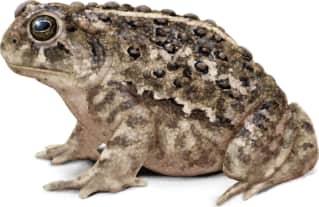
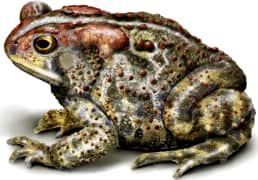
Eastern American Toad - Anaxyrus americanus americanus, Fowler's Toad - Anaxyrus fowleri, Woodhouse's Toad - Anaxyrus woodhousii woodhousii
Name and etymology
Genus
Anaxyrus
From Greek meaning a king or chief
Origin
Sources
- Laurenti, 1768. Syn. Rept., p. 25
Bufo. Laurenti, 1768 - Syn. Rept., p. 25
Species epithet
cognatus
Latin for related by blood
Origin
Sources
- Say, 1823.
Bufo cognatus. Say, 1823 -
Explore more names in the etymology index.
At a glance
Range
Northern Mexico through southwestern United States to central Canada. Canada south as Manitoba and southeastern as Alberta; M…
Habitat
Usually found in the lower, damper parts of shortgrass and tallgrass, prairies, desert mesquite, sandhills, and desert scrub…
Guide
Reptiles and Amphibians of North America
Range map
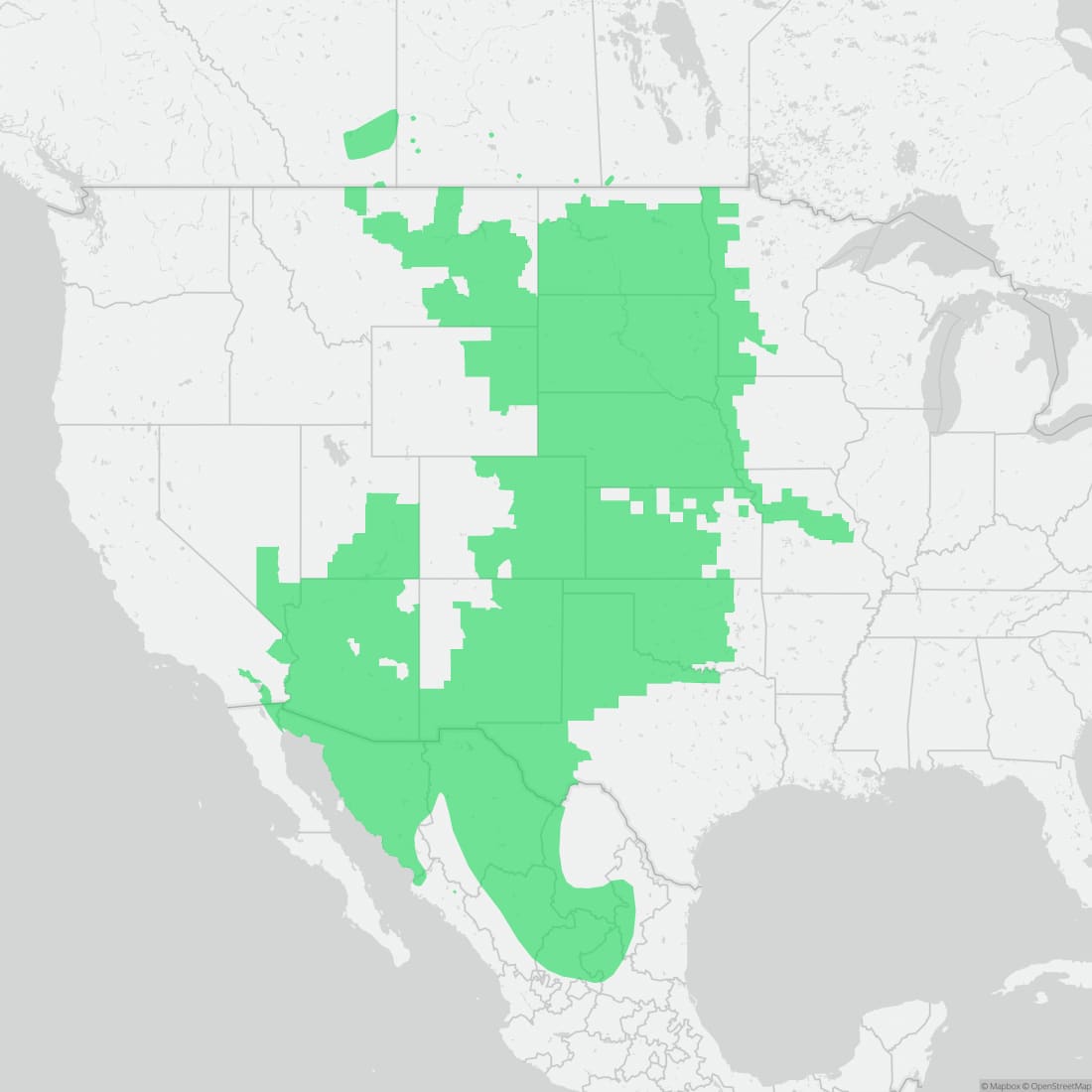
Approximate range. © Mapbox © OpenStreetMap