Hickory Nut Gorge Green Salamander
Aneides caryaensis
A. caryaensis is a slender salamander with a moderately flattened body, reaching a standard length of around 55mm for both males and females. The most distinguishing fea…
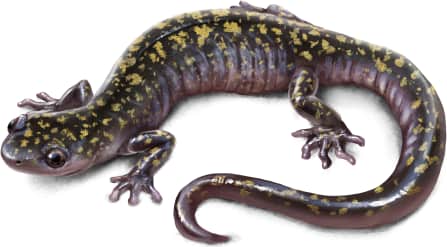
How to identify
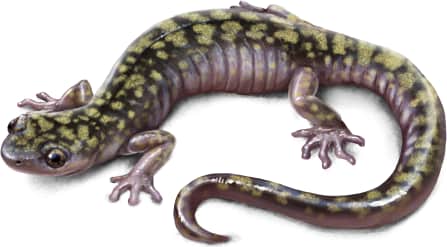
A. caryaensis is a slender salamander with a moderately flattened body, reaching a standard length of around 55mm for both males and females. The most distinguishing feature is its coloration. Unlike the more uniformly green A. aeneus, the Hickory Nut Gorge green salamander has a background color that can vary from brown to gray, overlaid with patches of bright green to yellowish-green pigment. These lichen-like patches tend to be smaller and more disconnected than those seen on A. aeneus.
Range
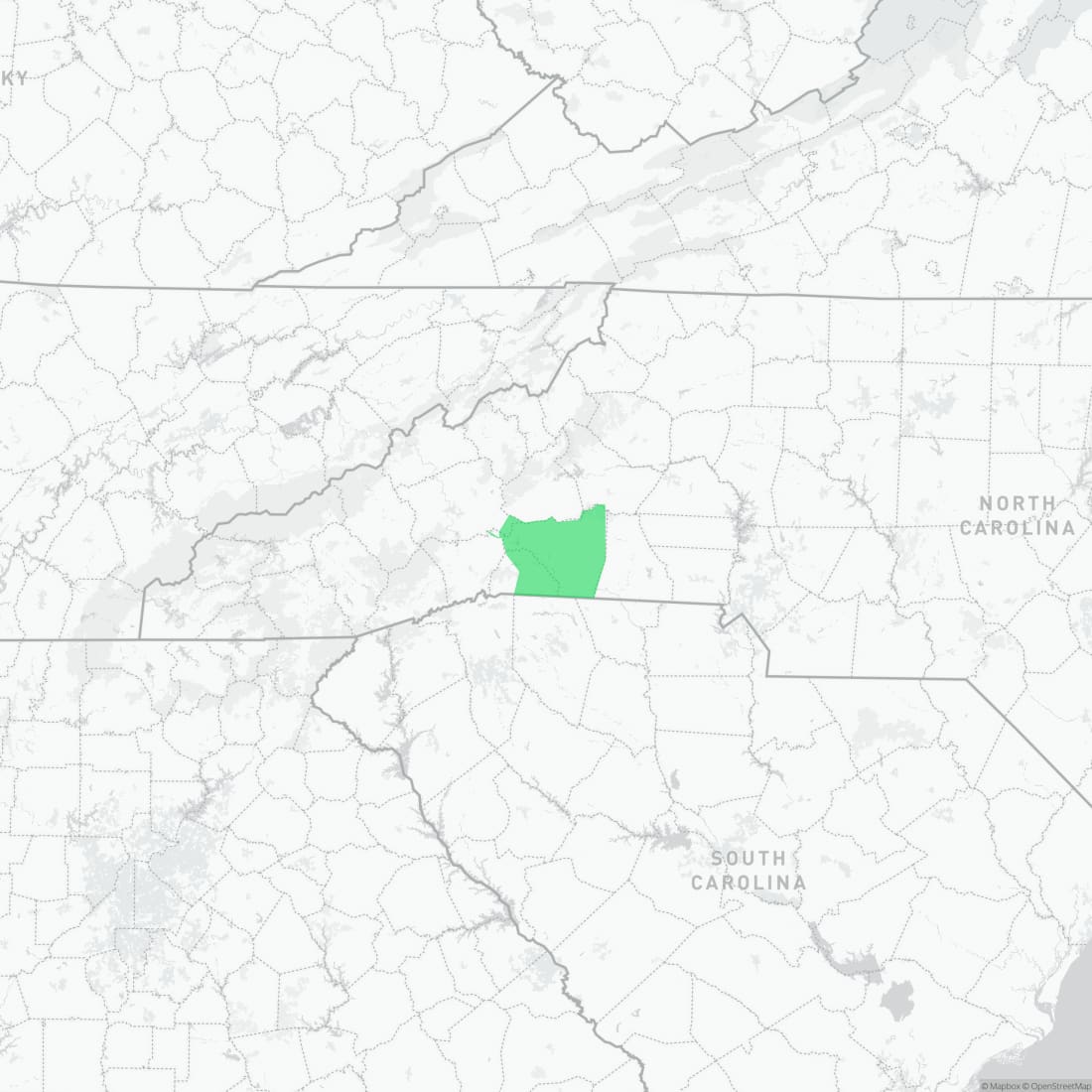
A. caryaensis is isolated to the Hickory Nut Gorge, a 14-mile-long gorge in Western North Carolina's Blue Ridge Mountains.
Habitat
A. caryaensis is a true cliff dweller, restricted to moist rock crevices and waterfalls within the Hickory Nut Gorge. They are most active at night and during wet weather, sheltering under rocks or leaf litter during dry periods.
Similar species
This recently described species was previously considered part of the widespread green salamander (Aneides aeneus), which can be distinguished by its more extensive and uniform green coloration.
Name and etymology
Genus
Aneides
Greek for lacking (an-) shape (eidos).
Origin
Sources
- Baird, 1849.
Aneides. Baird, 1849 -
Species epithet
caryaenis
Referencing the genus for Hickory trees; carya
Sources
- Wikipedia: Aneides caryaensis ↗
“Aneides caryaensis.” Wikipedia. https://en.wikipedia.org/wiki/Hickory_Nut_Gorge_green_salamander
Explore more names in the etymology index.
At a glance
Range
A. caryaensis is isolated to the Hickory Nut Gorge, a 14-mile-long gorge in Western North Carolina's Blue Ridge Mountains.
Habitat
A. caryaensis is a true cliff dweller, restricted to moist rock crevices and waterfalls within the Hickory Nut Gorge. They a…
Guide
Reptiles and Amphibians of North America
Range map
Approximate range. © Mapbox © OpenStreetMap