Eastern Diamondback Rattlesnake
Crotalus adamanteus
A very thick-bodied venomous snake with a distinct wide diamond pattern down the center of its back. Its tail ends in a rattle that ranges in color from tan to black. It…
How to identify
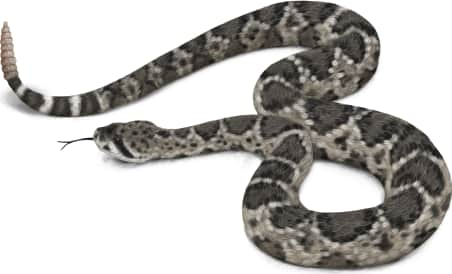
A very thick-bodied venomous snake with a distinct wide diamond pattern down the center of its back. Its tail ends in a rattle that ranges in color from tan to black. It has a large triangular head with wide jaws and a dark mask across its face. This dark mask is outlined with light diagonal lines on each side of the face. It has 2 heat-sensing pits on its snout, positioned between the eyes and mouth. The diamond pattern is tri-color; black with a brown center, outlined in white. They average 3-6 feet in length and 2-10 lbs in weight, but can grow to 8 feet in rare cases, and weigh as much as 15 lbs.
Range
From the southern coast of North Carolina south throughout Florida and west along the Gulf Coast to eastern Louisiana.
Habitat
Inhabits a wide variety of environments, including dry forests, sandy coastal areas, grassy marshes and swamps, mixed woodlands, and wet prairies. It will often hide in abandoned gopher and tortoise burrows during extreme temperatures.
Variations
Some are lighter and more vibrantly patterned, while others are much darker and their pattern blends into the background color.
Similar species
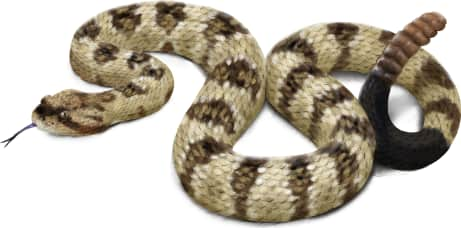
Most akin to the western diamondback rattlesnake (*Crotalus atrox*), eastern black-tailed rattlesnake (*Crotalus ornatus*), or western black-tailed rattlesnake (*Crotalus molossus*). None of these species overlap in range with the eastern diamondback.
Name and etymology
Genus
Crotalus
Greek for rattle (krotalon).
Origin
Sources
- Linnaeus, 1758. Syst. Nat., 10th ed., Vol. 1, p. 214 ↗
Crotalus. Linnaeus, 1758 - Syst. Nat., 10th ed., Vol. 1, p. 214
Species epithet
adamanteus
Greek for stubborn or unyielding.
Origin
Sources
- Palisot de Beauvois, 1799. Trans. Amer. Philos. Soc., Vol. 4, p. 368, figs. 1, 2 ↗
Crotalus adamanteus. Palisot de Beauvois, 1799 - Trans. Amer. Philos. Soc., Vol. 4, p. 368, figs. 1, 2
Explore more names in the etymology index.
At a glance
Size
1 to 2.4 m
Range
From the southern coast of North Carolina south throughout Florida and west along the Gulf Coast to eastern Louisiana.
Habitat
Inhabits a wide variety of environments, including dry forests, sandy coastal areas, grassy marshes and swamps, mixed woodlan…
Range map
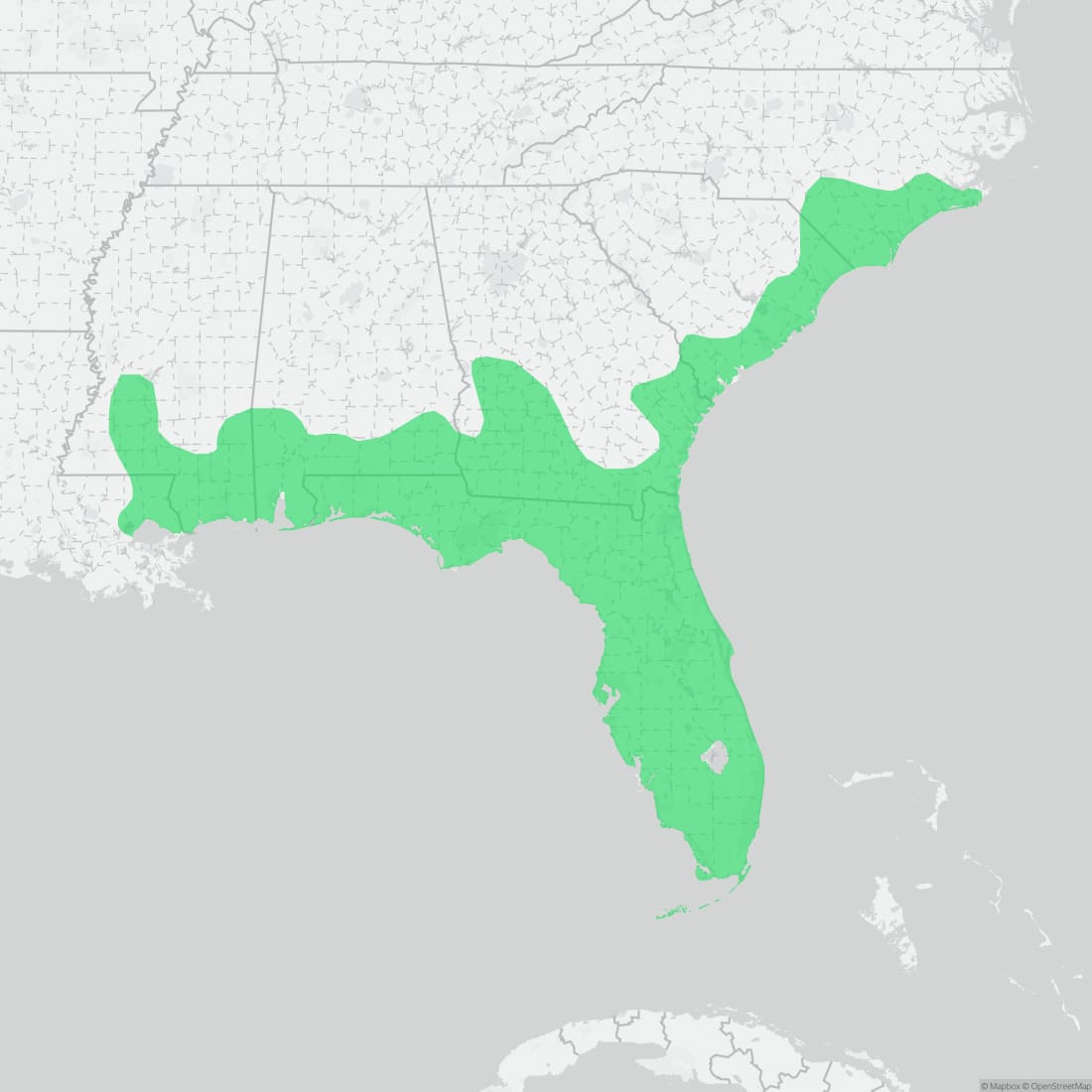
Approximate range. © Mapbox © OpenStreetMap