Leatherback Sea Turtle
Dermochelys coriacea
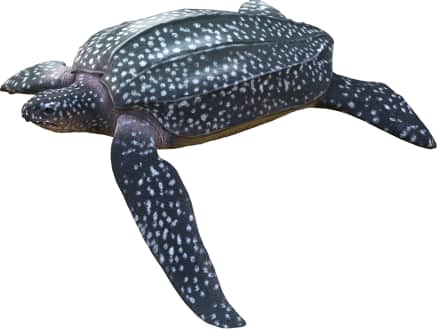
Compared to other turtles, shell is flexible to an extent and feels rubbery when touched. Unlike any other sea turtle, does not possess scutes on shell and exhibits ridge…
How to identify
Compared to other turtles, shell is flexible to an extent and feels rubbery when touched. Unlike any other sea turtle, does not possess scutes on shell and exhibits ridges running lengthwise across carapace. Carapace is either black or dark blue with pink or white spots. Five ridges apparent on whitish plastron. Juveniles are either black or white and have many smaller scales that are shed before adulthood. Females lay clutches containing 50 to 170 eggs. Eggs take about 9 weeks to hatch.
Range
Very wide global distribution; inhabit temperate and tropical areas of the Indian, Pacific, and Atlantic Oceans. Also found in Mediterranean Sea, and areas in Norway, Canada, South America, and New Zealand.
Habitat
Inhabit open ocean, gulfs, seas, estuaries, and bays. Can dive as deep as two thousand meters; spotted near the surface at midday but spends most of its time completely under water. Will hardly ever be near land unless nesting. Females will nest on vegetative, sandy beaches and lay their eggs on wet sand.
Variations
The age of sexual maturity ranges from 6 to 50 years. Overall, females in Pacific Ocean habitats are smaller than those living in Atlantic Ocean.
Similar species
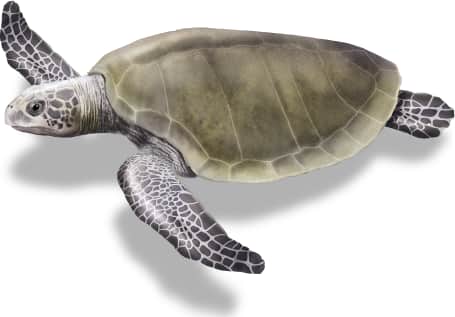
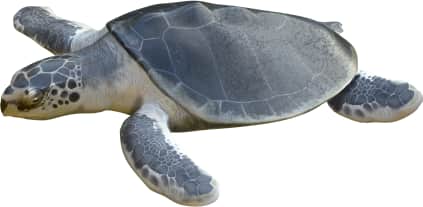
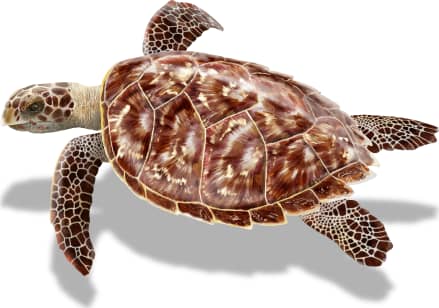
Name and etymology
Genus
Dermochelys
Greek for skin (derma) turtle (chelys).
Origin
Sources
- Blainville, 1816. Bull. Soc. Philom. Paris, p. 111 bis
Dermochelys. Blainville, 1816 - Bull. Soc. Philom. Paris, p. 111 bis
Species epithet
coriacea
Latin for having the color of (-acea) leather (corium)
Origin
Sources
- (Vandelli, 1761). "Epistola de Holothurio, et Testudine coriacea ad celeberrimum" Carolum Linnaeum Equitum Naturae Curiosum Dioscorcidem II. Conzatti, Patavii (Padova). 12 pp.
Dermochelys coriacea. (Vandelli, 1761) - "Epistola de Holothurio, et Testudine coriacea ad celeberrimum" Carolum Linnaeum Equitum Naturae Curiosum Dioscorcidem II. Conzatti, Patavii (Padova). 12 pp.
Explore more names in the etymology index.
At a glance
Size
145 to 160 cm
Range
Very wide global distribution; inhabit temperate and tropical areas of the Indian, Pacific, and Atlantic Oceans. Also found i…
Habitat
Inhabit open ocean, gulfs, seas, estuaries, and bays. Can dive as deep as two thousand meters; spotted near the surface at mi…
Range map
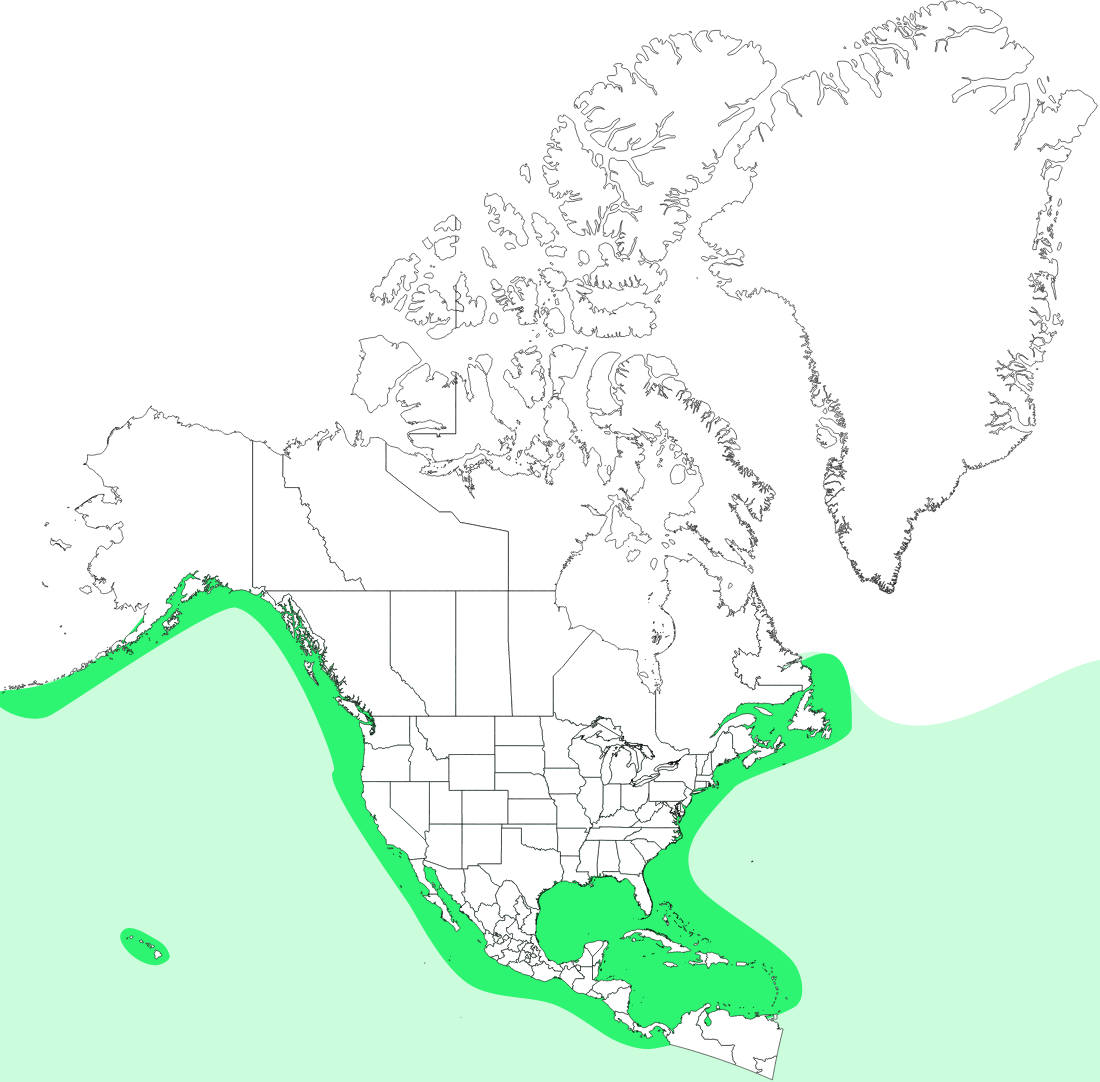
Approximate range. © Mapbox © OpenStreetMap