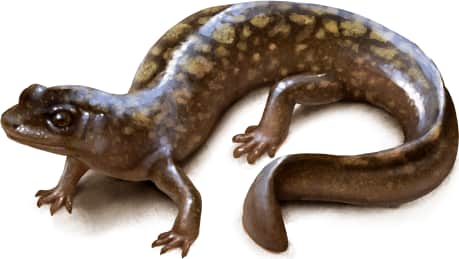
Central Shovel-nosed Salamander
Desmognathus intermedius
D. intermedius is a small salamander, typically reaching a total length of 3.5 to 5 inches (9 to 12.5 cm) with a record length of 5.8 inches (14.6 cm) documented in Virgi…
How to identify
D. intermedius is a small salamander, typically reaching a total length of 3.5 to 5 inches (9 to 12.5 cm) with a record length of 5.8 inches (14.6 cm) documented in Virginia. True to its name, it possesses a flattened, shovel-shaped head. The body color varies between shades of gray, brown, or black, often adorned with a mottled pattern on the back. Two rows of light spots may be visible along the sides.
Range
D. intermedius ranges in the Blue Ridge Mountains of western North Carolina and eastern Tennessee, in the drainages of the Lower Little Tennessee, Upper Little Tennessee, Tuckasegee, Lower French Broad, Pigeon, and Upper French Broad Rivers. It can be found from 300–1500m in elevation.
Habitat
Shovel-nosed salamanders occurs in rocky riffle zones of a fastflowing, high-gradient mountain streams
Similar species
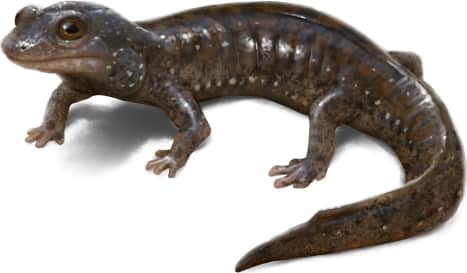
Shovel-nosed salamanders can be easily confused with Black-bellied Salamanders. However, key distinctions exist. Black-bellied salamanders have a less flattened head, more prominent eyes, and a more noticeable light stripe extending from the eye to the jawline. Additionally, Black-bellied salamanders frequent the edges of streams, spending time both in and out of the water, while Shovel-nosed salamanders are nearly fully aquatic salamander.
Southern Shovel-nosed Salamander
Desmognathus aureatus
Northern Shovel-nosed Salamander
Desmognathus marmoratus
Cherokee Blackbelly Salamander
Desmognathus gvnigeusgwotli
Kanawha Blackbelly Salamander
Desmognathus kanawha
Blue Ridge Blackbelly Salamander
Desmognathus mavrokoilius
Southern Blackbelly Salamander
Desmognathus amphileucus
Name and etymology
Genus
Desmognathus
Greek for jaw (gnathos) ligament (desmos).
Origin
Sources
- Baird, 1850. Journ. Acad. Nat. Sci. Philadelphia, Ser. 2, Vol. 1, p. 282 and p. 285 ↗
Desmognathus. Baird, 1850 - Journ. Acad. Nat. Sci. Philadelphia, Ser. 2, Vol. 1, p. 282 and p. 285
Species epithet
intermedius
Latin for intermediate referencing its size when originally compared to D. marmoratus
Origin
Sources
- The Reptile Database: Desmognathus intermedius ↗
Uetz, P., et al. The Reptile Database. s.v. “Desmognathus intermedius.” https://reptile-database.reptarium.cz/species?genus=Desmognathus&species=intermedius
Explore more names in the etymology index.
At a glance
Range
D. intermedius ranges in the Blue Ridge Mountains of western North Carolina and eastern Tennessee, in the drainages of the Lo…
Habitat
Shovel-nosed salamanders occurs in rocky riffle zones of a fastflowing, high-gradient mountain streams
Guide
Reptiles and Amphibians of North America
Range map
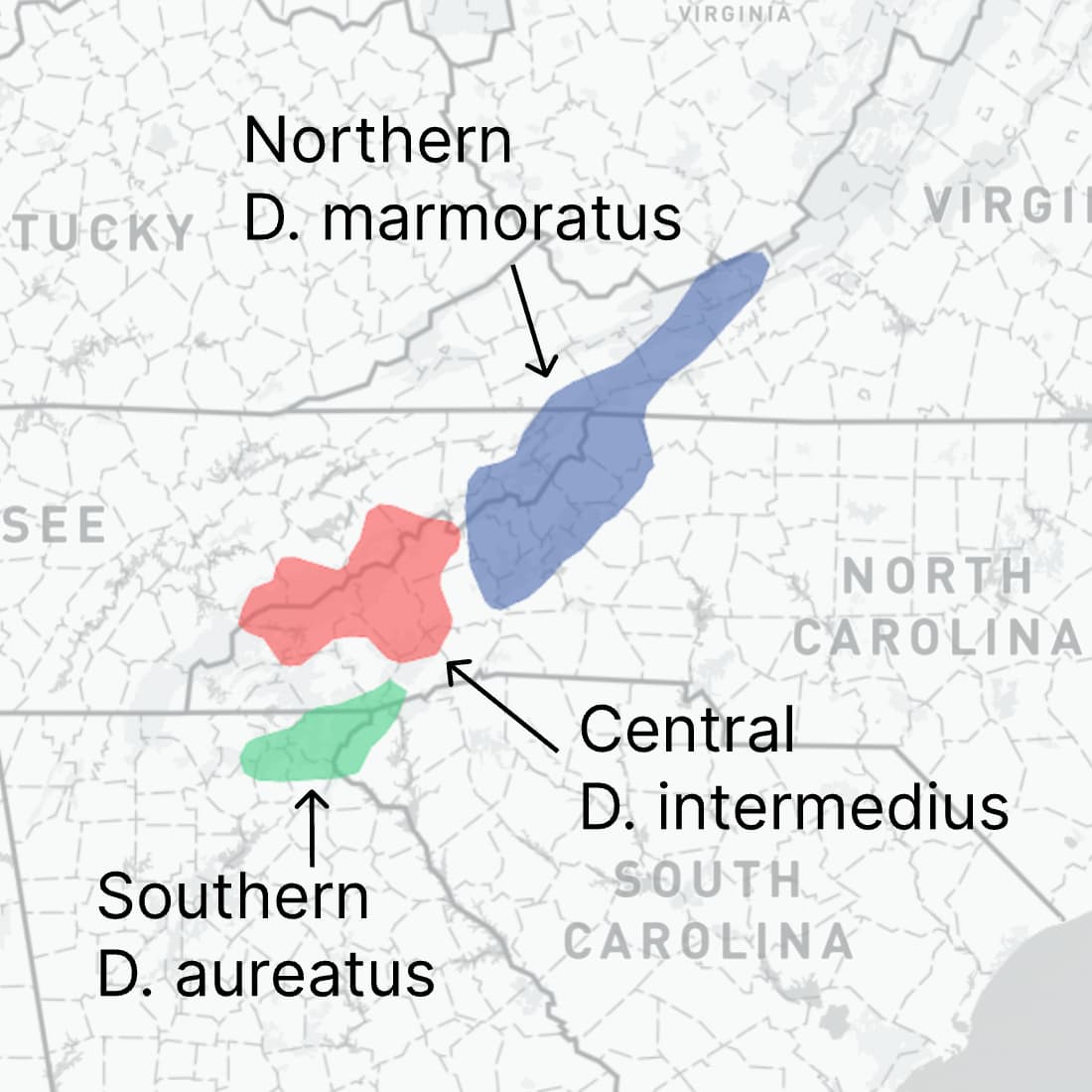
Approximate range. © Mapbox © OpenStreetMap