Desert Iguana
Dipsosaurus dorsalis
A medium to large lizard that is mostly light tan or grey in color, sometimes almost cream. They grow to a total length of 24 inches. They have a short snout and rounded…
How to identify
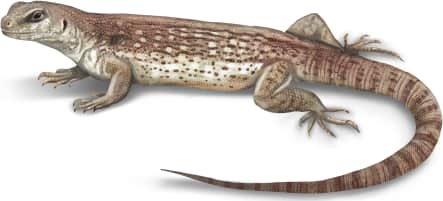
A medium to large lizard that is mostly light tan or grey in color, sometimes almost cream. They grow to a total length of 24 inches. They have a short snout and rounded face. They have a row of raised scales down the center of their back and tail, and a reticulated pattern in brown or grey on their back. The pattern merges into even rows of spots on their tail.
Range
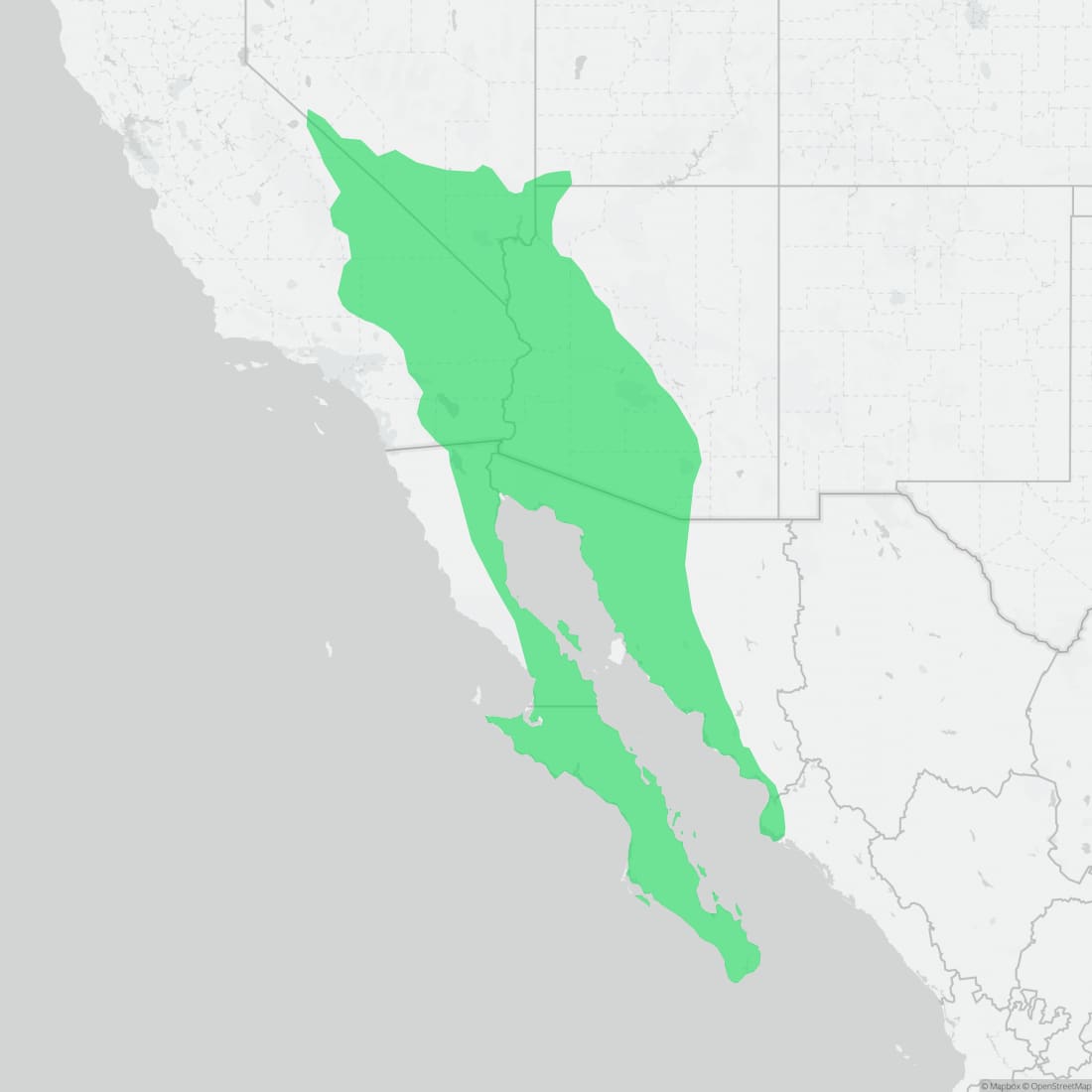
The Sonoran and Mojave deserts of southeastern California, southern Nevada, western Arizona, and south into Mexico along both coasts of the Gulf of California.
Habitat
The desert iguana is most prevalent in hot, dry, sandy areas where the creosote bush grows. It can also be found in rocky streambeds or arid subtropical scrublands. It is often active during periods of extreme heat, when other lizards have taken cover to stay cool.
Variations
Juveniles have darker patterning than adults. Breeding adults develop pink shading on their sides.
Similar species
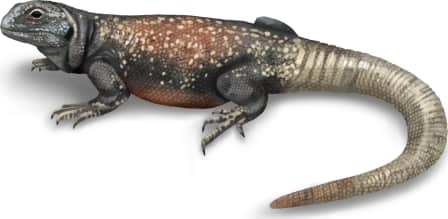
This unique species is not likely to be confused with other types of lizards. To the amateur eye, it could resemble the common chuckwalla (*Sauromalus ater*).
Name and etymology
Genus
Dipsosaurus
Greek for thirst (dipsos) lizard (saurus).
Origin
Sources
- Hallowell, 1854. Proc. Acad. Nat. Sci. Philadelphia, Vol. 7, p. 92 ↗
Urosaurus. Hallowell, 1854 - Proc. Acad. Nat. Sci. Philadelphia, Vol. 7, p. 92
Species epithet
dorsalis
Latin for of the side.
Origin
Sources
- (Baird and Girard, 1852). Proc. Acad. Nat. Sci. Philadelphia, Vol. 6, p. 126 ↗
Dipsosaurus dorsalis. (Baird and Girard, 1852) - Proc. Acad. Nat. Sci. Philadelphia, Vol. 6, p. 126
Explore more names in the etymology index.
At a glance
Size
33.02 to 40.64 cm
Range
The Sonoran and Mojave deserts of southeastern California, southern Nevada, western Arizona, and south into Mexico along both…
Habitat
The desert iguana is most prevalent in hot, dry, sandy areas where the creosote bush grows. It can also be found in rocky str…
Range map
Approximate range. © Mapbox © OpenStreetMap