Northern Alligator Lizard
Elgaria coerulea
Known for alligator-like characteristics including a large head, powerful jaws, large bony scales, and an elongated body. Although body is slim with short limbs, tail ca…
How to identify
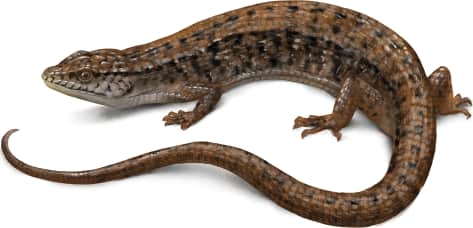
Known for alligator-like characteristics including a large head, powerful jaws, large bony scales, and an elongated body. Although body is slim with short limbs, tail can reach twice the length of the body. Large bone-reinforced scales run across the back and middle of body. They are separated by a band of small granular scales on the back and belly which create a fold that expands to hold eggs, food, or live young. Can be either grey, brown, or olive in color with broad olive-gray bands running down the back. Underside usually light gray with slight darkness around each scale. The male's head is usually broader and more triangular than the female's. Newborn lizards are about 4 inches long with shiny, smooth skin and tan, copper, or light brown back and tail.
Range
Western coast of North America from southern British Columbia, Canada southward through Washington, Oregon, and west-central California. Spotted populations range as far east as western Montana, northern Idaho, and northwestern Nevada.
Habitat
Grassland, forests and woodland, clear-cuts, marshes, coastal dunes, and along streams. Usually found under surface cover including logs and bark. Along the coast, they tend to appear far from any major cover in sunny clearings.
Variations
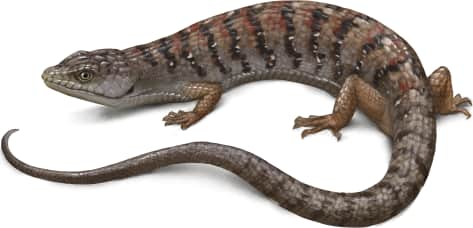
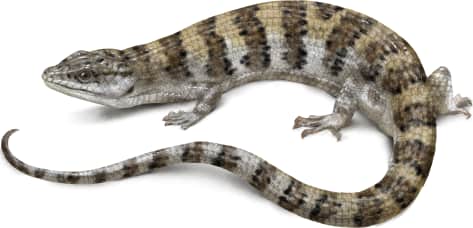
Number and intensity of bands on back can vary greatly. Some lizards have faint markings and others exhibit a more complex pattern of bold bands. Some but not all exhibit a broad strip on the back. Subspecies Sierra Alligator Lizard, or *Elgaria coerulea palmeri*, has a yellowish or greenish underside and usually does not have definite crossbands.
Similar species
E. m. scincicauda - Oregon Alligator Lizard E. m. webbii - San Diego Alligator Lizard E. panamintina - Panamint Alligator Lizard
Name and etymology
Genus
Elgaria
Unknown, possibly a pun on alligator or honoring an Elgar.
Origin
Honors
Sources
- Gray, 1838. Ann. Mag. Nat. Hist., Vol. 1, p. 390 ↗
Elgaria. Gray, 1838 - Ann. Mag. Nat. Hist., Vol. 1, p. 390
Species epithet
coerulea
Latin for dark blue.
Origin
Sources
- (Wiegmann, 1828). Isis von Oken, Vol. 21, p. 380 ↗
Elgaria coerulea. (Wiegmann, 1828) - Isis von Oken, Vol. 21, p. 380
Explore more names in the etymology index.
More illustrations
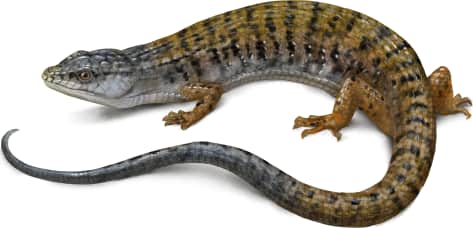
Shasta Alligator Lizard
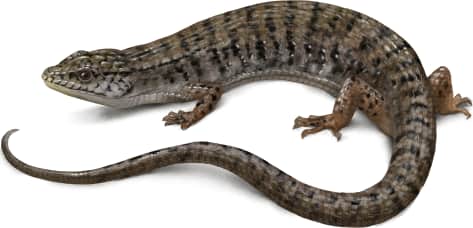
San Francisco Alligator Lizard
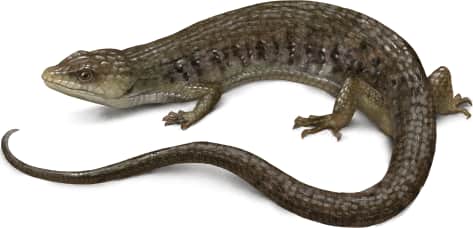
Sierra Alligator Lizard
At a glance
Range
Western coast of North America from southern British Columbia, Canada southward through Washington, Oregon, and west-central…
Habitat
Grassland, forests and woodland, clear-cuts, marshes, coastal dunes, and along streams. Usually found under surface cover inc…
Guide
Reptiles and Amphibians of North America
Range map
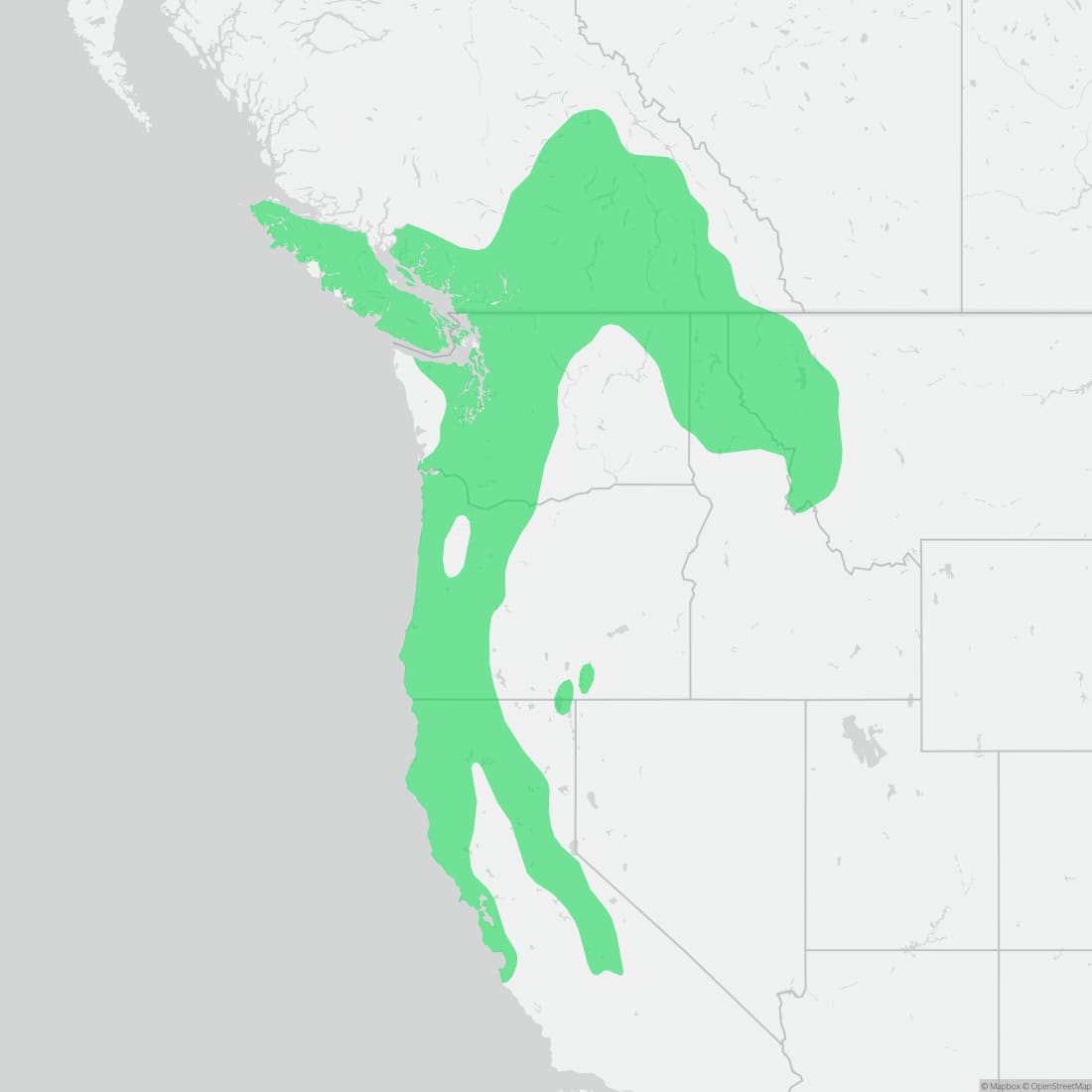
Approximate range. © Mapbox © OpenStreetMap