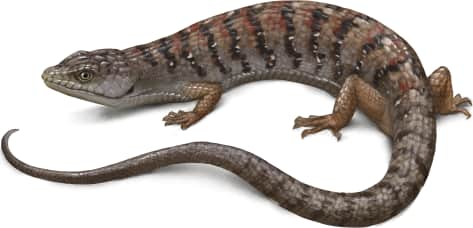
Southern Alligator Lizard
Elgaria multicarinata
Dorsum is either gray, brown, red, or yellow; width-wise bars run across back and usually contain white flecks. Long tail can grow up to twice the length of the body. Ent…
How to identify
Dorsum is either gray, brown, red, or yellow; width-wise bars run across back and usually contain white flecks. Long tail can grow up to twice the length of the body. Entire body covered with bony, overlapping plates followed by scales. Two skin folds on either side of body help expand body size when prey is consumed, lungs expand, or when holding eggs. Tongue possess a small, forked tip and is enclosed in powerful jaws. Females and males are mainly similar, but some males will have slightly larger heads than females.
Range
West coast of America and Mexico starting west of the Cascade-Sierra Nevada crest; south-central Washington through north-central Oregon, western southern Oregon, California, and ending in northern Baja California. Isolated populations inhabit islands off the coast of southern California and Baja California.
Habitat
Found in a variety of areas that can include open forests, grasslands, and chaparral. Usually stay near wet areas under rocks, logs, wood piles, and other natural shelter. Females lay their eggs in underground burrows or under rocks in protected areas. Diet can include a range of invertebrates and also small vertebrates including other lizards, young birds, and small mammals.
Variations
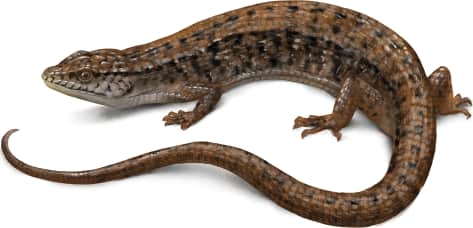
Subspecies Woodland Alligator Lizard, or *Elgaria multicarinata webbii*, exhibits more heavily keeled scales than any other subspecies. Temporal scales are keeled in addition to the back and leg scales being keeled.
Similar species
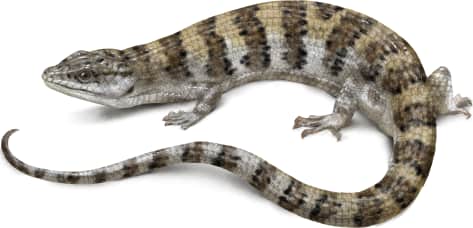
Panamint Alligator Lizard - Elgaria panamintina Northwestern Alligator Lizard - Elgaria coerulea principis
Name and etymology
Genus
Elgaria
Unknown, possibly a pun on alligator or honoring an Elgar.
Origin
Honors
Sources
- Gray, 1838. Ann. Mag. Nat. Hist., Vol. 1, p. 390 ↗
Elgaria. Gray, 1838 - Ann. Mag. Nat. Hist., Vol. 1, p. 390
Species epithet
multicarinata
Latin for many (multi) keeled (carinata).
Origin
Sources
- (Blainville, 1835). Nouv. Ann. Mus. Hist. Nat. Paris, Vol. 4, p. 298, pl. 25, fig. 2 ↗
Elgaria multicarinata. (Blainville, 1835) - Nouv. Ann. Mus. Hist. Nat. Paris, Vol. 4, p. 298, pl. 25, fig. 2
Explore more names in the etymology index.
More illustrations
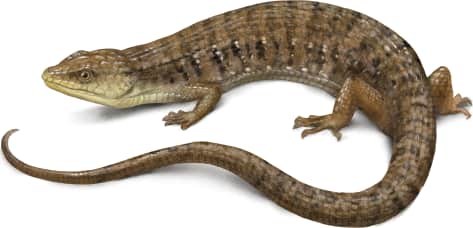
Oregon Alligator Lizard
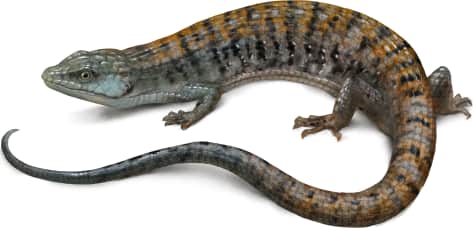
San Diego Alligator Lizard
At a glance
Range
West coast of America and Mexico starting west of the Cascade-Sierra Nevada crest; south-central Washington through north-cen…
Habitat
Found in a variety of areas that can include open forests, grasslands, and chaparral. Usually stay near wet areas under rocks…
Guide
Reptiles and Amphibians of North America
Range map
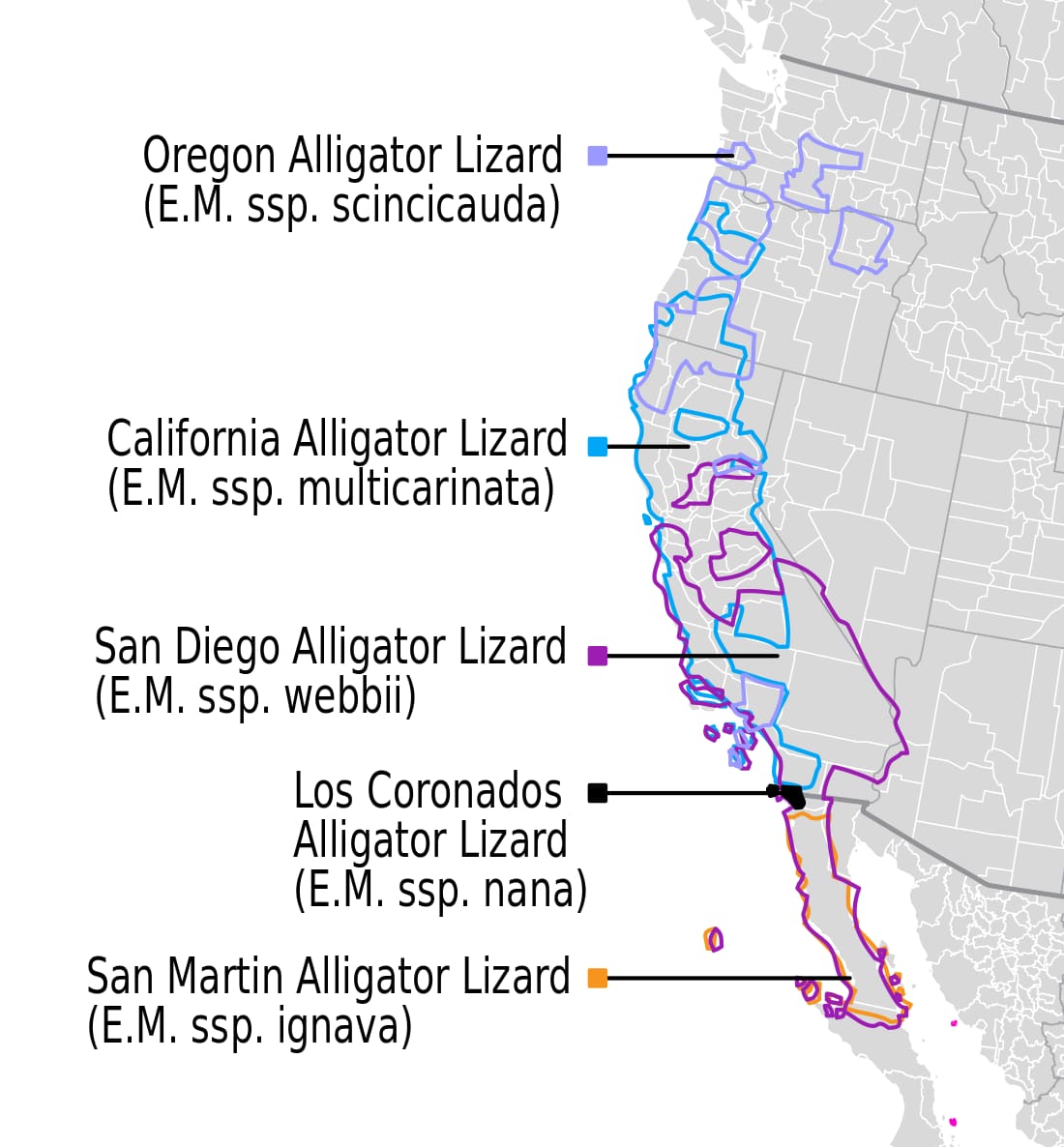
Approximate range. © Mapbox © OpenStreetMap