Cope's Leopard Lizard
Gambelia copeii
This uncommon lizard grows to a length of 3-5.5 inches from snout to vent, and is known to run bipedally when escaping danger. It has a moderately thin body with long leg…
How to identify
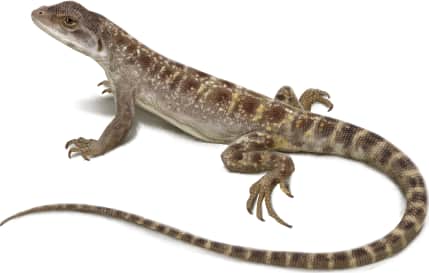
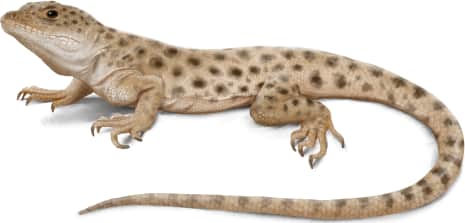
This uncommon lizard grows to a length of 3-5.5 inches from snout to vent, and is known to run bipedally when escaping danger. It has a moderately thin body with long legs, a long tail, and granular scales. The head is triangular and wider than the neck, which has several skin folds. Its background color is tan or grey, with dark irregular spots that become more numerous on the distal half of its body and tail. The spots merge into even bands about half way down the tail. The dark spots on the body are usually outlined in a pale shade of tan, and they can have thin bars across their body of the same pale color. Females develop bright orange spots along the sides of their body and face. Ventrum is pale and unmarked.
Range
Distributed throughout most of the Baja Peninsula, stretching north to a small area across the border into southern California outside San Diego.
Habitat
These lizards prefer chaparral, sage scrub, or oak woodland habitats with open areas for running.
Variations
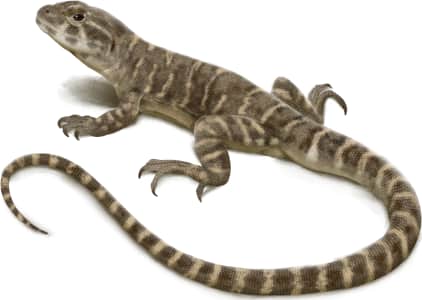
Their coloration lightens when their body temperature rises. Their dark spots are sometimes two-toned dark brown and brick red. Juveniles tend to have more distinct color and patterning.
Similar species
Two other species of leopard lizard look quite similar to the Cope's leopard lizard; the long-nosed leopard lizard (*Gambelia wislizenii*) which ranges further east in southern California, and the blunt-nosed leopard lizard (*Gambelia sila*) which is found north of Los Angeles in California.
Name and etymology
Genus
Gambelia
Honoring William Gambel.
Origin
Honors
Sources
- Baird, 1859. U.S. Mex. Bound. Surv., Vol. 2, Pt. 2, p. 7 ↗
Gambelia. Baird, 1859 - U.S. Mex. Bound. Surv., Vol. 2, Pt. 2, p. 7
Species epithet
copeii
Honorinbg Edward Drinker Cope.
Sources
- (Yarrow, 1882). Proc. U.S. Natl. Mus., Vol. 5, p. 441 ↗
Gambelia copeii. (Yarrow, 1882) - Proc. U.S. Natl. Mus., Vol. 5, p. 441
Explore more names in the etymology index.
More illustrations
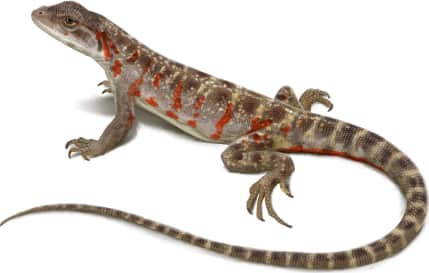
Female in breeding colors
At a glance
Range
Distributed throughout most of the Baja Peninsula, stretching north to a small area across the border into southern Californi…
Habitat
These lizards prefer chaparral, sage scrub, or oak woodland habitats with open areas for running.
Guide
Reptiles and Amphibians of North America
Range map
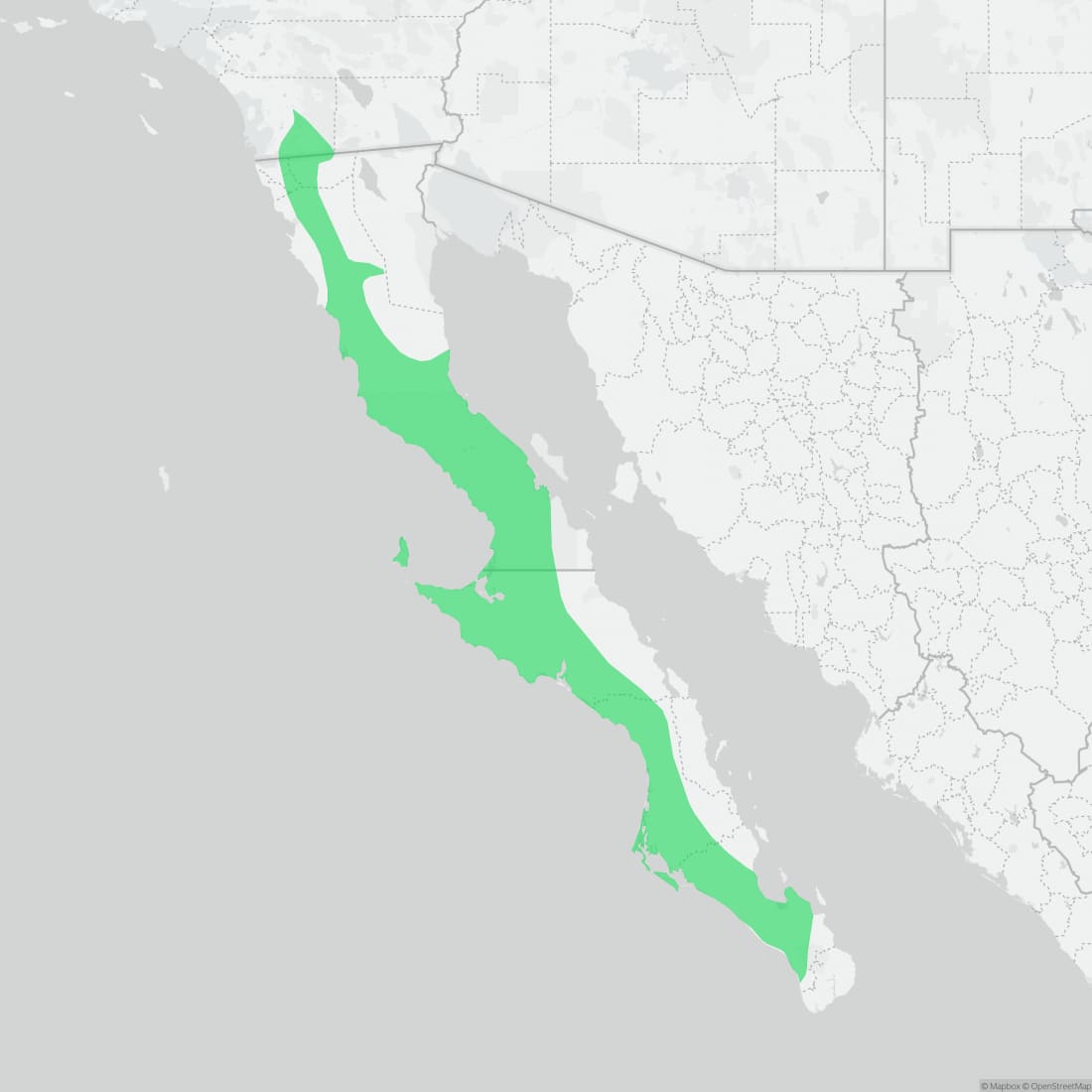
Approximate range. © Mapbox © OpenStreetMap