Ringed Map Turtle
Graptemys oculifera
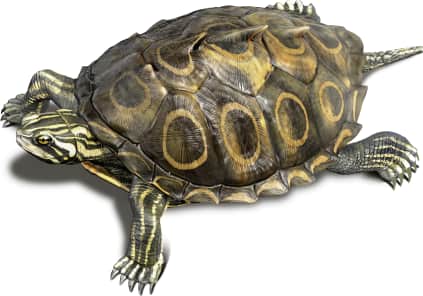
This species is named for the distinct light rings present on its pleural and marginal carapace scutes. The central carapace scutes on juveniles have tall, pointed peaks,…
How to identify
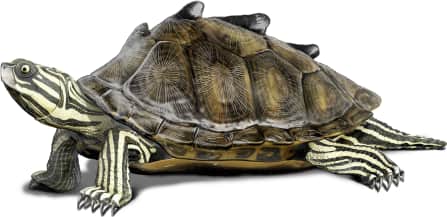
This species is named for the distinct light rings present on its pleural and marginal carapace scutes. The central carapace scutes on juveniles have tall, pointed peaks, which become dull and less pronounced with age. The background carapace color is brown to green, and the rings are usually yellow. The rings on the marginal scutes are often incomplete, and the posterior marginals are serrated. Its skin is dark black with yellow stripes and markings, including a spot behind each eye, and a "chin-strap" across the lower mandible. Its plastron is mostly yellow with variable, irregular dark markings along the seams. Males are smaller and average 3-4 inches in straight carapace length, while females average 5-8.5 inches.
Range
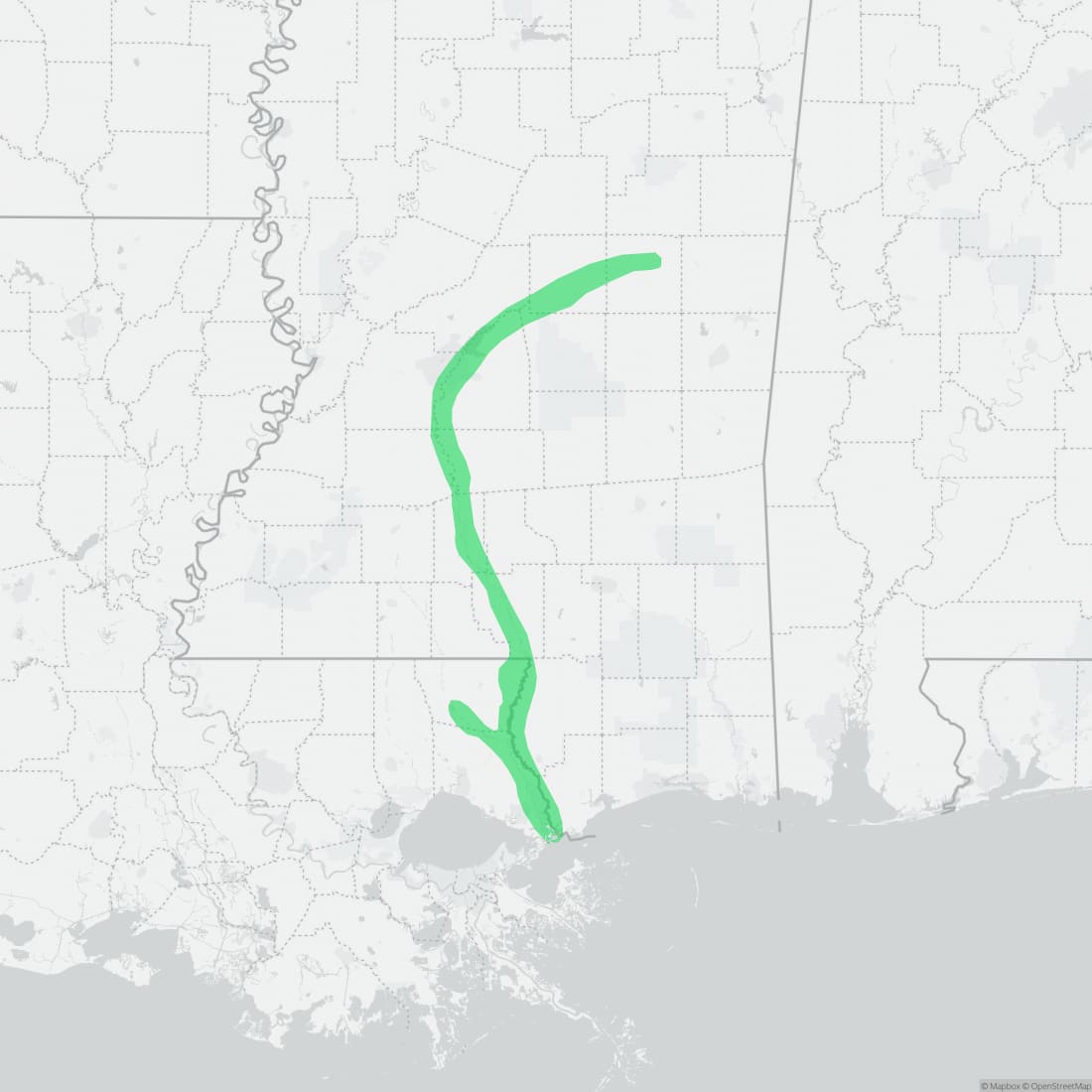
Range follows the Pearl River system from central Mississippi southward along the border of Louisiana to the Gulf of Mexico.
Habitat
This turtle prefers moderate to swift-flowing water in wide sections of river with lots of logs and sandbars for basking in sunny areas.
Variations
Some younger turtles have a yellow spot in the center of each ring. Older individuals often have less distinct rings.
Similar species
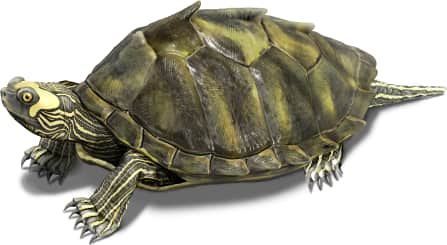
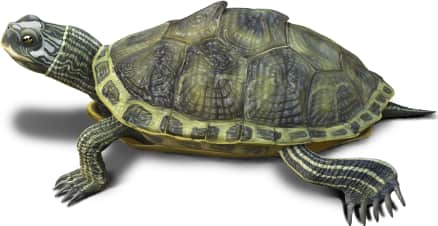
Shares its range with the similar Pearl River map turtle (*Graptemys pearlensis*). It strongly resembles the black-knobbed map turtle (*Graptemys nigrinoda*) found mostly in Alabama and northeastern Mississippi. The Pascagoula map turtle (*Graptemys gibbonsi*) is also quite similar.
Name and etymology
Genus
Graptemys
Greek for written (graptos) turtle (emys).
Origin
Sources
- Agassiz, 1857. Contr. Nat. Hist. U. S., Vol. 1, p. 436 ↗
Graptemys. Agassiz, 1857 - Contr. Nat. Hist. U. S., Vol. 1, p. 436
Species epithet
oculifera
Latin for having (-ifera) eye (oculus), referencing eye shaped markings on shell.
Origin
Sources
- (Baur, 1890). Science, Ser. 1, Vol. 16, p. 262
Graptemys oculifera. (Baur, 1890) - Science, Ser. 1, Vol. 16, p. 262
Explore more names in the etymology index.
At a glance
Range
Range follows the Pearl River system from central Mississippi southward along the border of Louisiana to the Gulf of Mexico.
Habitat
This turtle prefers moderate to swift-flowing water in wide sections of river with lots of logs and sandbars for basking in s…
Guide
Reptiles and Amphibians of North America
Range map
Approximate range. © Mapbox © OpenStreetMap