
Pearl River Map Turtle
Graptemys pearlensis
Juveniles start out with very high, dark central peaks down their plastron. With age, these shrink and combine to form a continuous keel that is still darker than the res…
How to identify
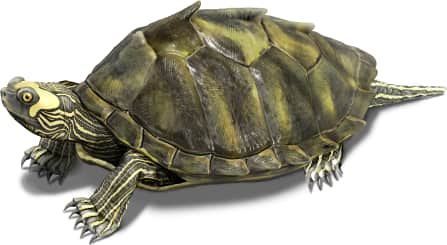
Juveniles start out with very high, dark central peaks down their plastron. With age, these shrink and combine to form a continuous keel that is still darker than the rest of the shell. Its central and pleural scutes are generally a dull greenish brown, but its marginal scutes have a pattern of dark blocks or circles separated by yellow bars. The posterior marginal scutes are serrated. This turtle's skin is dark green to black with yellow stripes all over. It has large yellow patches behind the eyes which meet on the top of the head to form a trident-like shape. The edge of its mouth is pale whitish. Its plastron is yellow with dark coloration around the seams. It has a narrow head with a pointed snout. Females are about twice the size of males and can reach 9-11 inches in carapace length. Their heads also grow disproportionately large compared to males.
Range
Range is restricted to areas surrounding the Pearl River system which stretches southward from central Mississippi along the border with Louisiana to the Gulf of Mexico.
Habitat
This aquatic turtle prefers wide, swift-moving streams and rivers with sand or gravel bottoms and plentiful logs or emergent vegetation for basking.
Variations
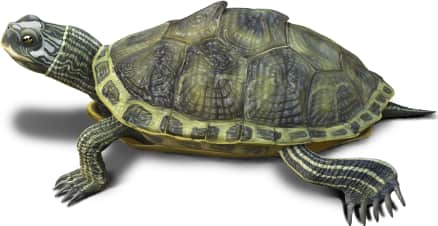
Markings may be more orange instead of yellow. The large patches on the head may be greenish or bluish.
Similar species
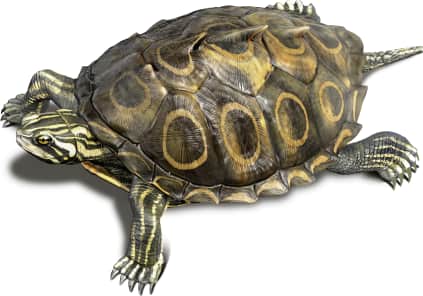
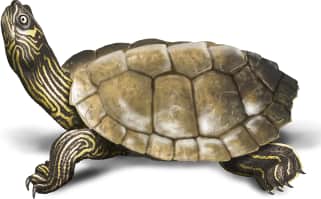
Historically it was considered the same species as the Pascagoula map turtle (*Graptemys gibbonsi*). It shares the exact same range as the ringed map turtle (*Graptemys oculifera*), which has similar characteristics. It could also be confused with the false map turtle (*Graptemys pseudogeographica*).
Name and etymology
Genus
Graptemys
Greek for written (graptos) turtle (emys).
Origin
Sources
- Agassiz, 1857. Contr. Nat. Hist. U. S., Vol. 1, p. 436 ↗
Graptemys. Agassiz, 1857 - Contr. Nat. Hist. U. S., Vol. 1, p. 436
Species epithet
pearlensis
Belonging to the Pearl River.
Origin
Sources
- Wikipedia: Graptemys pearlensis ↗
“Graptemys pearlensis.” Wikipedia. https://en.wikipedia.org/wiki/Pearl_River_map_turtle
Explore more names in the etymology index.
At a glance
Range
Range is restricted to areas surrounding the Pearl River system which stretches southward from central Mississippi along the…
Habitat
This aquatic turtle prefers wide, swift-moving streams and rivers with sand or gravel bottoms and plentiful logs or emergent…
Guide
Reptiles and Amphibians of North America
Range map
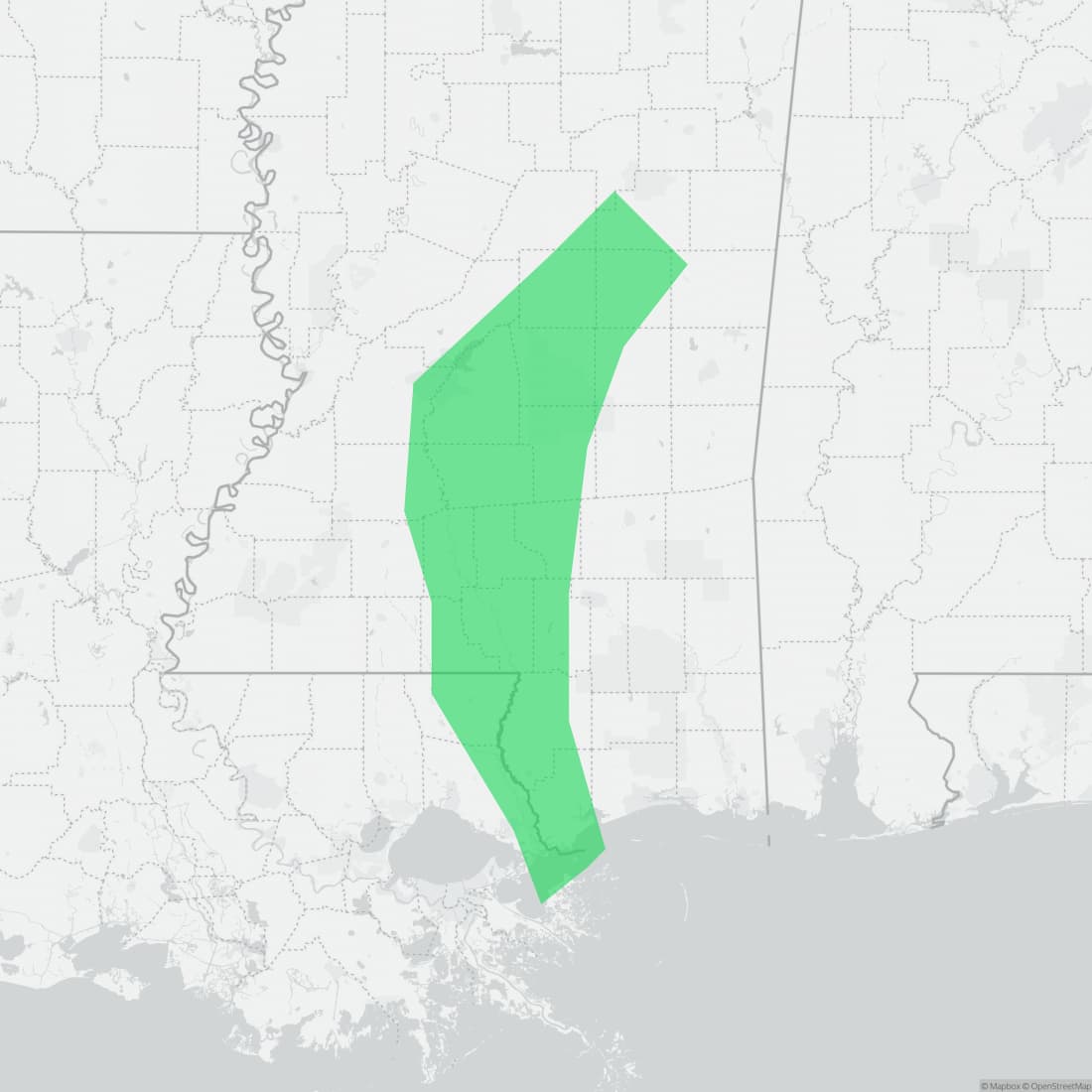
Approximate range. © Mapbox © OpenStreetMap