Four-toed Salamander
Hemidactylium scutatum
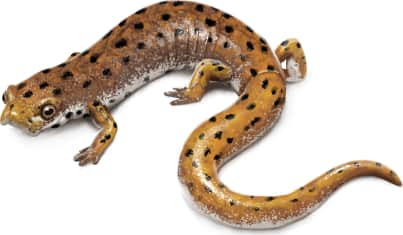
The four-toed Salamander has a white underbelly with black dots. Its dorsum ranges from orange-brown to reddish-brown, with greyish flanks. It has a length of 2-4 inches…
How to identify
The four-toed Salamander has a white underbelly with black dots. Its dorsum ranges from orange-brown to reddish-brown, with greyish flanks. It has a length of 2-4 inches It has elongated body and limbs but a short snout and more prominent eyes. The color of the tail is usually brighter than the body and this is noticeable with the constriction at the body/tail junction. It derives its name from the 4 toes at the posterior limbs. Males have elongated and square-like snouts while the females have round and short snouts. Juveniles have a shorter tail with a length of 11-15 mm.
Range
The four-toed salamander can be seen from Nova Scotia to northern Minnesota and south to the Gulf of Mexico. It spreads across states close to the Appalachian mountains.
Habitat
It is seen to dwell in sphagnum bogs, bog-based streams, and floodplains in woodland areas. They are also reported to hibernate underground the forest soil. They mate during fall and females don’t lay eggs until next spring. They could lay up to 30 eggs and tend the eggs until they hatch one to two months later. While adults feed on insects and other invertebrates like spider, worms, ticks, and springtails, juveniles feed on aquatic crustaceans like lobsters and shrimps.
Similar species
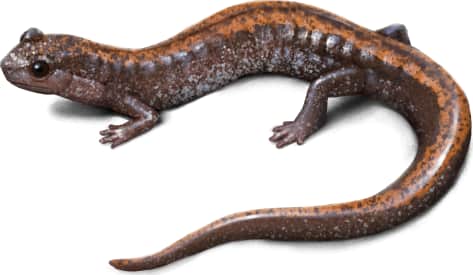
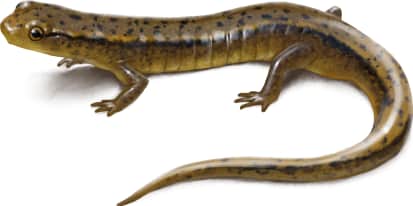
The common mudpuppy (necturus maculosus). It is an aquatic species that never loses its gills, has four toes on its hind legs and grow much bigger than the four-toed Salamander. The red-backed Salamander (plethodon cinereus) has a grey body with a red band that goes down the length of its back. The northern two-lined Salamander (eurycea bislineata) has a yellow or yellowish-brown skin coloration with two dark-brown lines down the length of its back and a lighter band between them
Name and etymology
Genus
Hemidactylium
Greek for half (hemi) digits (dakyloin), referencing reduced number of toes on hind foot.
Origin
Sources
- Tschudi, "1838" 1839. reprinted in Classif. Batr., Mem. Soc. Sci. Nat. Neuchatel, p. 59 ↗
Hemidactylium. Tschudi, "1838" 1839 - reprinted in Classif. Batr., Mem. Soc. Sci. Nat. Neuchatel, p. 59
Species epithet
scutatum
Latin for armed with a shield.
Origin
Sources
- (Temminck and Schlegel, 1838).
Hemidactylium scutatum. (Temminck and Schlegel, 1838) -
Explore more names in the etymology index.
More illustrations
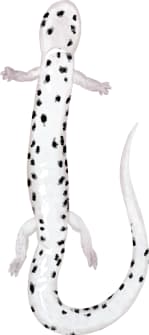
Underside
At a glance
Range
The four-toed salamander can be seen from Nova Scotia to northern Minnesota and south to the Gulf of Mexico. It spreads acros…
Habitat
It is seen to dwell in sphagnum bogs, bog-based streams, and floodplains in woodland areas. They are also reported to hiberna…
Guide
Reptiles and Amphibians of North America
Range map
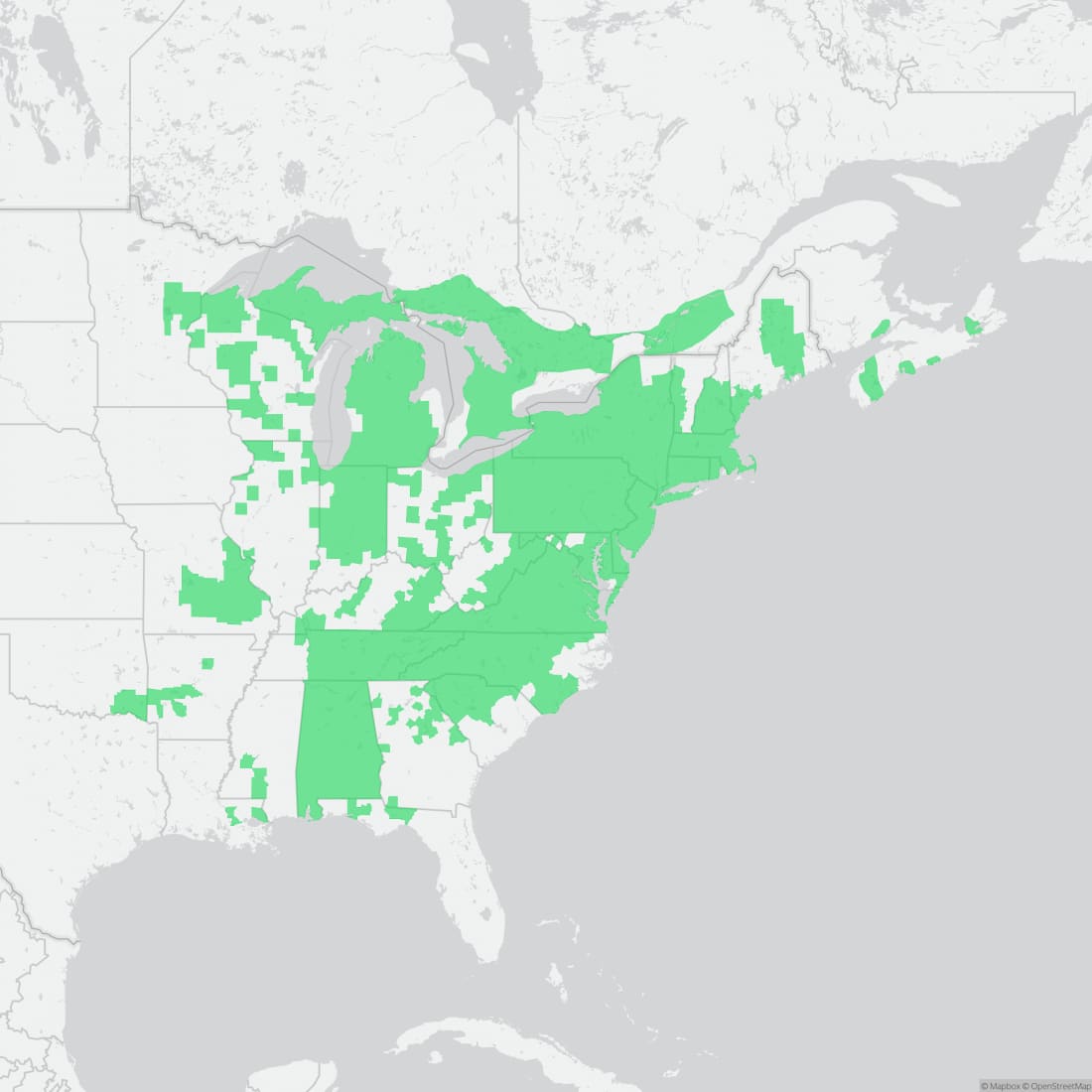
Approximate range. © Mapbox © OpenStreetMap