Hispaniolan Khaki Curlytail
Leiocephalus schreibersii
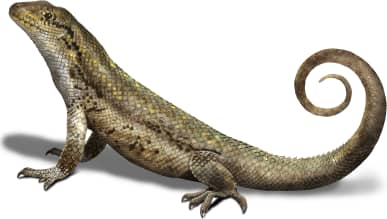
This thick-bodied lizard has a stubby head and row of short, spiked scales down its back. It will curl its tail into round loops when threatened, but otherwise it stays s…
How to identify
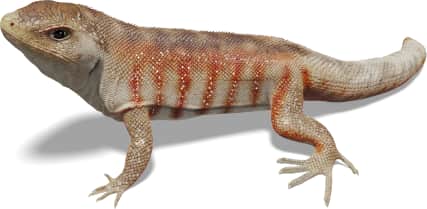
This thick-bodied lizard has a stubby head and row of short, spiked scales down its back. It will curl its tail into round loops when threatened, but otherwise it stays straight. It is named for the vertical reddish orange bars that develop on its sides in adulthood. Its dorsal scales are keeled, while its ventral and lateral scales are granular. Its back legs lack a distinct pattern, but are generally a greyish tan coloration. These dull dorsal scales transition down its sides to a speckled mixture of turquoise and reddish orange scales, then break into the reddish orange vertical bars, with unmarked pale areas between the bars. It has a wide neck and its throat may be tinted turquoise. On average, it is about 3.5 inches in snout to vent length.
Range
Native to the island of Hispaniola, but an introduced population is established in south Florida.
Habitat
This species prefers dry habitats with cacti or thornscrub. It likes to hang out on rocks or concrete walls, and will inhabit urban areas.
Variations
Juveniles are not as thick-bodied, and they lack any vibrant coloration. Their side bars are dark grey and subtle. They may have some undefined dark banding on their backs.
Similar species
Most likely to be confused with the northern curly-tailed lizard (*Leiocephalus carinatus*).
Name and etymology
Genus
Leiocephalus
Greek for little (-ius) smooth (leio) head (kephale).
Origin
Sources
- Wikipedia: Leiocephalus ↗
“Leiocephalus.” Wikipedia. https://en.wikipedia.org/wiki/Curly-tailed_lizard
Species epithet
schreibersii
Honoring Carl Franz Anton Ritter von Schreibers.
Origin
Honors
Sources
- Wikipedia: Leiocephalus schreibersii ↗
“Leiocephalus schreibersii.” Wikipedia. https://en.wikipedia.org/wiki/Hispaniolan_curlytail_lizard
Explore more names in the etymology index.
At a glance
Range
Native to the island of Hispaniola, but an introduced population is established in south Florida.
Habitat
This species prefers dry habitats with cacti or thornscrub. It likes to hang out on rocks or concrete walls, and will inhabit…
Guide
Reptiles and Amphibians of North America