
Northern Cat-eyed Snake
Leptodeira septentrionalis
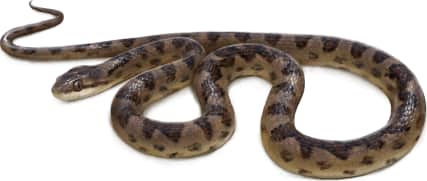
A long, slender snake reaching 1 meter in length, with a smallish head and defined neck. It is named for its large eyes with vertical, cat-like pupils. It has smooth scal…
How to identify
A long, slender snake reaching 1 meter in length, with a smallish head and defined neck. It is named for its large eyes with vertical, cat-like pupils. It has smooth scales with a light yellowish to brown background color and dark blotches that sometimes form a banded or zigzag pattern. Its ventrum is pale and unmarked.
Range
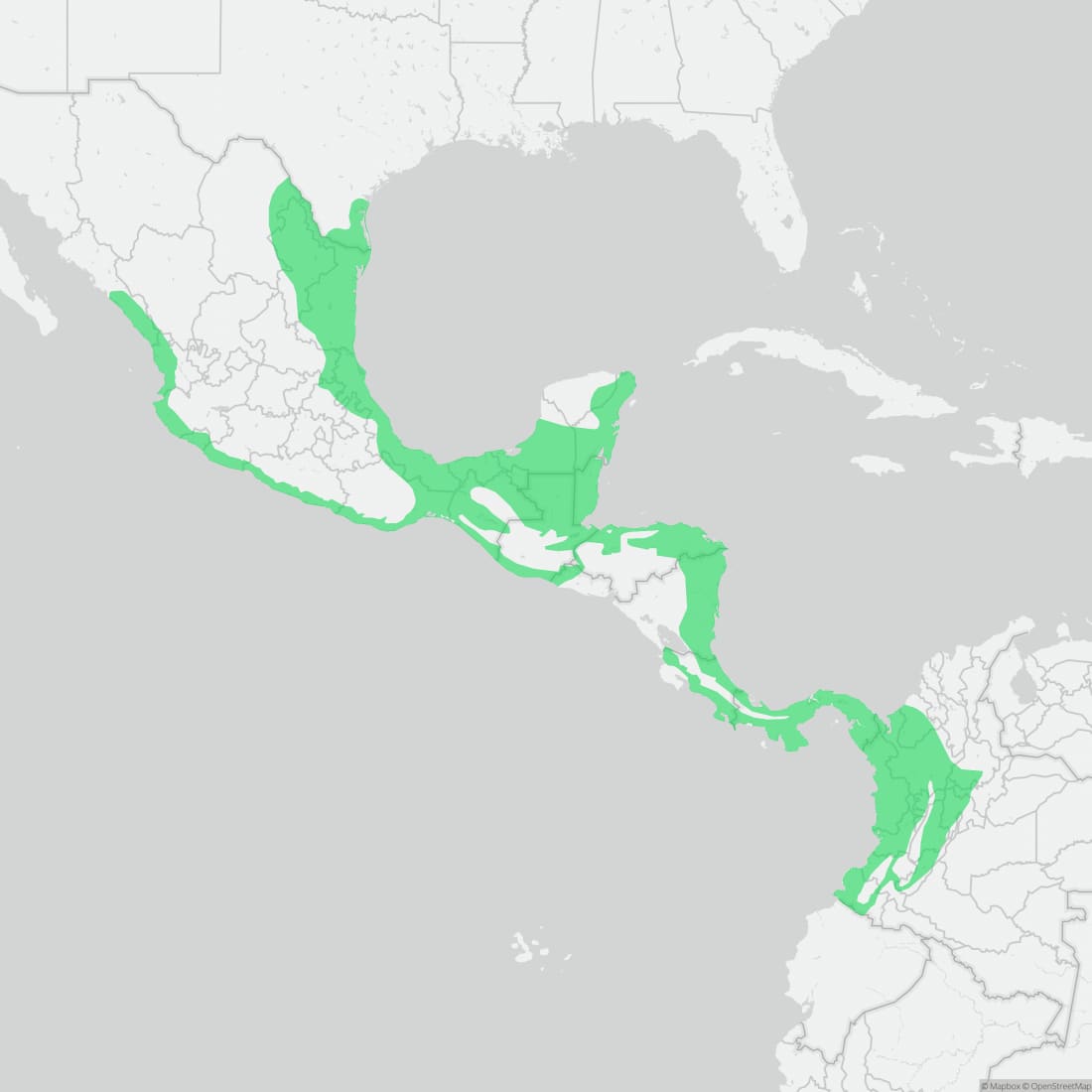
Primarily found in coastal and southern Mexico, Central America, and northwestern South America. The most northern tip of its range extends into deep south Texas.
Habitat
This nocturnal species is primarily arboreal, and most often found near bodies of water in forested or semi-arid thornscrub habitats. It prefers areas populated by amphibians, since frogs are a favorite food source. During the day, it tends to hide under logs or within thick vegetation.
Variations
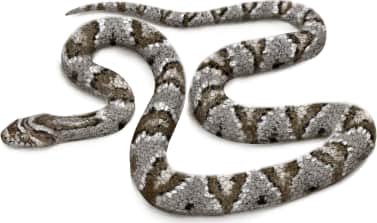
Pattern varies significantly, based on locality. Some have very irregular-shaped, separate blotches, others have very symmetrical bands, spots, or patches, and some have a continuous zigzag pattern.
Similar species
It is most similar to other species of cat-eyed snakes, only found in Mexico and Central America. In the United States, it resembles the Sonoran lyre snake (*Trimorphodon lambda*) which is found west of Texas.
Name and etymology
Genus
Leptodeira
Greek for slender (leptos) neck (deire).
Origin
Sources
- Fitzinger, 1843. Syst. Rept., p. 27 ↗
Leptodeira. Fitzinger, 1843 - Syst. Rept., p. 27
Species epithet
septentrionalis
Latin for northern.
Origin
Sources
- Dumeril and Bibron, 1841. Erp. Gen., Vol. 8, p. 538 ↗
Osteopilus septentrionalis. Dumeril and Bibron, 1841 - Erp. Gen., Vol. 8, p. 538
- Baird, 1854. Proc. Acad. Nat. Sci. Philadelphia, Vol. 7, p. 61 ↗
Rana septentrionalis. Baird, 1854 - Proc. Acad. Nat. Sci. Philadelphia, Vol. 7, p. 61
- (Kennicott, 1859).
Leptodeira septentrionalis. (Kennicott, 1859) -
Explore more names in the etymology index.
At a glance
Size
22.9 to 98.4 cm
Range
Primarily found in coastal and southern Mexico, Central America, and northwestern South America. The most northern tip of its…
Habitat
This nocturnal species is primarily arboreal, and most often found near bodies of water in forested or semi-arid thornscrub h…
Range map
Approximate range. © Mapbox © OpenStreetMap