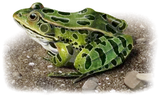
Plains Leopard Frog
Lithobates blairi
The plains leopard frog as an average body length of 2-4.3 inches with brown or grey skin pigmentation. They have distinctive and irregular dark colored spotting on their…
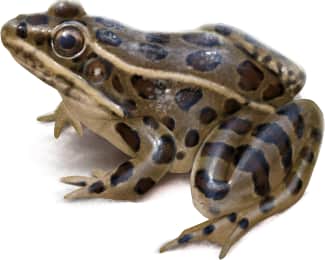
How to identify
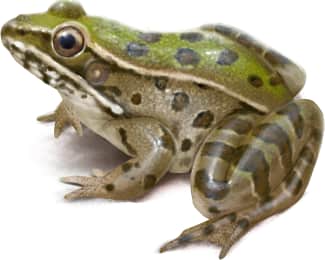
The plains leopard frog as an average body length of 2-4.3 inches with brown or grey skin pigmentation. They have distinctive and irregular dark colored spotting on their back and one on the snout. It has really strong, long legs, which helps it to make high leaps. It also has 2 incomplete dorsolateral ridges down the back, which is near to the groin. It has spots on the forelimb but has tiger stripes or bars on the hind leg, which are sometimes dark-greenish. The undersides of the groin and legs are pale yellow.
Range
The plains leopard frog is found throughout the great plains of the United States, spreading across Indiana, South Dakota, Colorado, New Mexico, Texas, and Arizona. It is also found in the southern half of Iowa, ranging north along the Missouri River to Plymouth County.
Habitat
It is found throughout semiarid regions and in or very near a permanent water source like rivers, streams, creeks, and ponds. They are shy animals as they often leap beneath the water when approached. They are active during night-time and they feed on insects and any other animal that they can overpower and swallow, including other frogs. They breed in March or April and a single female may lay between 3000 and 5000 eggs in a round mass.
Similar species
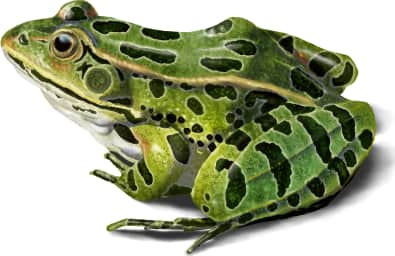
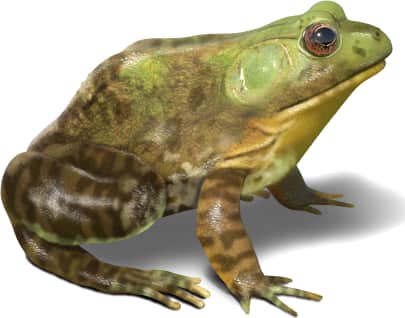
The southern leopard frog (lithobates sphenocephalus) has a brown or green dorsum, with a yellowish ridge on each side of the back. It is up to 13cm. The northern leopard frog (lithobates pipiens) has an average snout-to-vent length of 11cm, with large, dark and circular spots on its green or brown dorsum. The American bullfrog (lithobates catesbeianus) measures about 9-15cm, having an olive-green dorsum and an off-white belly, with yellow or grey blotching.
Name and etymology
Genus
Lithobates
Greek for rock (litho-) climber (bates).
Origin
Sources
- Linnaeus, 1758. Syst. Nat., 10th ed., Vol. 1, p. 210 ↗
Rana. Linnaeus, 1758 - Syst. Nat., 10th ed., Vol. 1, p. 210
Species epithet
blairi
Honoring W. Frank Blair.
Origin
Honors
Sources
- Mecham, Littlejohn, Oldham, Brown and Brown, 1973. Occ. Pap. Texas Tech. Univ., Vol. 18, p. 3
Rana blairi. Mecham, Littlejohn, Oldham, Brown and Brown, 1973 - Occ. Pap. Texas Tech. Univ., Vol. 18, p. 3
Explore more names in the etymology index.
At a glance
Range
The plains leopard frog is found throughout the great plains of the United States, spreading across Indiana, South Dakota, Co…
Habitat
It is found throughout semiarid regions and in or very near a permanent water source like rivers, streams, creeks, and ponds.…
Guide
Reptiles and Amphibians of North America
Range map
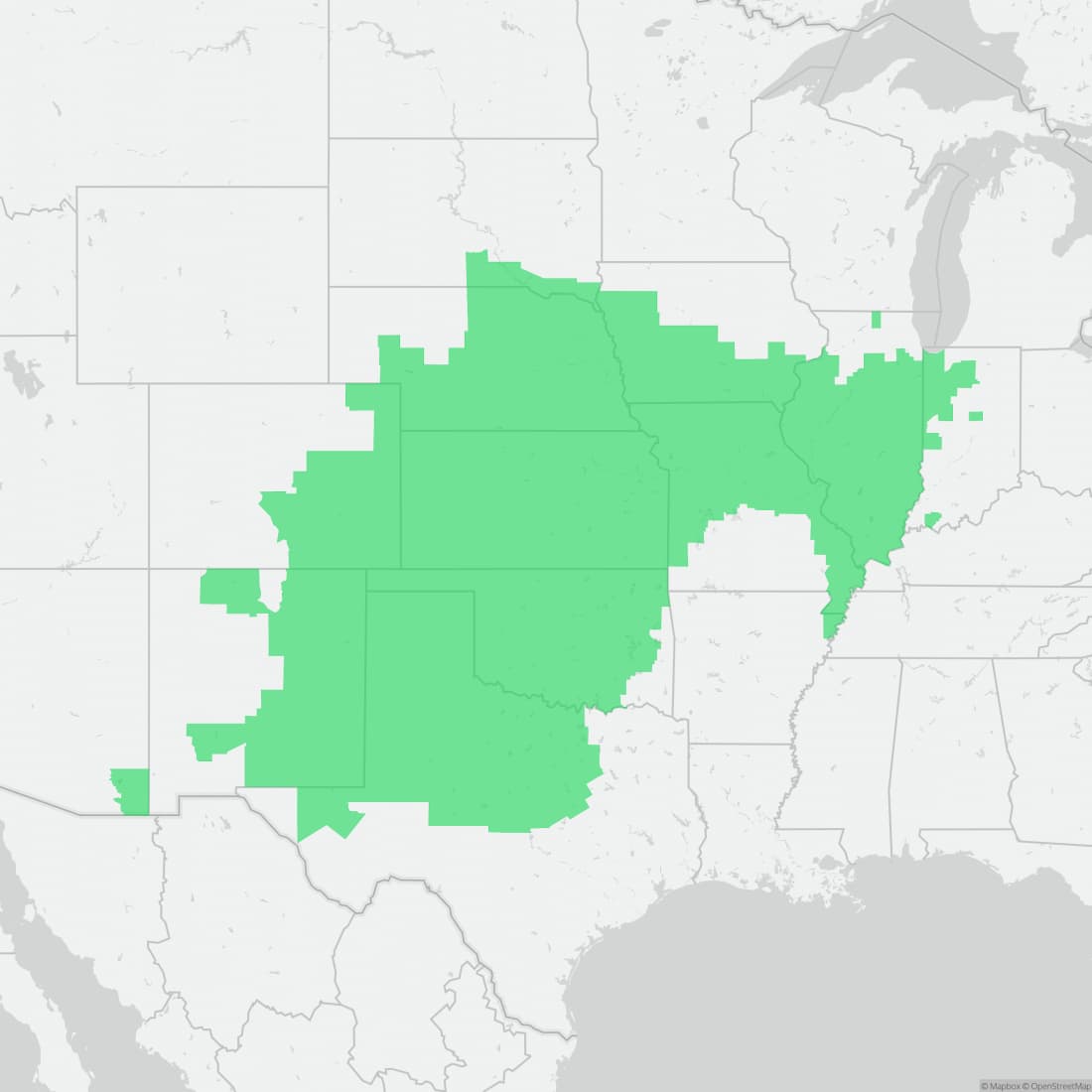
Approximate range. © Mapbox © OpenStreetMap