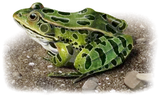
Lowland Leopard Frog
Lithobates yavapaiensis
A medium-sized frog that reaches an average body length of 4.5-7 cm for females and 5-8.7 cm for males. It has prominent light colored dorsolateral skin folds, and a noti…
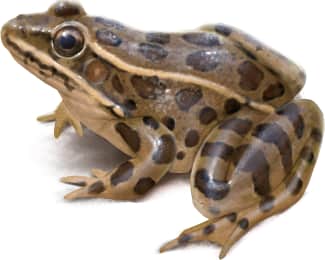
How to identify
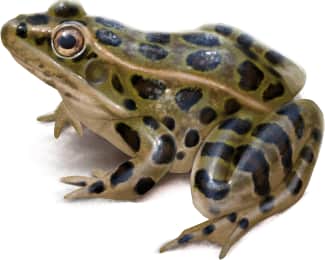
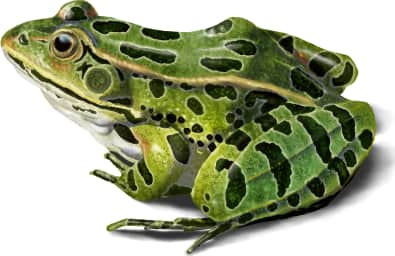
A medium-sized frog that reaches an average body length of 4.5-7 cm for females and 5-8.7 cm for males. It has prominent light colored dorsolateral skin folds, and a noticeable hip bone hump on its lower back. Its eyes are large and bulging with horizontal pupils. It usually has 2 dark stripes on the snout, running from the tip of the snout to the corners of each eye. Dorsal coloration is a lighter background with irregular dark spots and elongated blotches which form bands on the hind legs. Its ventrum is pale and unmarked, with some yellow tinting in the groin region. It has mildly bumpy skin.
Range
Ranges through most of central and southern Arizona, as well as adjacent areas of New Mexico and Mexico.
Habitat
Inhabits stagnant or slow-moving bodies of freshwater in scrub desert habitats. Most often found in or around deep water.
Variations
Coloration can be shades of brown, green, or grey. Some are very dark all over with subtle patterning.
Similar species
Most likely to be misidentified as the Rio Grande leopard frog (*Lithobates berlandieri*) or northern leopard frog (*Lithobates pipiens*).
Name and etymology
Genus
Lithobates
Greek for rock (litho-) climber (bates).
Origin
Sources
- Linnaeus, 1758. Syst. Nat., 10th ed., Vol. 1, p. 210 ↗
Rana. Linnaeus, 1758 - Syst. Nat., 10th ed., Vol. 1, p. 210
Species epithet
yavapaiensis
Of the Yavapai indigenous group.
Origin
Sources
- Platz and Frost, 1984. Copeia, 940-948 ↗
Rana yavapaiensis. Platz and Frost, 1984 - Copeia, 940-948
Explore more names in the etymology index.
At a glance
Range
Ranges through most of central and southern Arizona, as well as adjacent areas of New Mexico and Mexico.
Habitat
Inhabits stagnant or slow-moving bodies of freshwater in scrub desert habitats. Most often found in or around deep water.
Guide
Reptiles and Amphibians of North America
Range map
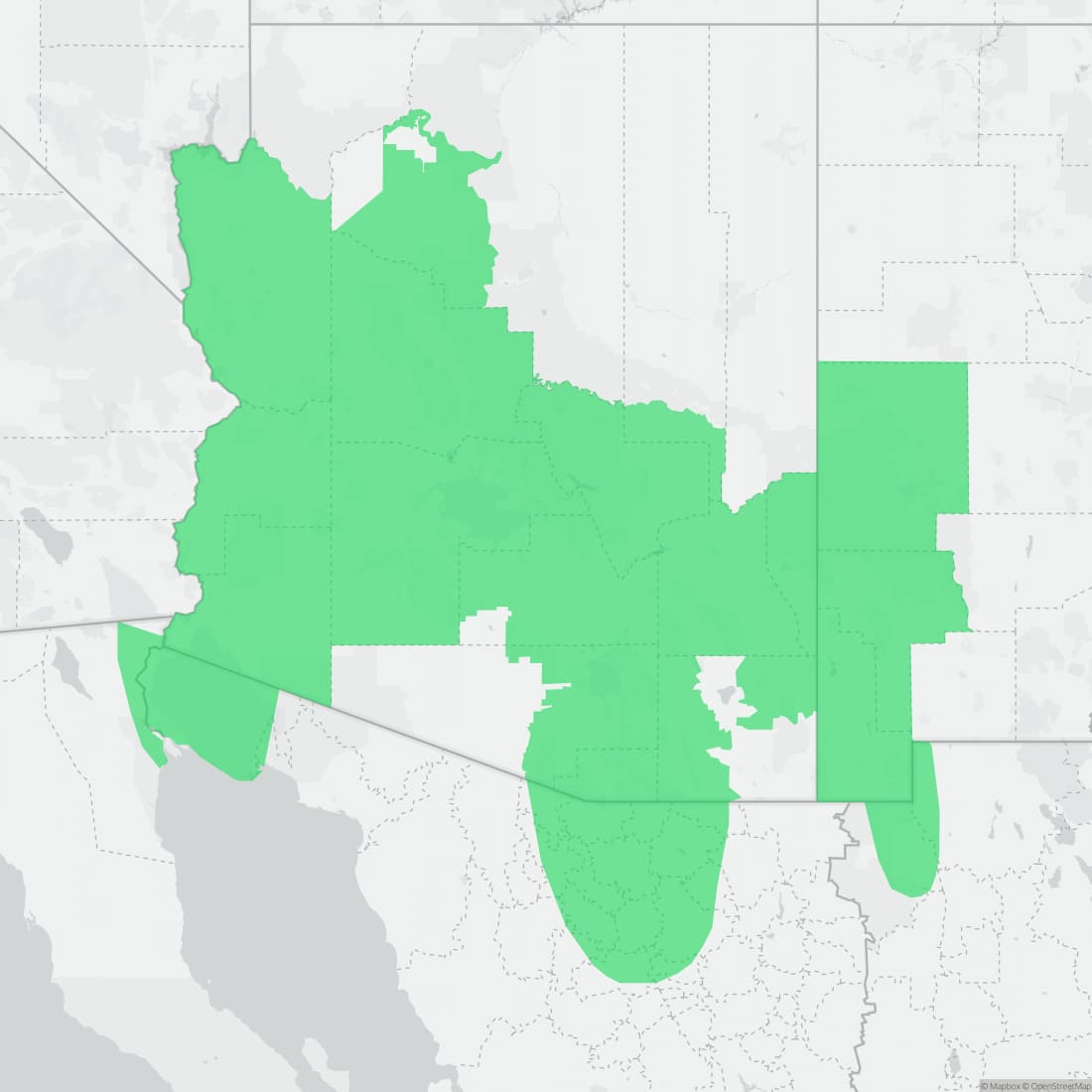
Approximate range. © Mapbox © OpenStreetMap