Banded Rock Lizard
Petrosaurus mearnsi
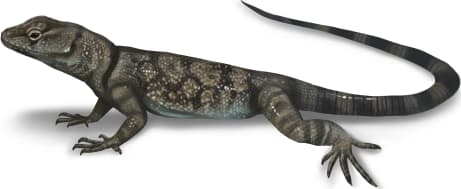
This lizard has an extremely flattened body for squeezing into rock crevices. Its triangular head is flattened as well. It averages 2.4-3.4 inches in snout to vent length…
How to identify
This lizard has an extremely flattened body for squeezing into rock crevices. Its triangular head is flattened as well. It averages 2.4-3.4 inches in snout to vent length, has granular scales on its body, and keeled scales on its legs and tail. It has elongated triangular scales over its ear holes, and a thin black band across its shoulders. Its body is tannish grey with slightly darker grey markings that create a clouded appearance down the back, intermixed with light spots. The tail is banded with the same grey coloration as the body markings.
Range
Extreme south central California into north central Baja Peninsula.
Habitat
This species favors boulder habitats, chaparral, and pinyon-juniper woodlands. It specializes in scaling rock faces.
Variations
Mature adults develop a blue tint to their pale markings. The black shoulder band is sometimes a complete collar that wraps around the chest. Juveniles are more distinctly patterned than adults.
Similar species
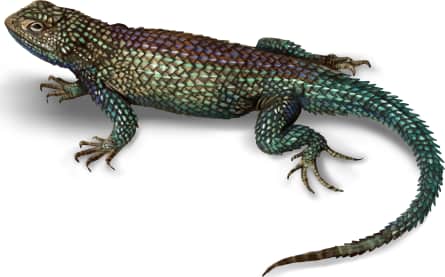
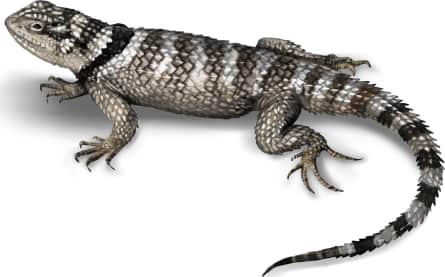
Most similar in appearance to the crevice spiny lizard (*Sceloporus poinsettii*) which does not overlap in range. It looks somewhat similar to the granite spiny lizard (*Sceloporus orcutti*) which does overlap.
Name and etymology
Genus
Petrosaurus
Greek for rock (petra) lizard (sauros).
Origin
Sources
- Boulenger, 1885. Cat. Liz. Brit. Mus., Vol. 2, p. 205
Petrosaurus. Boulenger, 1885 - Cat. Liz. Brit. Mus., Vol. 2, p. 205
Species epithet
mearnsi
Honoring Edgar A. Mearns.
Origin
Honors
Sources
- (Stejneger, 1894). Proc. U.S. Natl. Mus., Vol. 17, p. 589 ↗
Petrosaurus mearnsi. (Stejneger, 1894) - Proc. U.S. Natl. Mus., Vol. 17, p. 589
Explore more names in the etymology index.
At a glance
Range
Extreme south central California into north central Baja Peninsula.
Habitat
This species favors boulder habitats, chaparral, and pinyon-juniper woodlands. It specializes in scaling rock faces.
Guide
Reptiles and Amphibians of North America
Range map
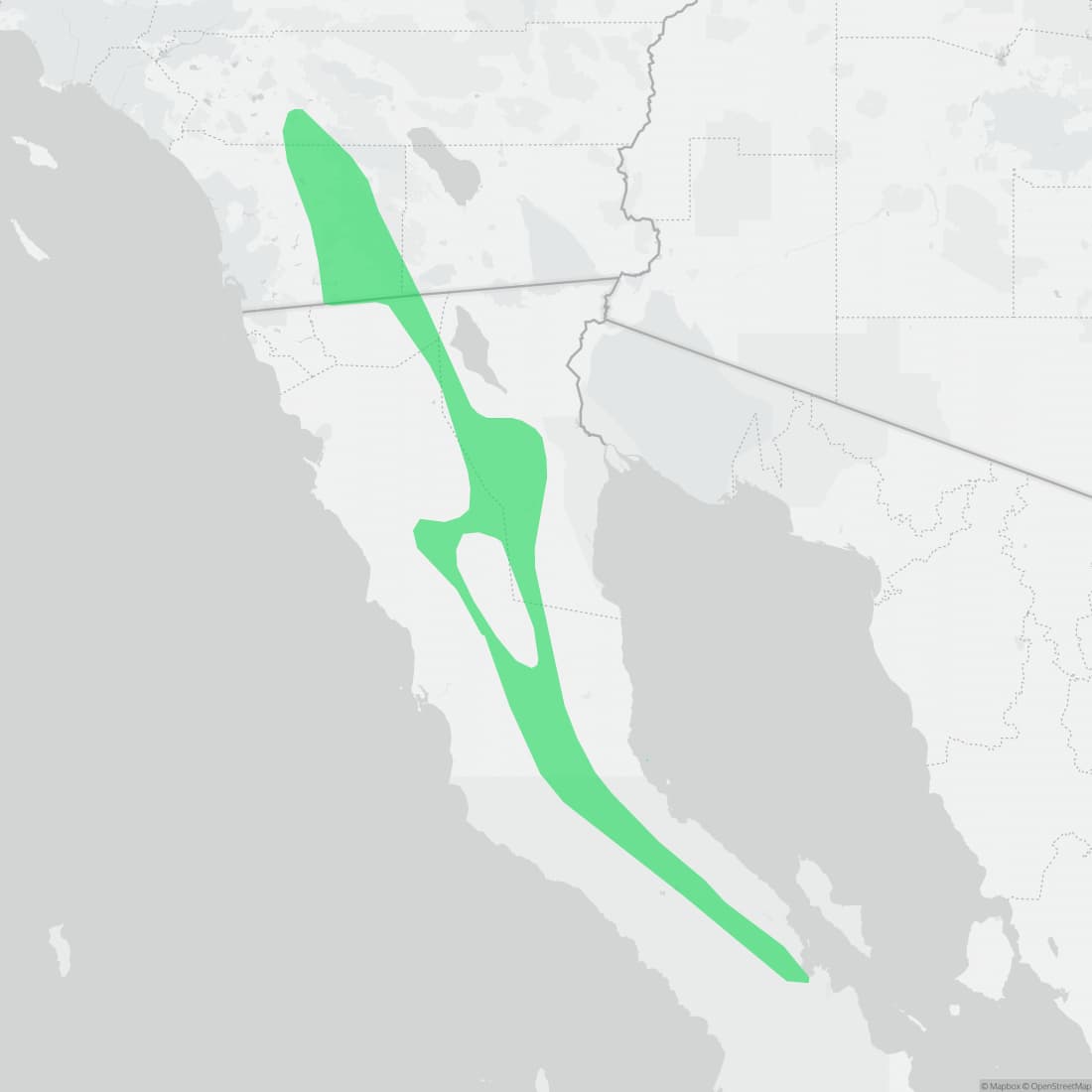
Approximate range. © Mapbox © OpenStreetMap